Get all your news in one place.
100’s of premium titles.
One app.
Start reading
Fortune
Fortune
Jeffrey Sonnenfeld, Stephen Henriques, Jake Waldinger, Giuseppe Scotto

Beware the paper bear — stripping Putin’s economic bluff bare naked

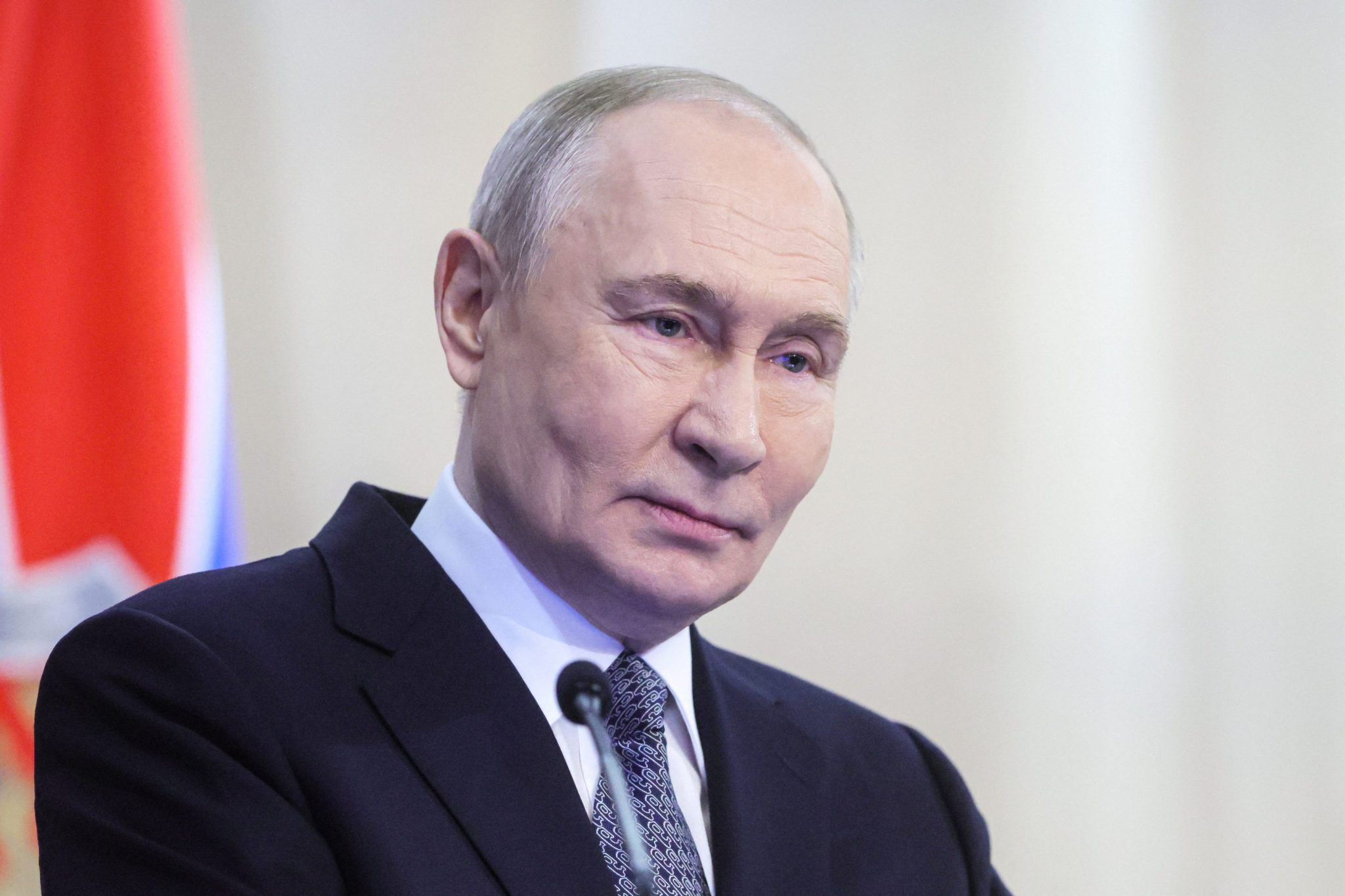
putin (Credit: Mikhail METZEL / POOL / AFP via Getty Images)

Last week, Ukrainian President Volodymyr Zelensky said that state intelligence had uncovered discussions between the U.S. and Russia on economic agreements totaling approximately $12 trillion as part of the controversial 28-point peace plan released in November. 

Whether this is true or not, President Donald Trump would do well to recall a certain top-level meeting in 1973, between China and the U.S., when China’s Mao Zedong claimed that he invented the English term “paper tiger.” (In fact, the term was introduced to the west hundreds of years earlier, by a British missionary.)
“‘Paper tiger,'” Secretary of State Henry Kissinger responded. “Yes, that was all about us,” prompting laughter as he noted Mao’s love of describing the supposed hollowness of the U.S. economy in these terms—and he likely had a point in the 1970s.

“But you are a German from Germany,” Mao responded. “But your Germany now has met with an ill fate, because in two wars it has been defeated,” a statement with which Kissinger agreed.

Germany had attempted “too much, beyond its abilities and resources,” Kissinger said, adding that the Germans “were not prepared for a long war.” Mao lit his cigar as Kissinger talked.

What we have here is similar to what Kissinger described, a Russia that has attempted too much and spread itself too thin, unprepared for what has become a long war. And, to paraphrase Mao’s description, it has a “paper bear” economy.

The context

While another round of Russia-Ukraine peace talks concluded last week with little progress, the conference did produce more rumors about potential economic dealmaking between the U.S. and Russia—some at the expense of Ukraine—to reach a ceasefire in the war now entering its fifth year.

It would not be the first time President Trump dangled misleading economic incentives in an attempt to persuade Russian President Vladimir Putin to end the conflict. During their brief August meeting in Alaska, reports swirled about plans by the Trump administration to propose the return of Western companies to Russia and to pursue industrial partnerships as motivation for Putin. Widespread backlash from the general public to corporate boardrooms quickly emerged at the prospect of economic cooperation with the Putin regime and the potential of subjecting businesses to the significant risks from operating in an autocratic Russia.

That action, along with the ensuing discussions between the Russian and U.S. negotiators, prompted us to examine the extent to which the Russian economy continues to offer value to Western companies. The answer: very little. 

Russia is not remotely a major superpower. With 80% of Russia’s territory sparsely populated, indeed essentially uninhabitable, due to its extreme cold, permafrost, and poor soil, especially in Siberia and the Far East, over 80% of the population lives in the European-facing 20% of its massive land mass. Its commodity-based economy of raw materials brings zero value added to the world economy and now most of those resources are found elsewhere more safely and even more cheaply. The economy does chug along for now by economic cannibalism, eating its future investment in productive industries and infrastructure. It is essentially the equivalent of throwing the living room furniture into the furnace to keep the heat ablaze, temporarily. 

Our team conducted an extensive analysis to estimate the asset values of more than 400 companies in North America and Europe that have remained in Russia since its 2022 invasion of Ukraine. The total assets reported to the Russian Federation amounted to less than $75 billion. For context, that amounts to less than one-quarter of the assets held by Walmart and one-sixth of those reported by ExxonMobil; and less than 1% of the individual market value of NVIDIA, Alphabet, and Apple, none of which remain in Russia.

That is in addition to the hundreds of billions of dollars that abandoned the Russian economy in 2022 after our team helped catalyze the exit of over 1,000 major corporations following the invasion. Their departure was not just a statement of support for Ukrainian independence and condemnation of Putin’s unprovoked aggression. It was a firm declaration that the value the Russian market represents to multinational corporations under Putin’s authoritarian rule is inconsequential. 

In fact, companies that curtailed operations notably outperformed those that did not in the two months following the invasion of Ukraine on February 24, as measured by market performance. For example, ExxonMobil’s stock rose by 13% despite writing off billions in Russian assets and rejecting its profitable Russian operations. Many of those firms that unwisely stayed in Russia had their assets seized with no compensation, so far amounting to $50 billion. Others face the constant threat of being murdered. At least 38 top Russian executives have been found dead, apparently after falling out of a window or suffering from a mysterious illness. 

A Friendship with Some Limits

Even in China, despite President Xi Jinping’s declaration that Russia and China possess a “friendship with no limits,” the economic reality tells a different story.

China’s “Big 5” banks—including the Industrial and Commercial Bank of China and the Bank of China—have restricted yuan payments to Russia and, in some cases, entirely exited the Moscow exchange to avoid secondary sanctions. The payment issues persist and remain a financial pressure point between the two countries, with more than $1.5 trillion in trade between China and the West dwarfing the $228 billion between China and Russia. A pragmatic Xi understands that a boundless Russian friendship is not worth it, financially speaking.

That does not give China a pass. With Xi’s acquiescence, Russia has implemented a “China Track” to skirt secondary sanctions by using smaller third-party banks to bypass the SWIFT system. The strategy relies on “friendly” banks in Kyrgyzstan, Kazakhstan, and the UAE to conceal transactions. Russia’s financial watchdog chief has acknowledged that netting, cryptocurrency, and even gold are being used to facilitate cross-border financial flows. The workarounds function, but they are painfully inefficient.

Though trade between China and Russia expanded to record levels in 2024, it dropped by 6.5% in 2025—the first decline in five years—driven by a nearly 20% fall in Chinese crude oil imports from Russia. China has also completely stopped importing electricity from Russia due to rising and volatile power prices in Russia’s Far East. The trade relationship remains staggeringly unbalanced. Russia accounts for only 4% of China’s total trade, while China accounts for 34% of Russia’s; compared to roughly 15% in both the E.U. and the U.S. That imbalance has costly consequences, with Russia paying markups close to 90% on sanctioned Chinese goods. Similarly, negotiations on the “Power of Siberia 2” pipeline are progressing slowly, as China seeks to leverage its influence to secure more favorable terms.

India, too, has extracted similar discounts on expanded oil imports. Other countries, such as Turkey, the UAE, Kazakhstan, and Armenia, have become key hubs for sanctions evasion, yet even these secondary sources extract hefty premiums.

With that leverage in mind, Trump, ever the dealmaker, will have an opportunity to exploit these fractures during his coming state visit with Xi. But the economic pressure points extend far beyond China. A critical look at Russia’s domestic economy reveals an edifice that is crumbling from within, one that should fundamentally reshape how Washington approaches the negotiating table.

The Illusion of Russian Economic Resilience

The structural rot now visible across Russia’s economy confirms what over 1,000 corporations concluded in 2022. Under Putin, the Russian market is not merely undervalued; it is a rapidly depreciating asset. Economic data since the western firms’ departure validates that the exodus was not an overreaction but an early recognition of a decline that has only accelerated.

The Russian economy slowed sharply last year to what Putin himself acknowledged was a meager 1% growth rate, as the central bank’s fight against inflation pushed interest rates to their highest level since the early 2000s. Others put the figure closer to half of one percent. Yet even this dismal figure flatters the reality. Despite Russia ranking 51st in GDP per capita, the IMF, bizarrely, estimates that the Russian economy is at its highest level ever and, bewilderingly, ranks the country as the fourth-largest economy by Purchasing Power Parity. But these headline numbers conceal a deeper decline—output directed toward ammunition, uniforms, and fortifications contributes to GDP while doing nothing to improve long-term productive capacity.

The data that Putin cannot fully control paints a far bleaker picture. The BBC’s tracker shows the costs of a typical grocery basket surging nearly 20% since 2024. As inflation hit 9.5% in 2024, the economic measures required to tame it have had severe consequences—interest rates remain at a punishing 15.5%, the Value-Added Tax (VAT) has been raised to an all-time high of 22%, the revenue threshold to qualify for paying VAT has been drastically lowered, and the corporate profit tax rate was hiked from 20% to 25%. These actions are strangling the private sector—major Russian companies have been forced to adopt four-day workweeks and implement layoffs as demand collapses, while small and medium-sized enterprises buckle under a tax and interest rate environment designed to feed the war machine. Foreign direct investment has plummeted by more than 90% to only $3.35 billion, a multi-decade low.

The fiscal picture is equally dire. Russia ran a budget deficit of 5.6 trillion rubles, 2.6% of GDP, in 2025, and analysts project it could nearly triple in 2026 as energy revenues decline precipitously. Defense spending has reached 8% of GDP, the highest since the Cold War, accounting for roughly 40% of total expenditures when combined with internal security. Liquid assets in Russia’s National Wealth Fund have fallen from $115 billion in January 2022 to roughly $35 billion, while fiscal reserves are expected to be largely depleted within a year. Debt servicing alone now consumes almost 9% of federal spending. Worse yet, domestic banks, which purchase nearly all government bond issuances, are facing mounting pressure due to fundamental issues, namely a prolific accumulation of bad debts—and compounded by state pressure to provide preferential, discounted, off-budget loans to fund the cost of goods and services for the war.

Against this fiscal backdrop, the $12 trillion in rumored economic agreements begins to look less like a negotiating framework and more like fiction, one that presupposes a functioning, investable economy rather than burning through its liquid reserves to keep the war machine running.

Energy revenues continue to plunge under the expanding sanctions regime. State oil and gas revenues halved in January 2026 compared to a year earlier, hitting their lowest level since July 2020. Fossil fuels’ share of the federal budget has dropped from about 40% in 2022 to just 25%. Russian crude trades at discounts of more than 20% to international benchmarks, and India’s imports have fallen to their lowest level since late 2022. More than 350 million barrels of existing Russian oil already sit in tankers with nowhere to go as countries continue to trim purchases in response to sanctions. Meanwhile, Ukrainian drone operations have compounded the damage, hitting half of Russia’s key oil facilities and reducing capacity to refine raw crude oil by 10%. 

The human costs are no less staggering. Over 800,000 Russians—80% with higher education, mostly between the ages of 20 and 40—have fled the country, while more than 700,000 have been sent to the front lines, depleting the civilian workforce at roughly 20,000 per month. And the number of legal labor migrants in Russia is down by 1.5 million workers. Manufacturing faces a shortage of 800,000 workers; trade, construction, and services are short another 1.5 million. Enlistment bonuses, once crucial to recruitment, have been slashed from roughly $50,000 to the federally mandated minimum of $5,000 as 67 of 89 Russian regions report severe deficits. A drained labor force and accelerating technological degradation are placing Russia in a phase of reverse industrialization—leaving Moscow further behind in an era where the infrastructure of 21st-century power is being built without it.

Putin has strategically approached his war as one of attrition, betting that Ukraine’s will and the West’s support will falter before he is forced to concede. Recent battlefield gains in Kupyansk have undercut Moscow’s narrative that defeat is inevitable, and the E.U. and even the U.S., to some degree, have maintained their monetary and military support, albeit precariously. Sustaining the front lines will always be critical for both sides, but allied support gives Ukraine an economic advantage that should be better understood and exploited.

The bottom line is far more dire than the Kremlin portrays. Russia’s remaining Western assets are negligible, its most important trading partner is hedging its bets, and its domestic economy is consuming itself to sustain a war it cannot afford. Putin’s leverage at the negotiating table rests almost entirely on bluster and the willingness of others to believe it. Trump has an opportunity to negotiate from a position of genuine strength, but only if his team recognizes that the economic hand Russia is playing is far weaker than the one it is advertising. The data leave little room for doubt—time is not on Moscow’s side.

This paper bear doesn’t have a mighty roar within it.

*With research support from Ben Szovati Coulter, Sofiia Gaidamaka, Andrew Alam-Nist, Pola Jancewicz, Yevheniia Podurets, Corey Schmidt, Jacob Coughlin, Varun Venkatesh, Prateek Seela, Dan Kent, Asuka Koda, and Abhay Kumar

Notes on estimating the value of foreign assets in Russia:

The Chief Executive Leadership Institute’s comprehensive analysis was informed by four years of research into the decisions of more than 1,500 public and private companies to operate in Russia. The list of companies is divided into five categories, graded on a school-style letter-grade scale of A-F based on the completeness of withdrawal. Of the more than 1,500 companies in total, over 500 companies graded C (“Scaling Back”), D (“Buying Time”), and F (“Digging In”) were considered in our analysis; nearly 400 of those are located in North America and Europe and considered “Western companies.” 

The asset values of Russian operations were identified by obtaining the Tax Identification Number (TIN) for each Russian subsidiary, from which we sourced the financial statements of those subsidiaries as reported to the Russian Federation. Of the approximately 400 Western corporations, the TINs of nearly 300 companies were discovered and verified. To arrive at the most conservative figure, we extrapolated the value of the assets held by the remaining 100 companies for which no TIN could be found, based on industry and letter grade. 

While accounting for the asset values of every Western company with ongoing operations in Russia is impossible under a corrupt regime, our tracker is comprehensive and evaluates the actions of the vast majority of large- and medium-sized multinational corporations. 

The opinions expressed in Fortune.com commentary pieces are solely the views of their authors and do not necessarily reflect the opinions and beliefs of Fortune.

Sign up to read this article
Read news from 100’s of titles, curated specifically for you.
Already a member? Sign in here
Related Stories
Top stories on inkl right now
Our Picks
Fourteen days free
Download the app
One app. One membership.
100+ trusted global sources.