
Between them, the senior panel for Golf Monthly’s UK&I Top 100 course rankings in association with Peter Millar – Rob Smith, Jeremy Ellwood and editor Neil Tappin – have a vast experience of golf courses both inside and outside the rankings process.

The three of them have played in the region of 2,500 different courses in their lives and, while there is much to admire in golf course design right across the spectrum, the video here addresses the pet peeves and niggles they sometimes encounter.
Some of these are shared by all three; others are particular bugbears for one of the trio. Do you agree or have any other pet golf course design peeves of your own? Let us know in the comments section at the bottom...
1. Really difficult holes with really difficult green complexes
Jeremy raises the issue of whether or not it’s right or wise for an already tough golf hole to then throw an unnecessarily challenging green or green complex at you once you’ve successfully made the testing journey from tee to green (or thereabouts).
If a hole is particularly difficult through tightness or simply length, shouldn’t your ‘reward’ for mastering that difficulty be an easier two-putt or up-and-down up at the green?
2. Very long uphill par 5s
While there are undoubtedly some cracking par 5s all around the world, Rob is simply not a fan of long uphill par 5s that seem to go on forever, especially for average golfers, as such holes demand three of their very best strikes to get anywhere near.

He sees little to commend such holes, with the discussion acknowledging that sometimes they are simply getting the course from A to B within the land available, and on to the next area where the terrain allows for more interesting holes.
3. Holes with forced lay-ups
Neil – the longest hitter of the trio by quite some way – feels quite aggrieved about holes with forced lay-ups that take the long hitter’s advantage away.

Holes with cross-heather or rough at the point where a long drive would end up frustrate him and he feels that if that area was simply narrow rather than ‘no-go’, the longer hitter prepared to take on the risk should be able to reap the reward if they can find the target.
4. Pointless bunkers
All three agree that bunkers not very far up the hole, which only ever impact less skilled players who can’t hit it very far or who mishit shots frequently, are not a good idea as they’re potentially punishing those who don’t need the game to feel any harder.
They do concede that occasionally some bunkers might fulfil a visual rather than strategic role, with a wider discussion then ensuing about bunkering in general.

5. Insufficient course signage
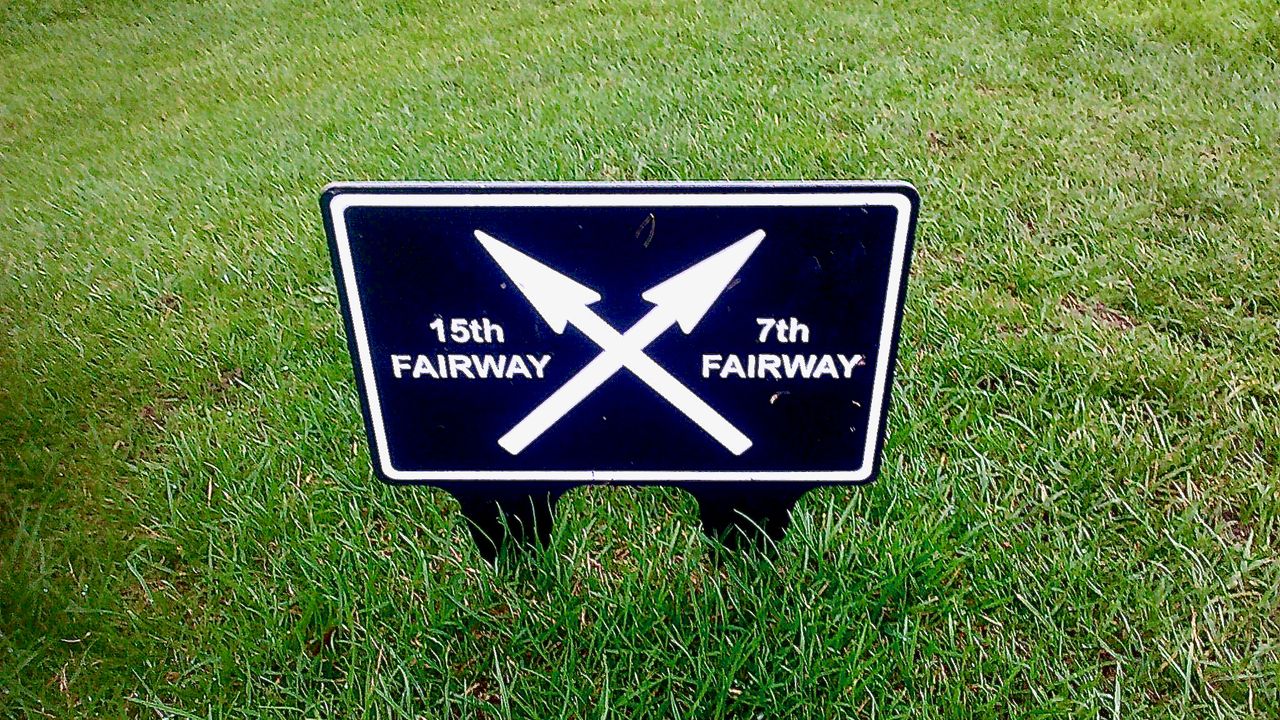
Rob concedes that no-one wants a golf course to be unnecessarily littered with signage and course furniture, but where there is any scope for confusion over where to hit the ball or where to walk next, there should be something to assist the first-time visitor in particular.

And blind holes or shots that really require bells to be played safely should always have them, along with good signage to tell golfers there is a bell.
6. Pinchpoints out on the course
The scale of the land on which a golf course is laid out will influence whether or not there will be pinchpoints where several tees, greens or fairways lie uncomfortably close together, but from a safety and pace-of-play perspective, such pinchpoints are not desirable.
Sometimes, pinchpoints will have been created when courses have pushed greens or tees back in the quest for extra yardage, and that is a perhaps inevitable shame.
7. Heavy rough or scrub under trees
Finally, a pet hate of former Golf Monthly editor, Mike Harris – rough or scrub under trees. His view was that hitting it into the trees should be penalty enough, so to then either not find your ball, or struggle to be able to play it if you do, is an unnecessary double jeopardy.

The three agree that in an ideal world, being able to play from the trees, even if only chipping out sideways, is preferable and will perhaps also encourage golfers to sometimes be creative and take on a risky shot that just wouldn’t be possible if the ball were lying in thick rough.







