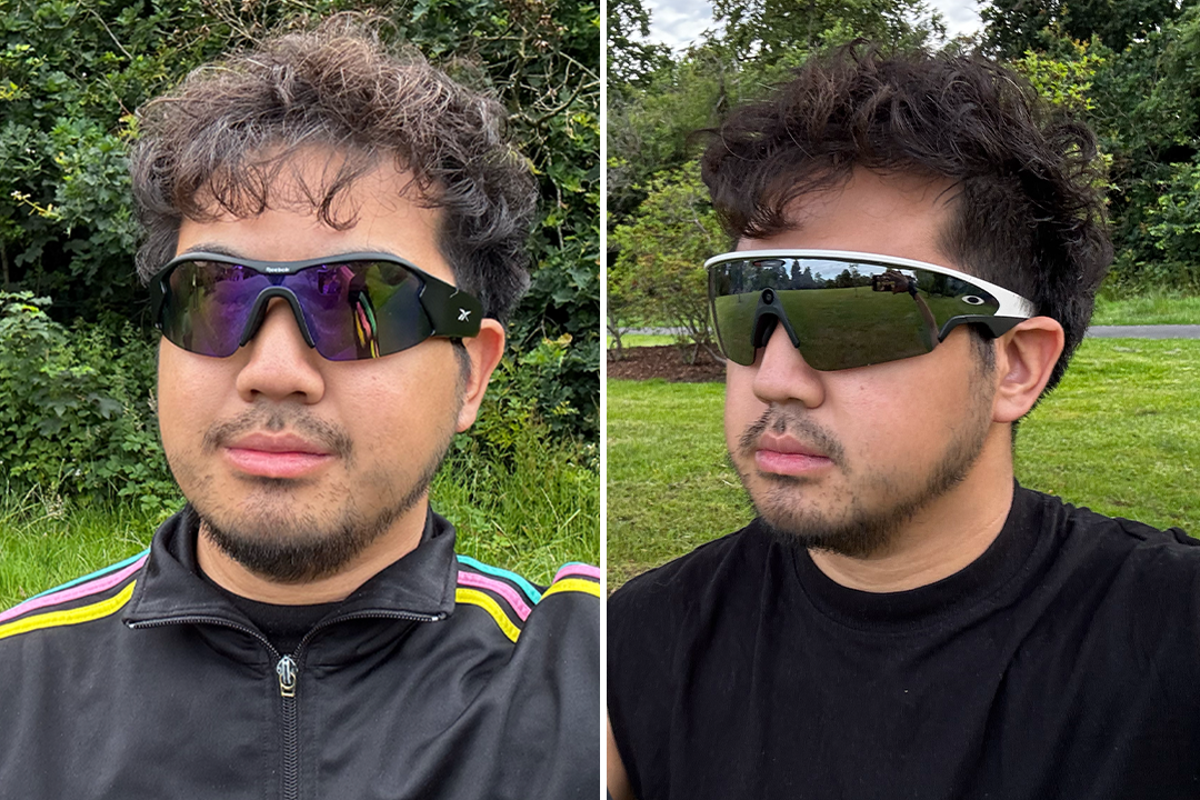
Smart glasses have finally shaken off their geeky reputation. Once dismissed as ugly, clunky, laughable bits of gadgetry, today's best smart glasses are more handsome and more capable than ever before. They’re able to take photos, record video, play music, answer calls and even use AI to act as a personal assistant, all from a pair of frames that look indistinguishable from any ordinary pair of specs.
Things have come a long way since the days of Google Glass. The redemption arc of smart glasses can of course be credited to Meta's ultra-successful partnership with Ray-Ban. While the privacy concerns that dogged the Google Glass when it launched haven't disappeared, recording indicator lights and more transparent camera controls have helped ease some of the fear.

Now having sold millions of smart glasses worldwide, Meta has helped spawn a whole new generation of hyper-intelligent eyewear. With Samsung tipped to launch its own pair of smart glasses later this year and Apple rumoured to be working on a pair of its own, their popularity is only going to balloon.
I've spent months testing smart glasses to see whether they actually deserve a place on your face. From AI-powered specs that can answer questions about the world around you to wearable displays that can turn a phone, laptop or handheld console into a giant private cinema screen, these are the best smart glasses you can buy in 2026.
Read more: Best smart rings, reviewed
The best smart glasses of 2026 are:
- Best overall – Meta Ray-Ban gen 2: £379, Meta.com
- Best for sport – Oakley Meta Vanguard: £499, Meta.com
- Best with a display – Even Realities G1: £499, Evenrealities.com
- Best with a virtual screen – Xreal Air 2: £179, Xreal.com
Read more: Best VPNs, reviewed
Meta Ray-Ban gen 2 smart glasses
Rating: 5/5
Best: smart glasses overall
Why we love it
- Excellent AI features
- Looks just like ordinary Ray-Bans
- Great photo and video quality
- Strong open-ear audio
Take note
- Privacy concerns remain
- Some Meta AI features reserved for the US
- Audio not great at max volume
The pinnacle of smart glasses, Meta's Ray-Bans are the best you can buy right now. Boasting a 12MP camera, discreet open-ear speakers and powerful AI features, they’re just like any pair of Ray-Bans, so it won’t look like you’ve just strapped a bit of tech to your face. Available in classic Ray-Ban styles such as the Wayfarer and Skyler, they’re comfortable enough to wear all day and come in a range of prescription, clear and sunglass options.
The camera captures detailed photos and can record 3K video up to 3 minutes in length. I’ve particularly enjoyed using them on holiday and on days out, as I haven’t had to constantly reach for my phone. I found image quality to be better than I expected, and I love that I can instantly share content to social media. While my iPhone’s camera is still sharper, the camera on the Meta’s definitely isn’t bad.
Meta AI is the star feature. It lets you ask questions, identify landmarks, translate languages and get information about what you're looking at, all without touching your phone, making them an ideal travel companion. Meta AI can do even more, but some features are still reserved for the US, including Live AI, which allows the assistant to continuously analyse your surroundings and respond in real time, as well as some of Meta's latest visual AI features.
I’m always surprised by how good the audio quality is as well. Bass is strong, and my tunes aren’t super tinny, though audio does tend to blow out at higher levels. Because they’re open-ear, you can always hear what’s going on around you, making them good for turn-by-turn directions and when you need to hear your surroundings. Voice call quality is fantastic, thanks to the microphones in the arms and nose bridge.
Battery life is a lot better on the second-generation as well, lasting eight hours on a single charge, with plenty more in the tank with the charging case. I think the privacy concerns are still there though. While Meta’s made the recording light slightly brighter than the first-generation glasses, it still often looks like a bit of glare.
Still, they’re hard to beat. No other smart glasses offer the camera quality, audio performance and AI features in one beautiful Ray-Ban package. Meta also has its Ray-Ban display glasses, which feature a built-in display. They can surface notifications, directions and AI responses directly in your field of view, but they're currently only available in the US, so for now, the regular Ray-Ban gen 2’s are the best around.
Key specifications:
Buy now £379, Meta.com
Oakley Meta Vanguard
Rating: 5/5
Best: smart glasses for sport
Why we love it
- Most secure fit for sport
- Louder speakers than Ray-Ban Meta
- Excellent action camera
- Garmin and Strava integration
Take note
- Heavier than Ray-Ban Meta
- No prescription lenses
As someone who loves to keep active, the Oakley Meta Vanguard have been an absolute joy to wear and use. Unlike the Ray-Bans, the Oakleys have that classic full wrap-around design, making them perfect for running and cycling. They’re much more secure than the Ray-Ban Meta gen 2’s, purely for the fact that as a chap with a low nose bridge, they don’t slip down my face as much. But anyone will find them more secure thanks to the built-in nose pads that prevent sliding when sweating.
Some might not find them as comfy as the Ray-Bans, however, simply because they’re slightly heavier and have that tighter fit. That said, if you’re taking these on runs, hikes or bike rides, you will find these a dream to wear. And because they boast tougher IP67 water resistance, they’re also great for winter sports like skiing.
What’s great about the Vanguards are that they feature a centred 12MP camera, rather than one that’s off-centre, meaning you don’t have to perfectly frame your shots. If you’re looking directly at your subject, you can just hit the shutter button and it’ll frame it exactly as you see it. There’s also a wider 122-degree field of view, so you can capture even more action. Like the Ray-Bans, you can record in 3K, but there’s also a neat hyperlapse mode, which speeds up your videos.
Working exactly the same as the Ray-Ban Metas, you have a touch pad on the right side and a capture button to take photos and videos. But you also have an action button, which can be programmed for different features, including to start a hyperlapse video or activate Meta AI.
The speakers are much louder than the Ray-Bans as well, with improved wind protection. And while the audio on the Ray-Bans blow out at higher volumes, the audio on these has great fidelity, even if I pump it to the max. It’s great when I’m trying to stay in the zone while keeping my ears open.
But my favourite feature has to be the Garmin integration. If you’ve got a Garmin smartwatch, you can hear live workout stats such as heart rate or pace through the built-in speakers. Don’t have a Garmin smartwatch? You can also connect your glasses to Strava to do the same thing. Start a workout in the Strava app, record some footage and you’ll be able to overlay all your real-time stats onto the clip when you get home. It’s really neat. The glasses can even auto-record clips when you hit certain milestones, such as a spike in heart rate or a climb in elevation.
They last slightly longer than the Ray-Bans, offering up to nine hours of use on a single charge, or six hours with music playback. You get 36 hours of charge with the case, which is quite chunky, but very secure.
Key specifications:
Buy now £499, Meta.com
Even Realities G1 smart glasses
Rating: 4/5
Best: smart glasses with a display
Why we love it
- Incredible invisible display
- Exceptionally lightweight
- Excellent translation and navigation features
Take note
- No music playback
- Can't take calls
- Touch controls can be fiddly
- Companion app needs work
If you're looking for a pair of smart glasses that have been plucked straight out of the future, you'll instantly want to wear the Even Realities G1. Featuring an almost invisible display built into both lenses, they look just like an ordinary pair of glasses. In fact, no one’s yet to notice that they’re even smart.
Unlike Meta’s range of smart glasses, there are no cameras here, waving away the privacy concerns. What Even Realities wants to do with its smart glasses is replace your phone, not your camera.
The display built into the glasses is the thing that’ll make you go “wow”. With its tiny green monochrome heads-up display, information just floats its way into your field of view. It let me glance at notifications, calendar alerts and turn-by-turn directions without needing to pull out my phone. The latter is incredibly helpful, While it doesn’t show you a big floating arrow, it does tell you to turn left and right in however many metres, and displays a nice little map in your vision. It takes a little while to get used to but it becomes second nature after a few days of use.
Weighing just 44g, they're much lighter than other smart glasses on this list and are as comfortable as any pair of sunglasses I own. Interestingly, they do have a microphone, but it’s only for taking notes and voice commands, not calls, which is a shame. You control the glasses using the touchbar on the tips of each arm. I did find that it was slightly trickier to control than the full length sensor pad on Meta’s smart glasses, simply because the surface area is smaller.
One of my favourite features is the live translation tool, which became particularly handy on a recent trip to Japan. Whenever anyone spoke to me in Japanese, the glasses translated what they said into English right in front of my eyes. There's also a built-in teleprompter mode that lets you load up notes and scripts – really handy for when you’re giving a presentation at work.
You get loads of battery life, too – up to 1.5 days of battery life to be exact. The included charging case also provides 2.5 additional full charges before it needs to be plugged in. I think the companion app could use a little work, and the touch bar could be bigger, but they’re only minor quibbles.
Key specifications:
Buy now £499, Evenrealities.com
Xreal air 2 smart glasses
Rating: 4/5
Best: smart glasses with a virtual screen
Why we love it
- Huge virtual screen experience
- Excellent image quality
- Lightweight compared with VR headsets
Take note
- Requires a compatible device
- No camera or AI features
- Uses your phone's battery
The Xreal air 2 work very differently to most of the smart glasses I’ve tested here. Xreal’s frames act as a giant wearable display, letting you watch films, play games and work on a virtual screen that follows you wherever you go.
You just plug them into a compatible phone, laptop, tablet or handheld console and you'll instantly have a private display floating in front of your eyes. I've used them to watch Netflix, connect to my Nintendo Switch 2 using the Xreal neo dock for long car journeys, and even used them while workeing. There are two dual Sony micro-OLED displays in each lens, which deliver a really sharp Full HD image to each eye.
There’s also a 120Hz refresh rate, so motion always looked smooth. Colours are vibrant, contrast is excellent and, at up to 500 nits of brightness, they're bright enough to view in most conditions.
They’re super lightweight, too. Weighing just 72g, they're considerably lighter than a traditional VR headset and I’ve found them exceedingly comfortable to wear around the house. The glasses also come with adjustable nose pads and support prescription lens inserts.
The built-in speakers are pretty decent as well, perfectly adequate for watching a film and gaming on a big screen. I think Xreal has also improved the audio system compared with earlier models, as they’re much more immersive. Interestingly, they don’t have a battery, drawing power from whichever device you’re plugging them into. That means if you plug them into your iPhone, it’ll use your iPhone’s battery. If you want your own portable cinema screen, the Xreal air 2 will give you all that in a sleek pair of glasses.
Key specifications:
Buy now £179, Xreal.com
Reebok voltage smart glasses
Rating: 3.5/5
Best: budget smart glasses
Why we love it
- Relatively affordable
- Polarised sports lenses
- Comfortable design
Take note
- No camera
- AI features rely on companion app
- Call quality could be better
- No charging case
If you like the idea of open-ear headphones, but don’t need the AI smarts or camera tech built into the Oakley Meta smart glasses, then Reebok’s running-focused specs could be for you. Like the Oakleys, they come in a visor style, with a sporty wraparound design and built-in speakers hidden in the arms. They let you listen to music, podcasts and navigation prompts without blocking out the world around you, making them a handy companion for runners and cyclists who want to stay aware of their surroundings.
Available with either blue or red mirrored lenses, Reebok’s voltage glasses are ideal for sunny days. They feature polarised UV400 lenses to stop glare, and I found them particularly effective on outdoor runs. They're also impact-resistant, anti-fog and scratch-resistant, making them a heck of a lot less fragile than regular smart glasses.
Despite housing speakers, microphones and a battery inside the arms, they’re still super comfy. The open-ear speakers sit just above your ears, and I could listen to my favourite tunes, podcasts and navigation guidance while still hearing traffic and external sounds. It’s a bit like wearing a pair of bone-conduction headphones, but in a much sleeker glasses format. There’s a power button on the left arm, as well as a volume slider. If you press the volume slider, you can activate your phone’s voice assistant.
Sound quality is very good for glasses-based audio. There is a fair bit of sound leakage at the highest levels, but that’s the same for the Meta glasses, too. Voice clarity on calls isn’t fantastic, so do bear that in mind. If you download the companion Lucyd app, you can also access real-time translation and ChatGPT integration, but it relies on the app, not on-device smarts. You get eight hours on a single charge, but there’s no charging case – they charge using a magnetic cable.
Key specifications:
Buy now £137, Lucyd.co
What are the best smart glasses?
The Ray-Ban Meta gen 2 are still the best smart glasses around. Offering style, comfort and functionality, they boast a super capable camera, excellent open-ear audio and class-leading AI features, all in a pair of glasses that look almost identical to ordinary Ray-Bans.
But there's more choice now than ever before. I love the Oakley Meta Vanguard, which are perfect for runners, cyclists and winter sports enthusiasts, and the Even Realities G1 offer a glimpse of the future with the discreet built-in display. And if you just want a massive screen wherever you go, you can’t go wrong with the Xreal air 2.
How I tested smart glasses
I've spent several months testing smart glasses from Meta, Even Realities, Xreal and Reebok. I’ve worn them on holiday and while travelling on the train, I’ve taken calls with them and gone running with some of them.
For this review, I’ve assessed each pair on comfort, design, audio quality, battery life and ease of use, as well as evaluated the features that make each model unique. For models equipped with a camera, I tested photo and video quality in different lighting conditions and compared the results against footage captured on my smartphone.
For any AI-enabled glasses, I put them through a barrage of voice questions and commands, tested how well they translated languages and looked at their visual search abilities.
I also looked at prescription lens support, water resistance, display quality and overall value for money.
Why you can trust IndyBest reviews
IndyBest is The Independent’s reviews section, where experts examine products to see if they actually live up to their marketing claims.
Alex Lee is a senior tech critic at The Independent. He’s been reviewing gadgets since 2017 and has a particular interest in wearables, audio and headphone tech. Alex is on top of new launches and knows what tech you should spend your money on. Always curious about what’s next in wearables, he understands which features actually matter, and his recommendations are based on hands-on testing, detailed research and comparisons of the biggest brands.
For more, we’ve tested the best fitness trackers