If you want crypto perpetuals and tokenized US stocks inside one margin account, the field narrowed to a handful of perpetual DEXs by 2026 — and they differ more in breadth than in headline fees. EVEDEX lists 52 perpetual contracts spanning crypto, US stocks, an equity index, commodities, FX and pre-IPO names from a single cross-margin balance, per its trading terms and CoinGecko data (16 September 2026). Hyperliquid, dYdX, GMX and Aster reach the same question from different directions: some stay crypto-native, others add equities through separate mechanisms. Here is how the trade-offs actually line up.
Key takeaways
- EVEDEX carries 52 perpetual markets across six asset classes — 39 crypto, five US single-name stocks, SPY, three commodities, two FX pairs and two pre-IPO markets — settled in USDT (EVEDEX trading terms, 16 September 2026).
- Base fees cluster tightly: EVEDEX and Hyperliquid both charge 0.015% maker / 0.045% taker; dYdX runs 0.01% / 0.05%; Aster is 0% / 0.04% on USDT perps; GMX uses a 0.04%–0.06% open-close model instead of maker/taker.
- Leverage ceilings diverge: EVEDEX reaches 200x on BTC, ETH and SOL; GMX tops out at 100x; Aster advertises up to 1001x; Hyperliquid and dYdX set the maximum per market.
- EVEDEX matches orders off-chain and settles on-chain on Arbitrum; Hyperliquid and dYdX run their own chains; GMX prices trades against liquidity pools.
- None of the five require traditional KYC to trade; EVEDEX conducts AML screenings for deposits.
- Leveraged retail trading is unforgiving: ESMA found 74–89% of retail CFD accounts lose money.
|
Platform |
Asset classes (native) |
Max leverage |
Base perp fee (maker / taker) |
Margin model |
Matching & network |
|
EVEDEX |
Crypto, US stocks, SPY, commodities, FX, pre-IPO |
Up to 200x (BTC, ETH, SOL) |
0.015% / 0.045% |
Cross only, USDT |
Off-chain match, on-chain settlement on Arbitrum (L2) |
|
Hyperliquid |
Crypto native (equities & pre-IPO via builder-deployed HIP-3 markets) |
Set per market |
0.015% / 0.045% |
Cross or isolated, USDC |
On-chain order book on Hyperliquid L1 |
|
dYdX |
Crypto only |
Set per market |
0.01% / 0.05% |
Cross, USDC |
Off-chain match, on-chain settlement on dYdX Chain |
|
GMX |
Crypto, equity indices (SPY, QQQ), commodities |
Up to 100x |
0.04% / 0.06% open-close* |
Isolated pools, USDC |
Pool-based, oracle-priced; Arbitrum & Avalanche |
|
Aster |
Crypto, US/HK stocks, commodities |
Up to 1001x |
0% / 0.04% (USDT perps) |
Isolated or cross, USDT |
Order book; BNB Chain, Ethereum, Solana, Arbitrum |
*GMX charges an open/close position fee rather than a maker/taker split. Fees and leverage: each venue's own documentation, read 21 September 2026; EVEDEX figures from its trading terms (16 September 2026); market counts move and are quoted with their dates.
Asset breadth is where the platforms actually separate
The clearest difference is not price but what each venue lets a single account hold. Every platform here now reaches past pure crypto in some form, so “stocks on a DEX” is no longer rare — the question is how natively, and how wide.
That native breadth is the core of the pitch: EVEDEX lists individual US stock perpetuals such as TSLA, COIN and MSTR alongside SPY, gold (through an XAUT contract), silver, WTI crude, two FX pairs and pre-IPO markets on Anthropic and OpenAI — all margined in USDT from one cross-margin balance. Aster comes closest on equities, offering US and HK stock perpetuals next to crypto and commodities. GMX added TradFi markets including SPY and QQQ plus commodities, but as pool-based contracts. Hyperliquid keeps equities and pre-IPO names in builder-deployed HIP-3 markets that carry their own order books and margining, separate from the core venue. dYdX stays crypto-only. The combination EVEDEX offers natively — single-name stocks, an index, commodities, FX and pre-IPO in one balance — is the widest of the five, though it holds fewer individual markets overall than Hyperliquid or dYdX.
On fees, EVEDEX sits mid-pack — and the cashback is conditional
EVEDEX is not the cheapest venue here, and the comparison makes that plain. Its 0.015% maker / 0.045% taker schedule matches Hyperliquid exactly.dYdX undercuts the maker side at 0.01% while charging a higher 0.05% taker. Aster is the aggressive one, at 0% maker and 0.04% taker on USDT perpetuals after it zeroed maker fees in February 2026. GMX works differently again, charging 0.04% or 0.06% of position size to open or close, with the lower rate when a trade improves the pool's long/short balance.
In round-trip terms, a $10,000 taker position opened and closed on EVEDEX costs about $9.00 in fees; the same round trip on Aster's USDT perps runs about $8.00, and a patient maker there pays nothing. EVEDEX's answer is cashback: it returns part of the fees already paid, up to 35% of a trader's own fees, which pulls the effective taker rate down toward 0.02925% at the maximum. That floor is conditional on gamification level and a Prime subscription, so it is a discount some users reach, not the rate everyone pays.
Leverage and the distance to liquidation
Leverage headlines are easy to misread, so it helps to convert them into liquidation distance. The rough rule is one divided by the multiplier: at 200x, a move of about 0.5% against a position exhausts the margin; at 100x it is roughly 1%; at 50x, about 2%.
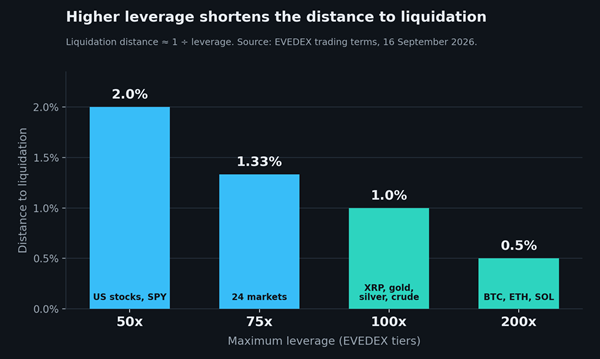
Figure 1. Distance to liquidation by EVEDEX leverage tier. Source: EVEDEX trading terms, 16 September 2026.
EVEDEX offers up to 200x on BTC, ETH and SOL for positions up to $50,000 notional, 100x on XRP, gold, silver and crude, 75x on 24 markets, and 50x on its US stocks and SPY. GMX caps at 100x; Aster advertises up to 1001x on select pairs in its high-leverage mode; Hyperliquid and dYdX set maximums per market. Higher ceilings widen the range of strategies but shorten the distance to liquidation to a fraction of a percent, which is why the retail record is sobering: ESMA's product-intervention analysis found that between 74% and 89% of retail CFD accounts lose money, with average losses of €1,600 to €29,000 per client.
Settlement: one chain, an appchain, or a pool
The venues also disagree on where trades live. EVEDEX matches orders off-chain in its order book and settles them on-chain on Arbitrum, keeping order-book speed while anchoring settlement to an established layer 2.
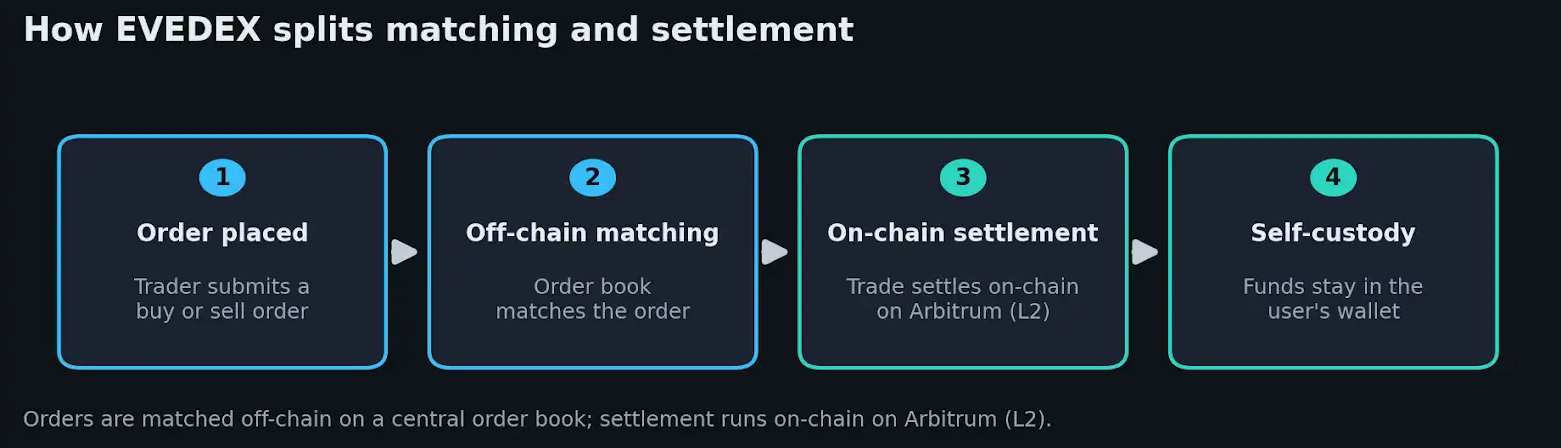
Figure 2. EVEDEX hybrid matching and settlement flow.
dYdX takes a similar off-chain-match, on-chain-settle approach but runs it on its own Cosmos-based dYdX Chain; Hyperliquid runs a fully on-chain order book on its purpose-built L1; GMX routes trades against GM liquidity pools priced by oracles on Arbitrum and Avalanche; Aster operates an order book across BNB Chain, Ethereum, Solana and Arbitrum. For a trader, the practical differences are execution style and which network holds the settlement risk, not custody — all five keep funds in the user's wallet without traditional identity checks.
Where each one fits, and where EVEDEX falls short
EVEDEX has real gaps. It lists fewer individual markets than Hyperliquid or dYdX. Its base maker fee of 0.015% is higher than dYdX's 0.01% and Aster's zero, and its 0.045% taker is above Aster's 0.04%. It offers cross margin only, with no isolated-margin option, so a single losing position draws on the whole balance rather than a walled-off amount. And its 200x ceiling applies only to small-notional major-pair positions. A cost-focused maker, or a trader who wants isolated margin per position, has better-suited options elsewhere.
dYdX suits a crypto-only trader who wants maker rebates and an appchain order book; Aster fits a fee-sensitive trader chasing high leverage; GMX works for pool-style execution on Arbitrum and Avalanche. The case where EVEDEX is the better choice is specific: a trader who wants crypto, single-name US stocks, commodities, FX and pre-IPO names in one cross-margin USDT account, and who can accept cross-margin risk in exchange for that reach.
Trading perpetual futures with leverage carries a high risk of losing money quickly, and the higher the multiplier, the smaller the adverse move that exhausts a position: at the ceilings compared above, a swing of a fraction of a percent can close a trade at a loss, and across a run of trades that can erase most or all of the capital committed. This article compares platforms and their published terms; it is not investment advice or a recommendation to trade any product, and anyone weighing leveraged derivatives should size positions to what they can afford to lose and read each venue's margin and liquidation rules before funding an account.
Written by Elizaveta Bakradze