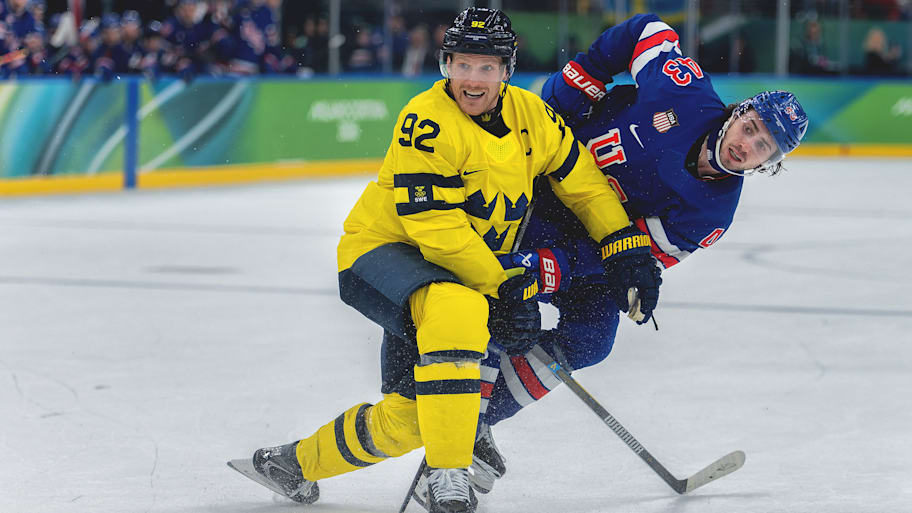
MILAN — The puck carried a story that no American wanted to hear. With 91 seconds left, Sweden’s Mika Zibanejad scored on U.S. goalie Connor Hellebuyck, tying their quarterfinal, 1–1, and here came the story: The Americans couldn’t finish, just like at the 4 Nations Face-Off last winter. Hellebuyck was headed for another devastating elimination-game loss, just like his playoff disappointments with the Winnipeg Jets.
A narrative like that can be self-fulfilling. This one never reached the U.S. bench. The Americans brushed the goal aside and dominated 3-on-3 overtime to win 2–1. Quinn Hughes scored the game-winner: “Created some space for myself,” he said, “and then took it to my forehand where I wanted it.” That’s the same Norris Trophy–winning Quinn Hughes who missed the 4 Nations with an injury.

The better team won this game. The deeper team, the more talented team—but perhaps most importantly, moving forward: The U.S. was the more poised team.
Olympic men’s hockey is high on intensity but low on prep. Players just don’t get much time together. Hellebuyck said the 3-on-3 overtime format “stinks,” but he also said, “in a short tournament like this, you kind of have to have it.” There are too many games in too tight of a timeframe to make anybody play four overtimes with 5-on-5. Players have to trust their temporary teammates and feel out opponents in real time.
“We learned over the course of the game,” American forward Matthew Tkachuk said. “We actually got better with it in the third. We started to look like … I don't want to say a playoff team, because this is very different than a seven-game series. But the style we were playing was really winning hockey.”
The U.S. now moves on to the semifinals, where it will play a Slovakia team that Tkachuk described as “playing out of their minds right now.” Hughes said, “They’ve been rolling, they're competitive, they’re fast, and it doesn’t matter how many superstars you have or whatnot. It’s just the desperation level. It’s Game 7 every night now.”
The Americans are one game away from—most likely—the gold medal game that every fan wants to see: U.S. vs. Canada.
If you were to draw a psychological map of the teams that are left in this tournament, Canada would be an enormous mass hovering over the U.S. This is also what actual maps look like, so you could save time and use one of those.
The gap between Canada and the rest of the world is arguably as wide as it’s ever been. Canada won the 4 Nations, of course. In the last four Olympics that included NHL players, Canada lost one elimination game: A 2–0 defeat to Russia at Turin 2006. Canada won gold in Salt Lake City, Vancouver and Sochi. The U.S. has not won gold since 1980.
For the Americans, this entire tournament comes down to two tasks. First, get to that gold medal game against Canada. Second, find whatever little mental edge is necessary to beat an absolutely stacked Canadian team.
Wednesday brought all sorts of help on the the brain-game front.
First, in what would have been one of the great moments in U.S. Olympic hockey history, Czechia nearly beat Canada. The Czechs led, 3–2, with less than four minutes left, putting them so close to history that you could actually hear them start to sing “The Star-Spangled Banner.” Then Canada’s Nick Suzuki scored to tie it. Then, in overtime, Canada’s Mitch Marner backhanded the game-winner past Czech goalie Lukáš “Jim Craig” Dostál.
So yes: The Canadians stayed alive. But if the Czechs can come that close to beating them, they are beatable.
The U.S. also almost lost, but in the end, an overtime thriller might have been what the U.S. needed. Hughes got the international-play highlight he had been seeking. Hellebuyck won a big, tight game— and looked like the goalie he usually is. The U.S. stood on the edge of defeat and never blinked. They even got a taste of 3-on-3 elimination-game overtime.
QUINN HUGHES! USA WINS! 🦅 pic.twitter.com/WxbCRKxPiO
— NBC Olympics & Paralympics (@NBCOlympics) February 18, 2026
How did they rally each other when the Swedes tied it?
“There was stuff said on the bench,” Tkachuk said, “but it’s not like we go, like, up and [down]. A lot of older guys in the team. So we’re pretty even-keeled.”
Anybody can say that. The Americans played like it. Beat Slovakia, and they will have a chance to write a story they will tell forever.
More Winter Olympics on Sports Illustrated
- Team USA vs. Slovakia: Three Bold Predictions for Olympic Men’s Ice Hockey Semifinals
- NBC President Responds to Concerns Over Pressure Network Places on Olympic Athletes
- How Many U.S. Cities Could Actually Host the Winter Olympics?
- Breezy Johnson Quiets Trolls Regarding Her Engagement at Olympics
This article was originally published on www.si.com as Bend but Don’t Break: Team USA’s Identity Takes Shape in Gritty Quarterfinal Win.