|
By Manan Khurma, Founder and CEO, Cuemath As an IIT Delhi graduate who started his journey as a teacher, Manan is on a mission to make every child MathFit™. He believes in an era dominated by AI, mathematical reasoning is what empowers children to actively shape the future instead of letting technology shape it for them. |
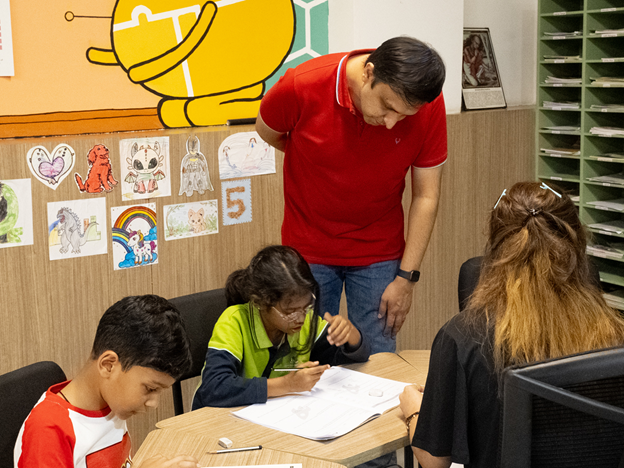
Manan mentoring children. Image Source: Cuemath
No child announces that they are bad at English. Almost every child I meet tells me, quite calmly, that they are not a math person.
And the children who say it are very often doing fine. Their marks are decent, but they will still tell you math is not their subject.
I have been teaching math for about 20 years, and I think there are two reasons for this. Neither of them is ability.
The first is that a child can solve problems and get correct answers for years without ever understanding what they are doing. The second is that math is the only subject we teach without telling children how it is relevant in real life. Let's dig deeper into this.
The Right Answer Gets Rewarded. The Thinking Behind It Rarely Does.
When a seven-year-old says they can’t solve ‘12 × 4’ because they haven't learned the table of 12, they are showing us exactly how they’ve been taught to think.
They have memorized tables for the right answers. Nobody told them ‘12 × 4’ is the same as ‘4 × 12’. If a child memorizes a table and gives the correct answer, we mark it right and move on.
We praise the result, but we rarely stop to check if they actually see the pattern behind the numbers. As a result, children learn to memorize facts without ever understanding how math works. They learn how to add three numbers together, but they are rarely asked to pause and think about whether three odd numbers could ever add up to 30.
When getting it right is the only thing that earns praise, children focus on finding quick answers instead of making sense of the problem. A child taught this way can get the answer right but cannot tell you how or why. And a report card will not warn you.
Math is the Subject We Least Often Connect to Real Life
I learnt about the ellipse during my engineering exam prep in grade 11. It was introduced in one line as a slanting cross-section of a cone, and then we spent weeks on tangents and normals. I forgot all of it the day the exam finished.
Only years later did I find out what an ellipse actually is: the shape of every planet's orbit, the reason a whispering gallery works, the geometry inside the machine that breaks up kidney stones without surgery. Nobody had thought to mention it.
I loved math, and I was raised by two university professors in a house full of books, and I even put the ellipse down and walked away from it. A child given no reason to care will not be more resilient than I was.
Every other subject feels relevant. English is our language. Science is what happened in the beaker. History is people. But Math? It often just feels like symbols and equations on paper.
So What Should a Math Class Actually Change?
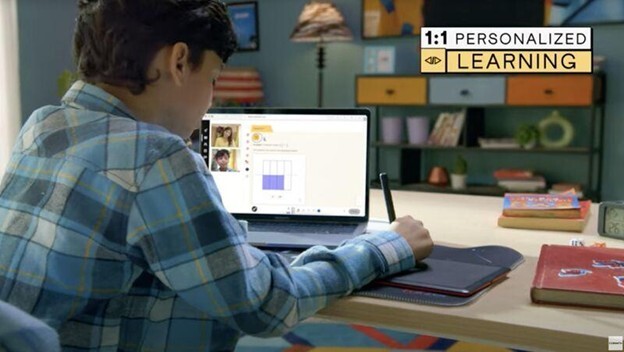
Cuemath student attending 1:1 class. Image Source: Cuemath
Two things, one for each problem.
The first is that the child has to do the thinking out loud. Not the teacher explaining while the child copies, but the child explaining while the teacher listens. A child who can say why a method works owns it. A child who can only reproduce it is borrowing it, and borrowed math runs out, usually somewhere around algebra.
The second is that every idea should arrive attached to something the child can picture. Not a real-life example bolted on at the end of the chapter, but the reason the idea exists at all, given first. Nobody ever had to sell me on why English mattered. Math is the only subject where we ask children to do years of work on trust.
Neither of these needs a new syllabus. They need a different question in the room. Instead of "what is the answer", the question becomes "how did you get there, and where else would this work?"
We Built Cuemath Around the Thinking, Not the Answer
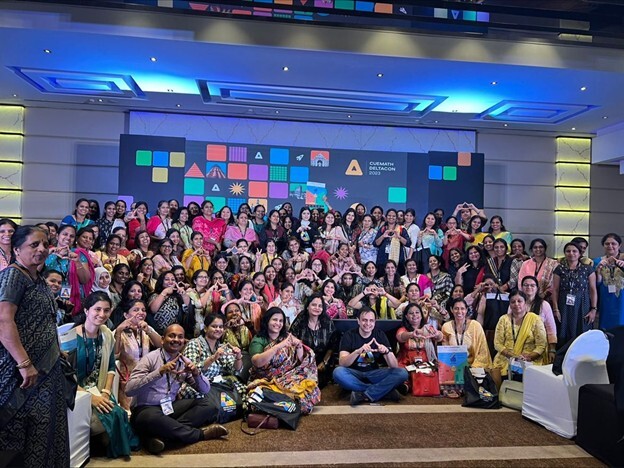
Manan with tutors. Image Source: Cuemath
We began our Cuemath journey in 2013 to put reasoning back at the centre of the math class. After 13 years, we have 4,000+ tutors and 200,000+ students across 80+ countries.
The scale changed. The class did not. It is still one tutor and one child, working through a problem together.
Our ultimate goal as a unit is to make every child MathFit. Here's something you should know about Cuemath:
- The child does the thinking, not the tutor. We worked with Dora Demszky at Stanford University on a feature we call the 'Talk Meter', which tracks who is talking. In an ordinary class the teacher speaks for most of it. The right zone, we have found, is nearer 50:50. The reason is simple, the more students explain their thinking and initiate to attempt the problems themselves, they understand.
- Tutors cue (give subtle hints), they never tell. Hence, the name Cuemath. We don't encourage tutors to give away the answers. We believe in productive struggle. It has helped students overcome their anxiety and fears.
- Every lesson carries real-world problems and simulations that show the why behind the what. Not a footnote at the end of the chapter. The ellipse should arrive with the planet already in it.
- Every class ends with a puzzle and no solution. The child is expected to struggle with it alone, for days if needed.
Inside a Cuemath class – tutor and student solve problems together. Image Source: Cuemath Platform
- One of our Grade 3 students once showed four correct ways to represent 15 × 5. Nobody taught her four ways; she understood multiplication well enough to rebuild it in any form she liked.
- A Grade 1 group was asked to fix a matchstick equation by moving one stick and found three answers, including one child who moved a stick to turn the equals sign into a "not equal to" sign. That was not on anybody's worksheet.
Our goal is never a child who gets everything right. It is a child who stops asking "is this right?" and starts asking "what happens if I try this?". These practices do not primarily produce better marks, though those do come. They produce children who behave differently.
The parent reviews that mean most to me are not about marks either. One mother wrote that her daughter's confidence in math had grown so much that she was now helping her friends at school.
That is the part I want to defend now, because the ground has shifted under it. A child today can get any math question answered in about a second. Every parent I meet asks me the same thing: does the AI boom make this better or worse?
The Children Who Can Reason Will Lead AI. The Rest Will Be Led by It.
Both, and which one you get depends on whether the child can think without it.
AI will soon handle most of the cognitive work that human beings have always done for themselves. That does not make thinking worthless. The people who will lead AI, in whatever field they choose, are the ones who can think clearly and reason logically. That is what our tutoring is for. We want children who will direct AI, not children who take direction from it.
I'll be honest about what AI does well. It can explain one idea five ways until one lands. It can produce a problem at exactly the right difficulty. It can take a question about wildlife and rewrite it about tennis because that is what this child cares about, which is the relevance problem from earlier, solved.
What AI cannot do is make a child want to try. Learning is a biological process and it does not happen without effort from the child. Somebody has to ask for that effort, notice when it flags, and care whether it comes. That is the tutor's job, and no model has taken it from them yet.
So our vision is simple.
Put a person in an Ironman suit and they can do things no human can do alone.
- AI is that suit for a teacher. It does the flying: the explanations, the difficulty, the endless patience for the tenth version of the same question.
- The human inside supplies the heart, which is the part that decides whether a child tries at all. Amplification, not replacement.
That is the way forward as I see it. My worry was never that AI would overpower our children. The ones who keep practising are the ones who will run it.
Parents, if you take one thing from this, make it the question you ask at the end of homework. Not "did you get it right?" but "how did you work it out?" The second question tells you far more, and it is the one every Cuemath class is built around.
The child who says they are not a math person is usually saying something narrower and far more fixable: nobody has shown them what the subject is for, and nobody has asked them what they think. You can start changing both at your kitchen table this week.
One last thing. I never told you whether three odd numbers can add up to 30. That was deliberate. It is how every Cuemath class ends.
Cuemath's first class is free at cuemath.com.