Get all your news in one place.
100's of premium titles.
One app.
Start reading
The Economic Times
The Economic Times

Behind bigger price tags hides a fault line in India’s growth story

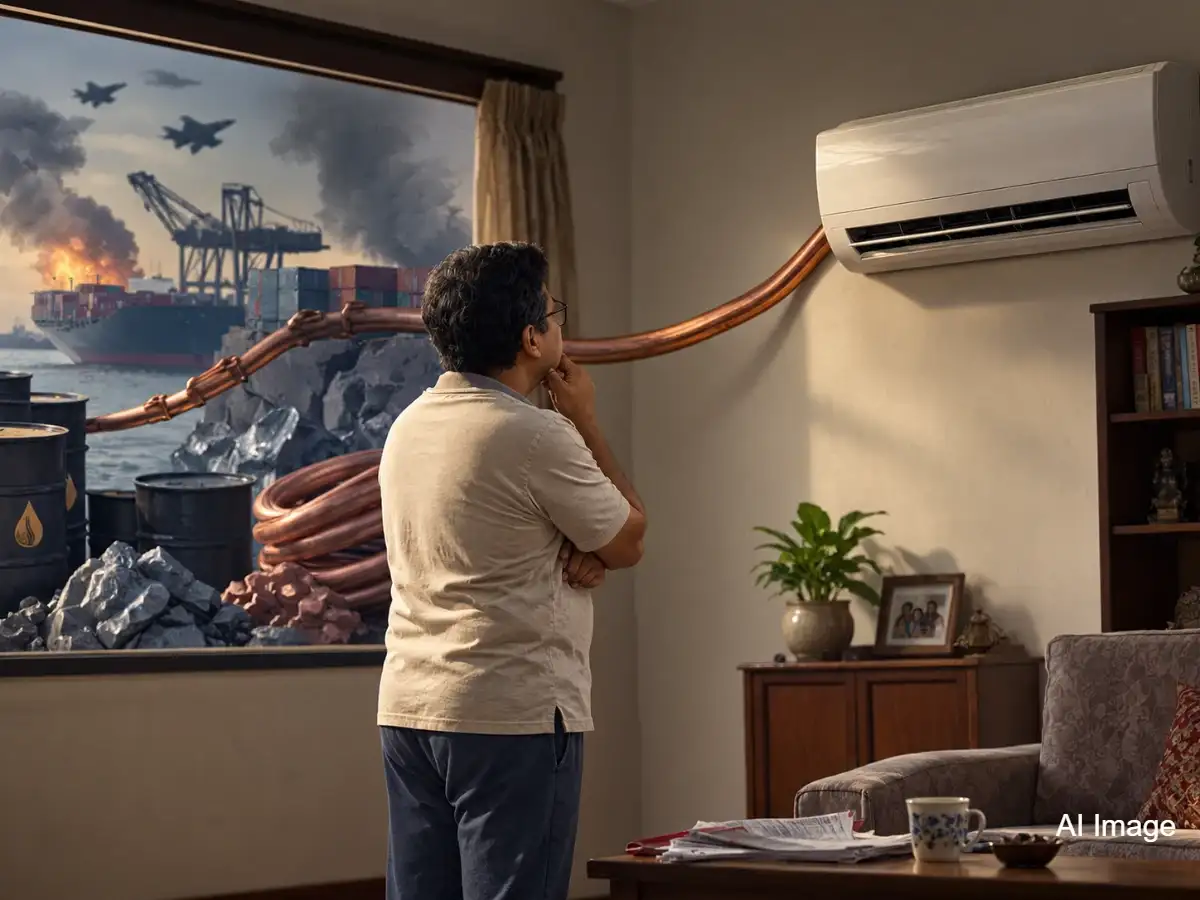
Festive season is coming and you will have the third price hike of the year in consumer durables. LG, Daikin, Voltas, Samsung, Godrej and others are raising prices by up to 10% from October, after copper, steel, aluminium and resin costs surged along with logistics and energy expenses, ET has reported. The immediate trigger is a global cost shock, intensified by the prolonged West Asia crisis.

But the episode exposes a deeper issue for an industry that the BCG-CII expects to grow 8-10% annually to Rs 3-3.25 lakh crore by 2030. India cannot prevent every global commodity shock, but it can reduce how much of that shock gets passed on to Indian consumers.

Also Read: Costly Diwali: Appliance makers set to serve up another price shock

Global shocks become local price hikes

The October increases are the third round of price hikes this year, taking cumulative increases across some categories to 16-18%, according to ET. LG told its trade partners that copper costs had risen 34% this year, resin 17%, steel 24% and aluminium 16%. Higher logistics and energy costs and adverse foreign-exchange movements also weigh on prices.

LG will be revising AC prices upwards by 5-7% from 1 October 2026 onwards while no decision has been taken with regard to the revision of prices of any other LG products as of now. Voltas is raising AC prices by 5-7%, Daikin by 6-10% and Godrej by 4-6%. Samsung has already increased television prices by Rs 1,000-10,000 across its 43-inch to 75-inch range. The timing could hardly be worse. Navratri and Diwali account for an estimated 25-30% of annual consumer-durables offtake.

Also Read: LG Electronics to hike AC prices by 5-7 per cent from Oct 1 ahead of festive season

Manufacturers had initially hoped to restrict the pre-Diwali increase to around 2-3% because they did not want higher prices to hurt festive demand. But input costs have continued to rise. In the three months before the latest round, copper was up about 10%, aluminium 5%, steel 13% and resin 18%, ET reported.

There is no easy way for India to insulate itself from all of this. Copper is a global commodity. So are aluminium, steel and petrochemical feedstocks. A geopolitical disruption in the Gulf can affect energy prices, freight and the availability of industrial inputs even if the final appliance is manufactured in India.

But the question is how much of the global shock has to enter the Indian appliance in the first place. That is where India's localisation problem becomes important.

The more India imports, the more global inflation comes in

A recent BCG-CII report estimates that India's consumer-durables market will reach Rs 3-3.25 lakh crore by 2030, growing 8-10% annually. Rising household incomes, nuclearisation, easier financing, wider distribution and premiumisation are expected to drive the expansion.

Yet localisation of the bill of materials varies from only 25% to 70% across categories. TVs and room air-conditioners are at the lower end, while refrigerators and washing machines are more localised.

That means a significant portion of the value of a product sold in India can still depend on overseas suppliers. Consider an AC. India may assemble the finished product locally, but if key components such as compressors, copper tubes or heat exchangers are imported, a global disruption can still raise the Indian manufacturer's cost. The same principle applies to display modules in televisions and motors or specialised components in washing machines.

This does not mean localisation will stop copper or aluminium prices from rising. What it can do is reduce the number of times a global shock is transmitted through the supply chain and increase the share of the final product whose cost is determined domestically. That is a more realistic definition of self-reliance.

A bigger opportunity than just avoiding imports

The BCG-CII report estimates that the growth of the consumer-durables market could create an additional Rs 40,000-50,000 crore opportunity for domestic value addition in materials and components by 2030. It expects localisation to rise from the current 25-70% range to 30-80%.

India's opportunity is not to become completely insulated from global markets which would be neither possible nor necessarily desirable. The objective is to make the domestic manufacturing chain deep enough to absorb some external shocks.

Metals can illustrate this point. India has substantial domestic production capacity for iron ore, bauxite and aluminium, but it remains dependent on imports for several minerals and intermediate materials. NITI Aayog's latest trade analysis says India remains relatively dependent on imports of copper and is a net importer of aluminium and iron and steel. Copper imports have risen sharply as domestic demand from electronics, power networks, renewables and manufacturing expands.

Steel offers another illustration. Reuters reported in August that Indian steelmakers were facing margin pressure from higher global coking-coal prices, with India importing about 95% of its coking-coal requirement. The Middle East conflict added to the cost and logistics pressure.

So even greater domestic appliance manufacturing cannot eliminate exposure to commodities. But it can change where the value is created and how much of the imported cost gets embedded in every appliance.

The govt is trying to build the missing layer

This is the logic behind two different policy efforts that now matter to consumer durables. The Electronics Component Manufacturing Scheme (ECMS) is aimed at building domestic capacity in components across electronics. In August, the government approved another 31 proposals involving Rs 7,877 crore of investment, taking the total number of approved projects to 106 and cumulative investment above Rs 69,000 crore. The latest projects include copper-clad laminate, display modules, connectors, enclosures, rare-earth magnets and other inputs.

The scheme matters to consumer durables because it addresses precisely the vulnerability exposed by the current price shock -- the gap between assembling a product and making the components that determine its cost.

The White Goods PLI is the more directly relevant programme for appliances. In January, the government selected five companies in the fourth round with committed investments of Rs 863 crore for AC-component manufacturing. The beneficiaries include Kirloskar Pneumatic, Indo Asia Copper, Godrej & Boyce, Kryon Technology and Pranav Vikas. Together, the projects are expected to generate production worth Rs 8,337 crore and 1,799 direct jobs by 2027-28.

The projects cover components including compressors, copper tubes and heat exchangers for ACs. The White Goods PLI, which has an overall outlay of Rs 6,238 crore, aims to build an AC and LED-component ecosystem and raise domestic value addition from roughly 20-25% to 75-80%.

That is exactly the sort of capacity that can eventually make a difference when commodity markets turn volatile.

Can localisation become competitive?

There is a risk, however, that localisation becomes synonymous with subsidised production without becoming globally competitive production. The BCG-CII report identifies scale, backward integration, technology gaps, financing costs and inadequate testing and certification infrastructure as reasons Indian manufacturers remain at a cost disadvantage. India's share of global consumer-durables trade is still below 1%.

Thailand shows what India is missing. Its share of global AC exports rose from 16% in 2010 to 22% in 2025, making it the world's second-largest AC exporter, according to BCG-CII. Its success rests on an ecosystem connecting appliance makers with component suppliers.

India will need the same depth if it wants domestic demand to generate a manufacturing advantage.

This also explains why simply increasing the number of factories will not be enough. The BCG-CII report says India's leading listed durables companies spend less than 1% of revenue on R&D, compared with 1-4% among global peers. Technology partnerships and joint ventures will be needed where critical know-how remains concentrated among global suppliers.

The price hikes therefore exposes two sides of India's consumer-durables story. On one side is a market that could grow faster than almost any major market in the world. On the other is an industry still exposed to global commodities, imported components, foreign exchange and international logistics.

While India cannot control the price of copper when global demand rises nor can it eliminate imports from a globalised manufacturing system, it can decide how much domestic value sits between the raw material shock and the Indian consumer.

Sign up to read this article
Read news from 100's of titles, curated specifically for you.
Already a member? Sign in here
Related Stories
Top stories on inkl right now
One subscription that gives you access to news from hundreds of sites
Already a member? Sign in here
Our Picks
Fourteen days free
Download the app
One app. One membership.
100+ trusted global sources.