
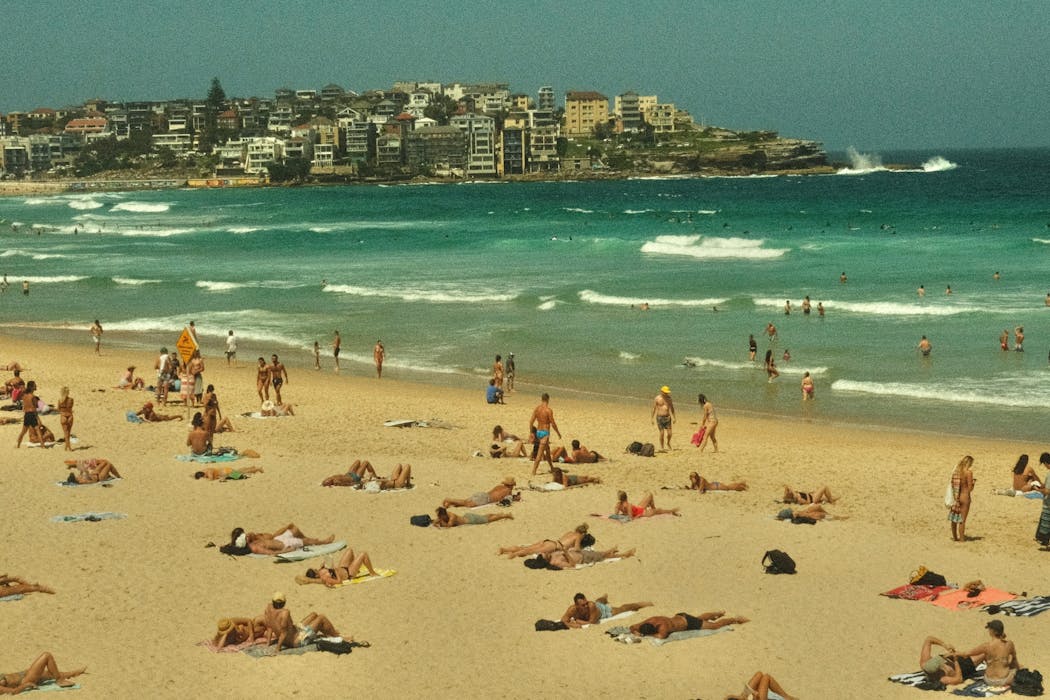
While the beach and swimming culture might feel like an intrinsic part of “Australianness”, this hasn’t always been the case. For many of us, swimming lessons, school swimming carnivals and weekends at the beach are defining childhood memories.
That deep connection to beach swimming helps explain why our responses to the Sydney region’s recent shark attacks and health concerns over South Australia’s algal bloom crisis feel like a form of collective grieving.

Swimming at the beach is seen as healing. It brings us together and connects people to the natural world. Yet our apparently intrinsic swimming identity is something that’s emerged over time. Our attitudes to swimming and beach-going have shifted according to social values and politics.
The “beach bodies” we celebrate as healthy and desirable would have been unthinkable in the 19th century, when sea bathing was a furtive, private affair for colonial Australians. Daytime public bathing was widely banned until around the early 1900s, when restrictions began to lift. And even when we did eventually hold swimming races, our first swimmers were hardly Olympic standard.
Meanwhile, a recent study by Royal Surf Lifesaving Australia warns that swimming culture might be on the retreat: fewer children are competing in swimming carnivals, or even have competence in the water. Drowning deaths increased last summer and swimming ability is falling “below minimum standards”, the report argues: 48% of Year 6 students and 84% of year 10 students are not meeting expected benchmarks for their age.
My research shows that Australia’s swimming culture didn’t evolve by accident: it was actively nurtured by swimming advocates and public education programs. A concerted public effort will be required to boost swimming skills and water safety once more.
Danger, modesty and bans
While most settler-colonial Australian coast dwellers in the 19th century viewed ocean bathing as essential for hygiene, being in the water also channelled all sorts of panics.
The ocean was a place where you drowned when ships went down, got taken by sharks, or simply succumbed to its depths. The beach was perilous. It took people.
Fear of the water also had a moral element. Bathing was necessary, but done in private and with modesty.
The swimming and diving feats of First Nations men and women were frequently commented on by colonists and observers. Aboriginal people “are bold and surprisingly expert, both in swimming and diving”, wrote William Govett in the Saturday Magazine in 1836.
In 1843, the missionary James Backhouse described Aboriginal women in Lutruwita (Tasmania) diving for crayfish “often using the long stems of the kelp to enable them to reach the bottom; these they handle as dextrously as a sailor would a rope in descending”.
And in Lieutenant William Dawes’ famous Dharug wordlist from 1790-91, we get the term “bóg’i” – to bathe or swim. (It’s a word still used today: “bogey holes” are features at Bronte Beach and Newcastle, where people can safely enjoy an ocean dip.)
But in 1810, Governor Lachlan Macquarie banned public bathing in and around Sydney Cove. The colonial bathing prohibition was extended in 1838 to all towns in New South Wales, “for the maintenance of the public peace and good order”. It was incorporated into the Colony’s Police Act:
it shall not be lawful for any person to bathe near to or within view of any public wharf quay bridge street road or other place of public resort within the limits of any of the towns aforesaid between the hours of six o'clock in the morning and eight in the evening.
To avoid prosecution, women and men discretely bathed behind privacy screens and segregated areas, away from public gaze, or at dawn and dusk, until the daytime bathing bans were lifted in the early decades of the 1900s.
Some people in the colonies could and did swim. Swimming races and demonstrations were held in places designated for segregated swimming, like Robinson’s Baths in Sydney’s Woolloomooloo Bay, or St Kilda Baths in Melbourne, during the middle decades of the 1800s.
Yet these carnivals were largely for entertainment and betting, rather than universal rites of passage. And mixed bathing continued to be scorned and policed until the turn of the 20th century.
During one Sydney competition in 1852, only two men entered the 100-yard race, and neither contestant swam overarm until the final few metres of the race, briefly accelerating their more sedate sidestroke.
Over the course of the 1800s, values about morality and modesty gradually shifted as views around gender, health and fitness changed – along with ideas about leisure and pleasure.
An 1860 news story about swimming matches in Port Phillip Bay touted the potential of swimming to strengthen both communities and physical bodies. “It is gratifying to see so many youngsters good swimmers,” the Melbourne Argus reported.
There was a significant racial element in all this, too, as the work of historians Marilyn Lake, Henry Reynolds and others explores. The colonies were anxious about their geographical isolation from Britain and obsessed with how their citizens might “measure up”.
At a time when ideas about bodily vigour and good health were growing, swimming was also viewed as a form of exercise acceptable for women. But swimming didn’t just promote physical fitness. Knowing how to swim was essential for public safety, especially for the Empire’s youngest subjects.
“The accidents that so often occur during the summer season would be reduced to a minimum, if women would but learn to swim,” one 1876 article from the Illustrated Sydney News insisted.
Swim safety and beach bodies
By the late 1890s, school swimming lessons had begun in Victoria and New South Wales. Amateur swimming associations were established around the country during this period. They advocated for the construction of public baths and the provision of lessons, along with that now famous rite of passage, the swimming carnival.
Bathing – once furtive and modest – was increasingly replaced with public swimming, for women and men. The more popular swimming became, the more people visited the beach.
In turn, people who visited the beach to swim, rather than stroll or splash up to their knees, further nibbled at 19th-century Victorian strictures of decorum. By the end of the 19th century, beach bodies were becoming markers of good health and virtue, rather than something to hide.
Surf life saving clubs
As the popularity of beach swimming grew, however, its physical dangers were thrown into ever sharper relief. Reports of tragic deaths were regular news right around the country.
Children were especially vulnerable. Newspapers reported stories like the drowning death of young Leslie Mitchell in December 1900. Seen wading knee-deep at St Kilda beach, he was found face down in the water only minutes later.
As accidents mounted, notes historian Caroline Ford, civic responses also grew. Many beachside communities established lifesaving clubs, like Bondi (formed in 1907), Cottesloe (in 1909) and Tweed Heads and Coolangatta (in 1911), and provided life-saving equipment like life-rings and surf-lines. There were also government inquiries into beach safety, which recommended funding for public education and surf lifesavers.
The Surf Bathing Association of New South Wales, formed in 1907, soon became the Surf Life Saving Association of Australia, and quickly expanded as clubs around the country were created.
The shift from furtive bather to confident beach swimmer reflected changing social attitudes. It also occurred during a critical time of emerging national identity – and federation.
Beach bodies became idealised figures of strength: admirable and desirable, rather than something to be ashamed of. Australian swimmers like Mina Wylie, Andrew “Boy” Charlton, Fanny Durack, and Annette Kellerman, were national heroes and celebrities. They won international races, appeared in variety shows and drew enormous crowds.
While that freedom-loving, strong and capable beach figure celebrated in popular culture at the time might have been bronzed by the sun, it was invariably white. The Immigration Restriction Act was one of the first pieces of federal legislation passed by the new nation in 1901 and it enshrined the White Australia policy.
The beach was a national leveller, of sorts, but only if you were actually welcome to sit on the sand in the first place.
Throughout the 20th century, as swimming became a sign of Australian egalitarianism and physical health, it was also a site of exclusion, as the 1965 Freedom Ride and 2005 Cronulla race riots demonstrate.
Australia’s celebration of beach and swimming culture – in all its complexity – went on to become a defining feature of national identity. And significant efforts supported by governments, surf lifesaving and community groups have attempted to make the beach an inclusive, safe place for everyone.
Ensuring beach safety is an ongoing part of those efforts.
Anna Clark does not work for, consult, own shares in or receive funding from any company or organisation that would benefit from this article, and has disclosed no relevant affiliations beyond their academic appointment.
This article was originally published on The Conversation. Read the original article.







