Get all your news in one place.
100's of premium titles.
One app.
Start reading
The Independent UK
The Independent UK
Lifestyle
Simon Mundy

BBC Proms from a distance: Turn the popular focus back to art, not the flags

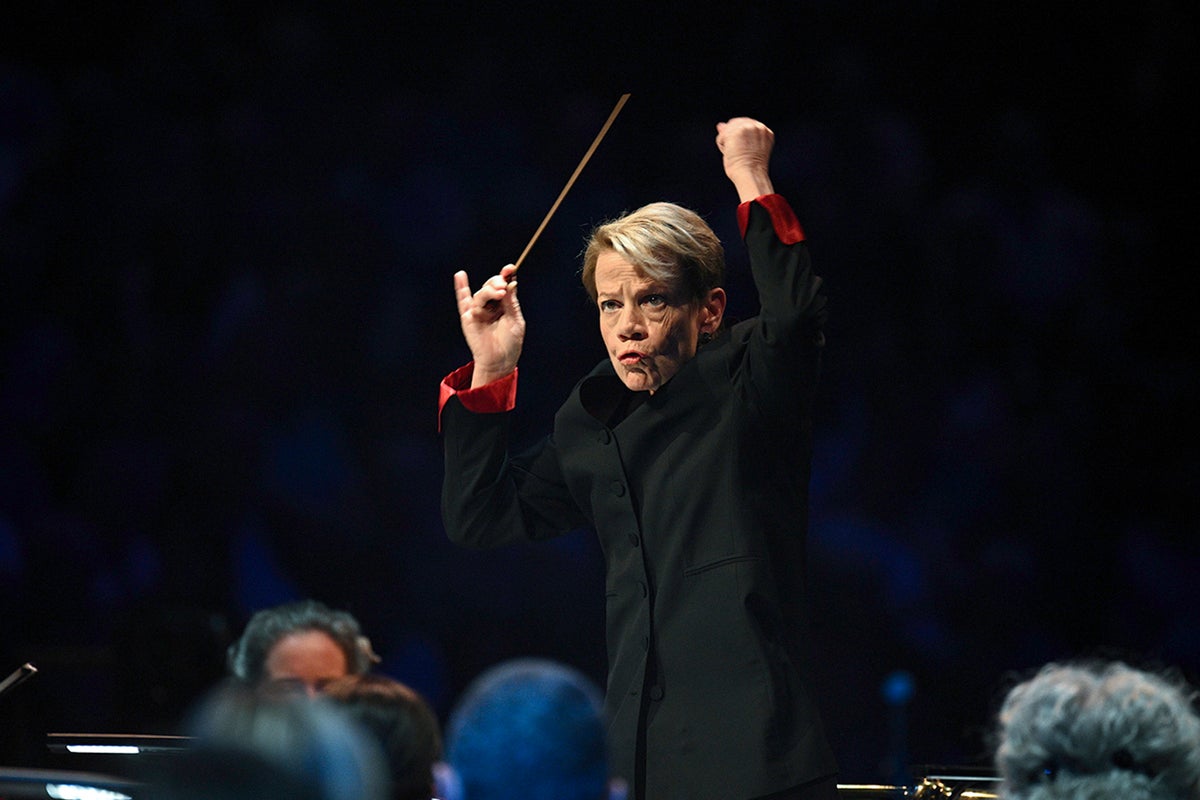
American Classics proms conductor Marin Alsop with the Philharmonia Orchestra - (Chris Christodoulou/BBC)

BBC Radio 3 trumpets the Proms as “the greatest classical music festival in the world”. In its 131st year since the series was started in the Queen's Hall by manager Robert Newman and the conductor Henry Wood, it is a claim hard to argue against. The BBC took over the management and the risk in 1927, when Newman could not continue, and moved concerts into the Royal Albert Hall after the Queen's Hall (ironically right next to Broadcasting House) was bombed in the Blitz.

These days, when the BBC is under severe political and financial pressure and the arts budget in England is stalled, the Proms are of enormous importance to the cultural fabric of the country. At two months the festival is not the longest – several in Europe last all summer – and there are others with a greater concentration of events. The Enescu Festival in Romania follows a similar pattern but only for one month every two years. The Utrecht Early Music Festival has a similar number of concerts from morning till night but is confined to the mediaeval, Renaissance and Baroque, and over only two weeks. So yes, the BBC Proms is still the greatest. It covers all genres of classical music and a few that are not (which I avoid, but that's my prejudice) from the middle of July till mid September, for standing ticket prices that exclude nobody.

Most of the population, even with concerts spreading to Bristol, Gateshead and Belfast, cannot attend in person and that is where the BBC, as the pre-eminent public service broadcaster, comes into its own. Every concert is broadcast live and you can listen in the old way by settling down in your sitting room and listening on the wireless, with expert interval talks from the presentation box. The concerts are archived for listening later on demand, repeated a few days later on Radio 3's afternoon show. They fit around daily life. Driving down the coast one day I heard the New York Met Orchestra and Joyce DiDonato's exceptional performance of Mahler's Fourth Symphony, conducted by Yannick Nézét-Séguin, surely the finest Mahler interpreter since the great Bernard Haitink. Living 700 miles from South Kensington, this is how I now tune in. The BBC engineers provide superb sound and are brilliant at suppressing most of the coughs that can ruin the experience in the hall.

The Met play Mahler's Fourth Symphony conducted by Yannick Nézét-Séguin, 27 August (Pete Scalzitti/BBC)

Listening live, like the Prommers with season tickets, helps understand the logic of the programming. On the final Sunday there was a morning concert of string music from the Sinfonia of London and the Welsh conductor John Wilson, who revived the orchestra – in the 1970s it was a freelance recording group. His insistence on extreme precision and dynamics is engrossing and perfect for the music of Benjamin Britten and his teacher Frank Bridge. In the evening the BBC Symphony Orchestra started with Britten's Young Person's Guide to the Orchestra and followed it with a composer (Gwilym Simcock) and three soloists all of whom years ago had started their careers by winning the BBC Young Musician of the Year competition.

An increasing number of Proms are filmed for television on BBC 2 or 4 over the weekends. Television is a challenge for classical music. Orchestras can be dull to watch and directors can pick irritating shots and too clever lighting effects that distract from the music. We have to endure hideous studio box designs and dumbed down presentation. The close view of big name conductors from the front can reveal them to be all show with inadequate technique. This year, though, there have also been some real visual successes. In the premiere of nonagenarian Thea Musgrave's bassoon concerto, Amy Harman appeared in an all white dress set against the Academy of St. Matin-in-the-Fields players all in black, illustrating the concerto's title – Out Of The Darkness. Watching the National Youth Orchestra being conducted by arguably our greatest living composer, Thomas Ades, was inspiring, as was Marin Alsop's utter command of the Philharmonia Orchestra's Prom of American classics. Alsop's mentor was Leonard Bernstein and she now carries the flame of connection to him and Aaron Copland. Her control in this Prom was so flexible, easily tying in the orchestra to the jazz improvisations of the Marcus Roberts Trio in Gershwin's Rhapsody In Blue.

The National Youth Orchestra play Berlioz’s ‘Symphonie fantastique’, conducted by Thomas Ades (Chris Christodoulou/BBC)

The penultimate night always used to be devoted to Beethoven's Ninth but these days that is slotted in earlier in the season. This year, though, listeners and viewers could choose between two other ninth symphonies, Mahler's on radio and Dvorak's on TV, the latter held over from the previous Sunday's concert referred to above. This showed the BBC Symphony Orchestra, the 'house band' of the Proms, at its best. The great Richard Hosford was sitting in the first clarinettist's seat and the whole orchestra responded to the joyous exuberance and sensitivity of Sakaro Oramo's conducting.

That brought the festival to the nonsense of the last night. Fifty years ago this was a party for season ticket holders and those of us who had queued every day for hours and stood to listen to every note. Then gradually it became a ridiculous nationalistic circus, broadcast to the bemused rest of the world just as British imperialism ebbed away. The BBC has tried to counter the worst of the jingoism by scheduling a serious first half, this year including Samuel Barber's piano concerto played by Yuja Wang, whose brittle style suited it. The trouble is, that goes out on BBC 2 but the second half, with the chanting, flag-waving and audience participation in Land of Hope and Glory, goes to the far bigger audience on BBC1, giving an entirely mistaken view, even with Oramo on the rostrum, of what the Proms season and classical concerts are all about – which is listening intently and silently.

The chanting, flag-waving and audience participation in Land of Hope and Glory, goes to the far bigger audience on BBC1, giving an entirely mistaken view, even with Oramo on the rostrum, of what the Proms season and classical concerts are all about (Chris Christodoulou/BBC)

Somehow, without upsetting those who love it, a way needs to be found to turn the popular focus back to the art, not the flags. On the evening after the “rave”, there was Sunday evensong broadcast from the national musicians' church, St. Sepulchre-without-Newgate, on Holborn Viaduct, where the ashes of Henry Wood are interred. It began with the last of the year's Proms commissions, an introit by David McGregor that did its best to offer hope – Among the Folk of Paradise – and included a prayer for all musicians and those of us listening at home.

Sign up to read this article
Read news from 100's of titles, curated specifically for you.
Already a member? Sign in here
Related Stories
Top stories on inkl right now
One subscription that gives you access to news from hundreds of sites
Already a member? Sign in here
Our Picks
Fourteen days free
Download the app
One app. One membership.
100+ trusted global sources.