
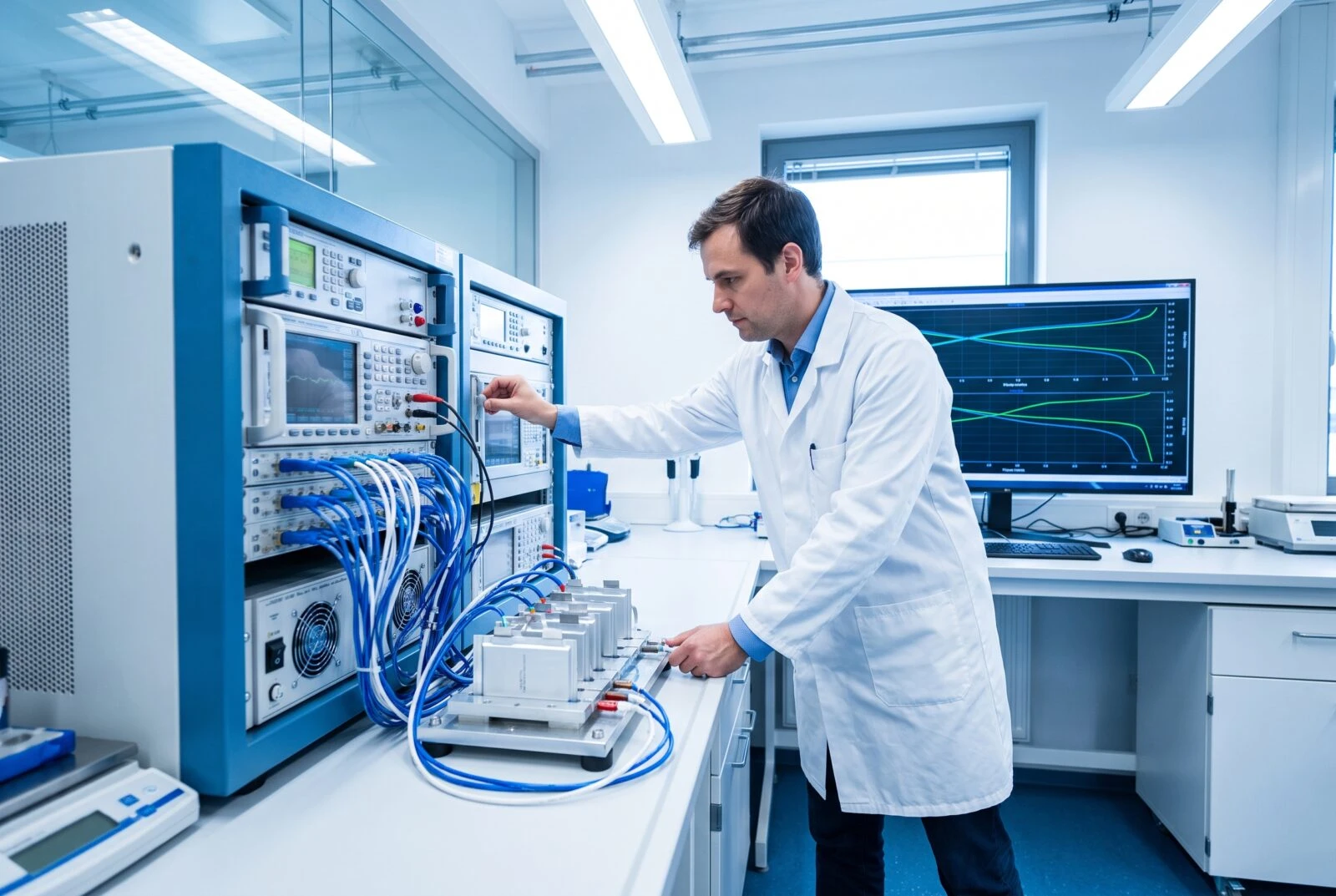
A battery cycler is a precision instrument that charges and discharges a battery cell or pack under controlled conditions while measuring voltage, current, capacity, and internal resistance over hundreds or thousands of repeated cycles. Research labs, battery manufacturers, and automotive engineers rely on these systems to answer one practical question: how will a given cell perform after months or years of real-world use? As electric vehicle production accelerates and grid-scale storage projects multiply worldwide, battery cyclers have moved from a niche electrochemistry tool into some of the most in-demand equipment in materials science labs. Systems range from single-channel benchtop units testing coin cells to rack-mounted platforms running 128 channels in parallel on full EV packs, and the specifications a lab chooses directly shape how fast new battery chemistry reaches the market.
Key takeaways
• Battery cyclers commonly test cells across a 0-5 V range for single cells and up to 0-60 V for multi-cell packs.
• Standard cycle-life testing uses charge and discharge rates between 0.05C and 10C, repeated for 1,000 to 3,000 or more cycles.
• The International Energy Agency reported that global electric car sales reached roughly 14 million units in 2023, a sharp increase over prior years.
• Commercial cycler systems typically offer between 8 and 128 parallel test channels per unit, depending on the application.
• Lithium-ion cells used in EVs typically carry an energy density in the 150-260 Wh/kg range, a figure battery cyclers help verify against manufacturer specifications.
What Is a Battery Cycler, and Why Does It Matter Now?
A battery cycler is an automated charge-discharge testing platform built to repeat controlled cycling protocols on cells, modules, or full packs while logging voltage, current, capacity, energy, and temperature at intervals as fast as a few milliseconds. The instrument's core job is straightforward: apply a defined current or power profile, record how the cell responds, and repeat that cycle hundreds or thousands of times to build a statistically meaningful performance and degradation curve. Demand for this kind of testing has grown alongside the electric vehicle market. According to the U.S. Department of Energy, batteries remain the single most expensive component in an electric vehicle, which is why manufacturers invest heavily in cycle-life validation before a cell chemistry ever reaches production. The International Energy Agency's 2024 Global EV Outlook put worldwide electric car sales at approximately 14 million units in 2023, and every one of those vehicles carries a pack that was cycle-tested during development, and often again during manufacturing quality control. The Department of Energy's own battery technology overview notes that the battery pack typically represents the single largest cost component of an electric vehicle, which is a core reason manufacturers run extensive cycle-life validation before committing a chemistry to a production line rather than discovering a degradation problem after millions of packs have shipped.
The same instruments serve a second, fast-growing market: stationary grid storage. Utility-scale battery installations are expected to operate for 10 to 20 years with daily cycling, so developers need cyclers that can simulate that lifetime in an accelerated test campaign lasting weeks rather than decades. A grid-storage system cycled once per day for 15 years completes roughly 5,475 cycles over its service life, a number that shapes the cycle-life targets written into most utility procurement contracts.
How Do Battery Cyclers Actually Test a Cell?
A battery cycler tests a cell by running it through repeated charge and discharge cycles at defined current, voltage, or power setpoints while continuously logging the resulting data. Three test types make up the bulk of a typical protocol.
Charge/Discharge Cycling
The cycler charges the cell to an upper voltage cutoff (commonly 4.2 V for standard lithium-ion chemistries), holds or tapers the current, then discharges to a lower cutoff (often 2.5-3.0 V), recording the capacity delivered in each direction. This single charge-discharge pair is one cycle, and a full qualification test can run 500 to 3,000 cycles depending on the target application.
Rate (C-Rate) Testing
C-rate describes how fast a cell is charged or discharged relative to its rated capacity: a 1C rate discharges a cell fully in one hour, while a 0.1C rate takes ten hours. Battery cyclers used in R&D typically support a C-rate range from about 0.05C up to 10C or higher, letting engineers see how a chemistry behaves under both gentle laboratory conditions and the aggressive fast-charging profiles EV drivers expect at public chargers.
Cycle-Life and Capacity Fade Estimation
Every cycle a cell completes loses a small amount of capacity, typically a fraction of one percent per cycle for a healthy lithium-ion chemistry. Cyclers track this fade automatically, and most EV pack qualification programs target retention of at least 80% of original capacity after 1,000 to 3,000 cycles, depending on the intended vehicle lifetime and warranty terms.
Battery Cyclers vs. Other Electrochemical Testing Tools
Battery cyclers share a lab bench with several related electrochemical instruments, but each is built for a different measurement. The table below compares typical specifications across the instrument classes most often confused with one another.
|
Instrument |
Typical Voltage Range |
Typical Current Range |
Typical Channels |
Typical Frequency / Rate Range |
|---|---|---|---|---|
|
Battery cycler (single-cell) |
0-5 V |
0-5 A |
8-32 |
0.05C-10C |
|
Battery cycler (multi-cell pack) |
0-60 V |
0-100 A |
4-32 |
0.05C-5C |
|
Potentiostat/galvanostat |
+/-10 V |
+/-1 A (higher with booster) |
1-16 |
N/A |
|
Electrochemical impedance analyzer |
+/-10 V |
1 uA-1 A |
1-4 |
10 uHz-1 MHz |
|
QCM-D |
N/A |
N/A |
1-4 |
~5 MHz fundamental |
|
Atomic force microscope |
N/A |
N/A |
1 probe |
Sub-nanometer resolution |
Key Specifications for Choosing a Battery Cycler
Choosing the right battery cycler comes down to matching three groups of specifications to the cell or pack under test, not to buying the highest number on any single spec sheet.
Channel Count and Voltage/Current Range
Coin-cell and small-format R&D labs generally need 8 to 32 channels at 0-5 V and a few amps per channel, while pack-level validation labs need far fewer channels, sometimes just 1 to 8, but each one must handle 0-60 V and up to 100 A or more. Buying pack-rated hardware for coin-cell screening wastes both budget and channel density.
Current Resolution and Accuracy
Accuracy is usually specified as a percentage of full scale, and laboratory-grade cyclers commonly guarantee 0.02% to 0.05% FS accuracy on both voltage and current channels. At low currents, this resolution determines whether a lab can detect the small parasitic losses, sometimes under 1 mA, that distinguish a good electrode formulation from a mediocre one.
Software, Data Logging, and Safety Interlocks
Sampling rates on modern cyclers range from about 10 Hz for routine cycling up to several kHz for pulse and hybrid-pulse-power-characterization tests. Safety interlocks matter just as much as the electrical specification: most systems include automatic cutoffs if cell temperature exceeds a set threshold, commonly in the 60-80 degrees Celsius range, or if voltage drifts outside the programmed window for more than a few seconds.
Battery Testing Infrastructure Is Becoming an EV Industry Bottleneck
Battery testing capacity has not kept pace with battery manufacturing capacity, and that gap is now a recognized bottleneck for the EV and grid-storage industries. The U.S. Department of Energy's Energy Storage Grand Challenge, launched in 2020, was created specifically to coordinate battery research, testing, and domestic manufacturing scale-up across national laboratories and industry, an acknowledgment that testing and validation infrastructure is as strategically important as cell production lines. A single full pack qualification campaign, running thousands of cycles at realistic C-rates, can take anywhere from 3 to 12 months of continuous cycler time, and labs frequently report multi-month backlogs simply waiting for open test channels. That bottleneck is one reason distributors and instrument makers, including regional specialists such as NewRoad, have expanded battery cycler product lines faster than almost any other electrochemical testing category over the past five years.
Sourcing Battery Cyclers: What Labs and Manufacturers Look For
Procurement decisions for battery cyclers rarely come down to price alone, because the instrument's practical lifetime value depends heavily on calibration support, spare-parts availability, and software compatibility with a lab's existing data pipeline. Universities and national labs often specify systems with 8 or more years of manufacturer support commitments, since a cycler purchased for a single research grant frequently stays in service for a decade or longer. In smaller markets, local distribution matters just as much as the hardware itself: a lab in Israel or elsewhere outside a manufacturer's home market typically relies on a regional partner for calibration, spare channels, and installation support, since shipping a multi-channel cycler back to the country of manufacture for routine service can take weeks. That is the role distributors such as NewRoad play in the Israeli market, pairing several manufacturers' cycler lines, including the battery cyclers NewRoad supplies to research labs, with local calibration and technical support so that a lab's cycling program is not interrupted by a multi-week international shipment every time a channel needs service. Academic groups typically weigh this support model heavily, since a research grant covering 3 to 5 years of funding cannot easily absorb a 6 to 8 week downtime window on a shared instrument while a replacement part clears customs from overseas.
What's Next for Battery Testing in 2026 and Beyond?
Battery testing requirements are shifting toward higher voltages, faster charge rates, and new cell chemistries, and cyclers are being redesigned to keep up. Next-generation EV architectures are moving from roughly 400 V packs toward 800 V and higher, pushing cycler manufacturers to extend voltage ranges well beyond the 60 V ceiling common in today's multi-cell systems. Ultra-fast charging targets of 10 to 20 minutes for a 10-80% charge are pushing C-rate testing capability past 6C on the charge side, a rate that was considered extreme for automotive cells only a few years ago. Solid-state and silicon-anode chemistries, both under active development across the industry, introduce new failure modes, such as dendrite growth and anode swelling, that require cyclers with faster fault detection and tighter safety cutoffs than earlier liquid-electrolyte designs needed. Standards bodies including the Electrochemical Society continue to publish and update testing protocols as these chemistries mature, giving cycler manufacturers a moving target that keeps this corner of the instrumentation market unusually active.
A second-life and recycling economy is also starting to place new demands on cycling equipment. A pack retired from a vehicle at 80% of its original capacity often still has 5 to 10 years of useful life left in a stationary storage role, but only if a lab first re-characterizes its remaining cycle life on a cycler rather than assuming the original spec sheet still applies. That re-testing step, largely absent from the industry a decade ago, is becoming a standard part of battery second-life programs as regulators in the EU and several U.S. states move toward mandatory reporting on battery state-of-health before reuse or recycling.
Frequently Asked Questions
What is the difference between a battery cycler and a potentiostat/galvanostat?
A battery cycler is purpose-built for repeated charge-discharge cycling of a complete cell or pack over hundreds or thousands of cycles, usually at currents up to 100 A or more for pack testing. A potentiostat/galvanostat is a more general electrochemistry instrument, typically rated to only 1-10 A without a booster, used for a wider range of techniques such as cyclic voltammetry and corrosion testing, and it is not optimized for the long-duration, high-channel-count cycling that battery qualification requires.
How many charge/discharge cycles should an EV battery pack survive during qualification testing?
Most EV pack qualification programs target retention of at least 80% of original capacity after 1,000 to 3,000 cycles, with the exact figure depending on the vehicle's intended lifetime and the manufacturer's warranty terms.
What C-rate should be used to test a new lithium-ion cell chemistry?
Early-stage R&D typically starts at low rates around 0.1C to 0.5C to characterize baseline capacity and efficiency, then moves up toward 1C-10C to evaluate fast-charge and high-power performance once the chemistry is stable enough to survive aggressive cycling without accelerated degradation.
Can the same battery cycler test both coin cells and full EV battery packs?
Not usually on the same channel. Coin-cell testing needs low-voltage, low-current channels (0-5 V, milliamp to low-amp range) with high channel density, while pack testing needs far fewer channels rated for 0-60 V and up to 100 A or more, so most labs run separate cycler platforms for each use case.
What safety and performance standards apply to battery cycle testing?
Lithium-ion cells and packs intended for EV or grid applications are commonly tested against standards such as IEC 62660 for automotive lithium-ion cell performance, UL 1642 for cell safety, and SAE J2464 for abuse testing, and battery cyclers are frequently configured with test profiles that map directly onto these published protocols.
Last updated: October 2026














