Get all your news in one place.
100’s of premium titles.
One app.
Start reading
International Business Times UK
Jaja Agpalo

Ayatollah Khamenei Is Dead: What Will Likely Happen In Iran After Supreme Leader's Death?

Ayatollah Khamenei is reported to be dead in Tehran after joint US–Israeli missile strikes that began on Saturday, according to Iranian state media and Western officials, with Donald Trump and Benjamin Netanyahu both claiming the Iranian supreme leader was killed in an operation aimed at regime change.

Rumours surrounding Ayatollah Khamenei had already been circulating in Western and Israeli media, including unverified reports that a photograph of his body had been shown to Trump and Netanyahu. Those claims were initially met with silence from Tehran, but state outlets later confirmed that Khamenei, who had ruled Iran since 1989, died after his secure compound was heavily damaged in the opening wave of strikes.
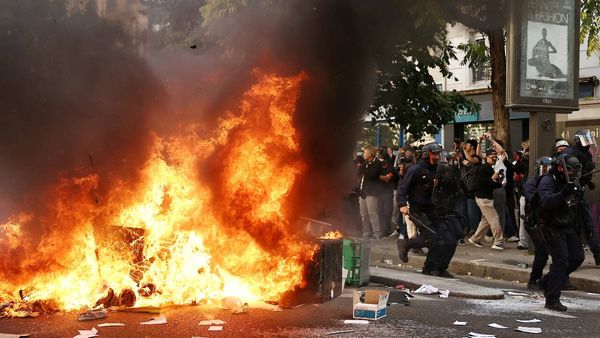
The confirmation, carried by Iranian media early on Sunday, followed a blunt announcement from Trump on his Truth Social platform. He told supporters that 'Khamenei, one of the most evil people in history, is dead,' and said the operation, conducted 'working closely with Israel,' had also killed 'other leaders' alongside him. Trump framed the campaign as a deliberate bid to topple the Islamic Republic's leadership, calling it 'the single greatest chance for the Iranian people to take back their Country.'

Israeli officials were scarcely more restrained. Netanyahu had already suggested that there were 'many signs' Khamenei was 'no longer alive,' while two Israeli broadcasters, Channel 12 and the public network Kan, reported that senior figures in Jerusalem had been briefed on what they called 'Khamenei's elimination.' Kan went further, saying his body had been recovered from the rubble of his compound.

Ayatollah Khamenei, A Target Removed And A War Unleashed

The news came after a barrage of US and Israeli missiles and airstrikes hit targets across Iran on Saturday morning, in what American officials described as a response to what they called an 'intolerable' threat from Tehran's ballistic missile programme and its regional activities. Satellite imagery cited in the reports showed extensive damage to Khamenei's supposedly impregnable residence, and he had not been seen or heard in public since the first explosions.

Iranian state media, which initially stayed quiet as speculation swirled, then confirmed that Ayatollah Khamenei had been killed. They also reported that his daughter, son-in-law and granddaughter died in the same strikes, attributing the information to 'informed sources' within the supreme leader's household. The semi-official Fars news agency said the deaths had 'unfortunately been confirmed'.

The cost of the opening phase of the operation has been high on both sides. Iranian outlets reported that 201 people were killed and 747 injured in the initial US–Israeli attacks, including more than 100 children at a school. Israel, for its part, has endured sustained missile fire from Iran, with air raid sirens sounding through the night and media reporting that a 50‑year‑old woman was killed when a missile struck Tel Aviv. Around 120 people there have been injured.

The conflict has already spilled far beyond Iran and Israel. Tehran launched strikes on US military installations in Bahrain, Kuwait and Qatar, and there were reports of explosions in Dubai. In the United Arab Emirates, one person was killed by shrapnel from an Iranian missile and debris from intercepted projectiles sparked fires at Dubai's main port and on the facade of the Burj Al Arab hotel, according to state media.

US Central Command said it was 'now delivering swift and decisive action as directed' and claimed to have 'successfully defended against' hundreds of Iranian missiles and drones, with no American casualties reported. A senior Trump administration official insisted the decision to hit Iran when they did was driven by intelligence that Iran was considering a pre-emptive strike, and by the judgement that its conventional missile arsenal in the 'southern belt' posed an immediate danger to US forces and allies.

What Happens In Iran After Ayatollah Khamenei's Death

Inside Iran, the removal of Ayatollah Khamenei leaves a gaping hole at the top of a system built around his authority. The constitution says the Assembly of Experts, a clerical body, should convene to choose a new supreme leader when the post falls vacant. Analysts quoted in the reports, however, argue that the Islamic Revolutionary Guard Corps, whose chief Mohammad Pakpour was also confirmed killed in the strikes, may still be better placed than any clerical council to shape the transition.

Iranian media said President Masoud Pezeshkian, judiciary chief Gholamhossein Mohseni Ejei and another senior official would lead a temporary collective leadership while a successor is chosen. At the same time, Israel's prime minister claimed that its forces had killed 'several leaders' linked to Iran's nuclear programme and promised further strikes against sites associated with it in the coming days.

So much for the mechanics of succession. The deeper struggle is over what kind of Iran emerges from the wreckage. Trump has explicitly tied the military campaign to a call for Iranians to 'rise up' against their rulers, saying US intelligence indicates that elements of the Revolutionary Guards, the regular army and other security forces 'no longer want to fight' and are seeking immunity. Netanyahu, in his own address, urged Iranians to 'flood the streets and finish the job.'

Those are bold appeals in a country where protests have repeatedly been met with live fire and mass arrests, from the Green Movement in 2009 to the recent 'Woman, Life, Freedom' demonstrations. The scenarios sketched by regional observers now range from a genuine transfer of power towards protesters and opposition networks, to a reconstitution of the regime under slightly less hardline figures from Khamenei's circle, through to a brutal consolidation by the most radical faction left standing.

Iran's leadership is projecting defiance. Officials quoted by state media insisted they were not surprised by the attacks and warned of 'long-lasting and extensive' consequences, saying all options were on the table, including some 'not previously considered.' The Revolutionary Guards threatened all US bases and interests in the region and promised retaliation until 'the enemy is decisively defeated.'

At an emergency meeting of the UN security council, the clash played out in formal language. The US ambassador, Mike Waltz, defended the legality of the operation and declared that 'Iran cannot have a nuclear weapon,' framing that as a matter of 'global security' rather than politics. Iran's ambassador, Amir Saeid Iravani, called the airstrikes a 'war crime' and a 'crime against humanity,' citing the hundreds of civilian casualties reported by Tehran.

UN secretary general António Guterres, warning of 'a potential wider conflict with grave consequences for civilians and regional stability,' urged all sides to halt their attacks and return to negotiations. For now, though, the only certainty is that Ayatollah Khamenei, the man who towered over Iranian politics for 35 years, is gone, and no one yet knows whether the system he built will fracture, harden or simply find itself a new face.

Sign up to read this article
Read news from 100’s of titles, curated specifically for you.
Already a member? Sign in here
Related Stories
Top stories on inkl right now
One subscription that gives you access to news from hundreds of sites
Already a member? Sign in here
Our Picks
Fourteen days free
Download the app
One app. One membership.
100+ trusted global sources.