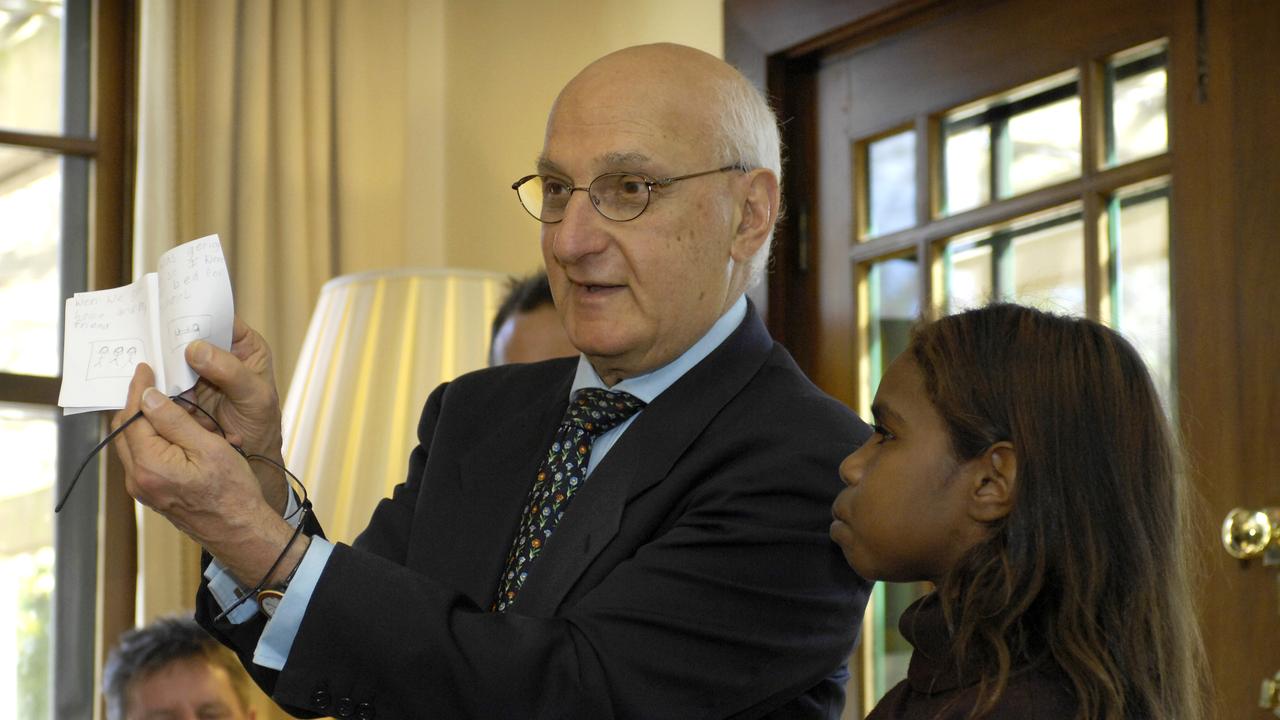
Australian author David Malouf is being remembered for an extraordinary career throughout which he examined the inner life of men as well as many other topics.
The acclaimed author and poet had died aged 92, longtime publisher Penguin Random House confirmed on Thursday.

Malouf was born in Brisbane on March 20, 1934, to a father from a Catholic Lebanese background and mother from a family of Sephardic Jews from Spain.
"David Malouf wrote across fiction, non-fiction, poetry, libretti and plays, and made a significant and continued impact on Australian literature," the publisher said.
Malouf gained international acclaim and won numerous prizes for his work, including the Miles Franklin Award, Commonwealth Writers' prize, the Prix Femina Etranger, IMPAC Dublin Literary Award and Australia-Asia Literary Award.
He was also taught and lectured in Australia and Europe.
"Alongside his achievements as a writer, David was a loyal, loving friend to many and devoted to his family. He was a passionate supporter of Opera Australia, Adelaide Writers Week and the Indigenous Literacy Foundation," the publisher said.
A memorial service will be held later in the year.
In his older age, Malouf spoke out about what he saw as Australia's privileged position in the developed world having dulled the nation's sense of empathy.
"The worst thing about Australia is a kind of blindness to how unjust, poverty-stricken, repressed and oppressed most people are," he said, pointing out that Australians' attitude to asylum seekers showed many were oblivious to what happened in the outside world.
"What you hope as a writer is your setting it all down will make people look at their own lives and ask questions about what kind of country we want to be, questions about how we came to be the country we are.
"Australia is such a rare place and I don't think we know it. I don't think people are aware of how privileged they are."
After graduating from the University of Queensland in 1955, Malouf worked as a lecturer before moving to the UK.
He worked as a teacher in London and Liverpool, travelling through Europe before returning to Australia in 1968, when he took up a lecturing post at the University of Sydney.
His first book, Johnno, was published in 1975, a semi-autobiographical tale about a young man growing up in Brisbane during World War II.
Malouf left university life to become a full-time writer in 1977 and another book, An Imaginary Life, followed in 1978 to international acclaim.
His 1982 novella Fly Away Peter, about three acquaintances and their experience of World War I, won The Age Book of the Year for fiction.
In 1990, his novel The Great World, about two Australians and the two world wars, won the Commonwealth Writers' Prize and the French Prix Femina Etranger.
Malouf's second Commonwealth Writers' Prize came in 1993 with the novel Remembering Babylon, which was also short-listed for the Booker Prize for fiction.
In 2007, his short-story collection, Every Move You Make, won three Australian literary awards.
A year later, Malouf won the inaugural Australia-Asia Literary Award for another short-story collection, The Complete Stories.
Also an accomplished poet, Malouf published eight poetry collections, as well as the libretti for four operas including Patrick White's Voss, which opened at the Adelaide Festival in 1986.
Prime Minister Anthony Albanese said Malouf's death "reminds us of all that his genius gave to Australia and the world".
"In both poetry and prose, David dealt in hard truths and deep insights. He captured the harsh, vast and intense beauty of our land and the lives it shaped," Mr Albanese posted on social media.
In 2008, Malouf won the Australian Publishers Association's Lloyd O'Neil Award for outstanding service to the Australian book industry and was also elected a Fellow of the Royal Society of Literature.
In 2011, he was short-listed for the Man Booker Prize, a biennial award that recognises a writer's overall achievement in fiction.
Although openly gay, Malouf remained reticent about his relationships and shared his inner-Sydney terrace house with friends for much of his life.