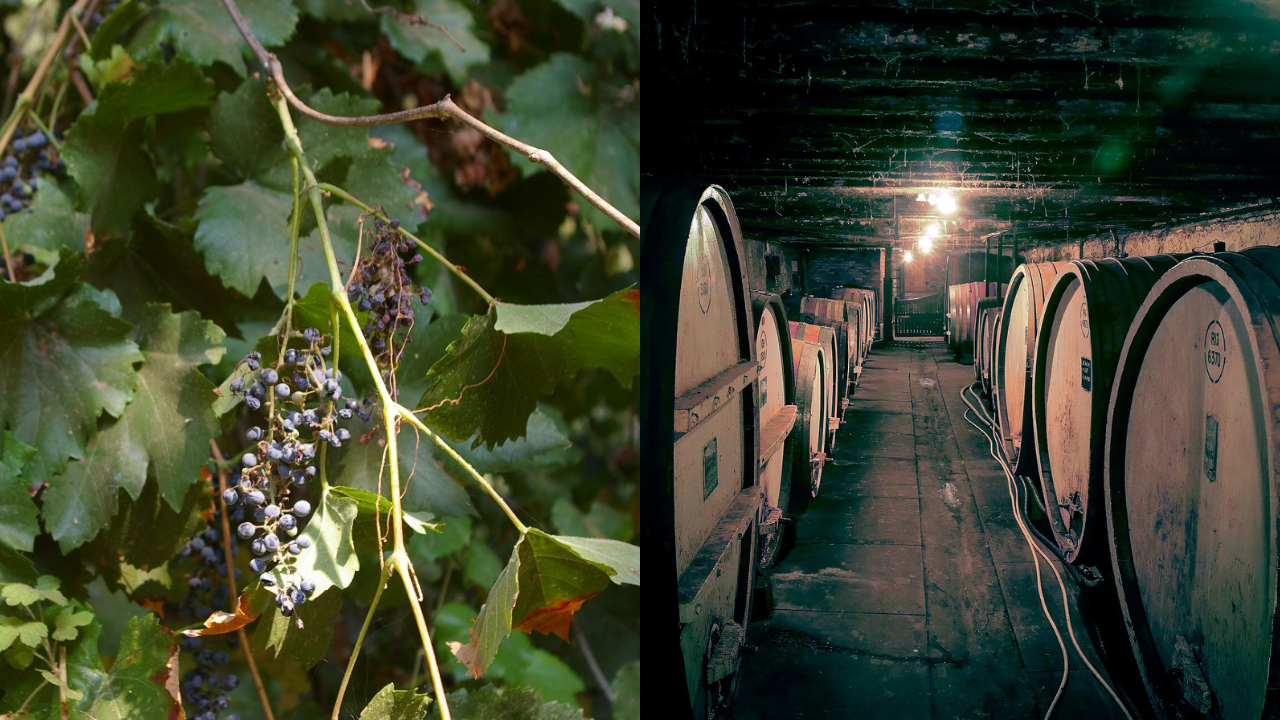
Fourth-generation grower James Cremasco watched as vines planted by his grandfather were removed. Millions of vines were being destroyed across Australia, while growers said tens of millions more would have to go as the country struggled with a surplus of wine and falling grape prices.
Get breaking news anytime, anywhere. Download the TOI app now!

More than two billion litres of unsold wine were sitting in storage, which is equivalent to roughly two years of production, Reuters reported. Some of the stock was already spoiling as producers tried to sell it at heavily reduced prices.The problem had built up over several years, with weaker global wine consumption being compounded by the loss of Australia's lucrative Chinese market.
The surplus had become too large for growers to ignore
Australia is one of the world's major wine-producing and exporting countries, with vineyards spread across dozens of growing regions. The immediate problem in 2024 was particularly severe for red wine, as demand for cheaper red wines had fallen, while Australia's growers were still carrying large areas of vines that were capable of producing more grapes.
Reuters reported that some Australian red grapes were selling for little more than A$100 a tonne, while prices had previously reached as much as A$600. In another comparison, the average price for inland red grapes had fallen to A$304 per tonne in 2023, compared with A$659 in 2020. Growers could harvest the crop and still lose money, and some therefore left grapes on the vines, while thers began removing the vines themselves.
Griffith became one of the places where the problem was visible
Cremasco's decision to remove vines showed the longer-term calculation confronting growers, since keeping an unprofitable vineyard in production still requires irrigation, labor, pruning, harvesting and other costs. If wineries do not want additional grapes, the grower can be left with a crop that has little or no commercial value.
Reuters reported that Australia's wine industry estimated as many as 20,000 hectares (about 8% of the country's vineyard area) might need to be removed to restore balance between supply and demand. For individual growers, however, the decision was not simply about industry statistics, as removing established vines meant giving up land that had produced grapes for decades and finding another crop or use for it.
China's disappearance from the market made the surplus worse
China had been Australia's most valuable export market for wine before Beijing imposed steep tariffs in 2020, and the trade restrictions sharply reduced exports just as broader global wine consumption was weakening. The Australian wine industry therefore lost an important outlet while vineyards continued producing. Chinese authorities were expected to remove the tariffs by early 2024, but growers and industry representatives did not expect the reopening of the market to immediately absorb the accumulated stock.
An ABC Rural report from February 2024 cited Rabobank's estimate of a two-billion-litre oversupply, and also reported that Australia's average inland red-wine grape value had fallen to A$304 per tonne in 2023, which was the lowest recorded level at the time.
Growers were being asked to reduce production
Growers in South Australia's Riverland (another major wine region) called for a moratorium on new plantings in March 2024. An ABC Rural report said the country had accumulated more than two billion litres of excess wine by August 2023, according to Rabobank, and farmers argued that production needed to fall before prices could recover. Higher-value vineyards that served premium markets faced different economics, while large producers were also shifting toward premium wines and reassessing their production.
The national stockpile eventually began to decline, with Wine Australia's 2023–24 production and inventory report estimating Australia's wine inventory at 1.96 billion litres as of June 30, 2024, down 228 million litres from the previous year.
Most growers were owning vineyards that had been planted by earlier generations, and the arithmetic had become more immediate: keeping vines in the ground meant continuing to produce into an already oversupplied market, while removing them meant abandoning an established source of income. In Griffith, that calculation was visible in rows of uprooted vines and bare soil where vineyards had stood for decades.