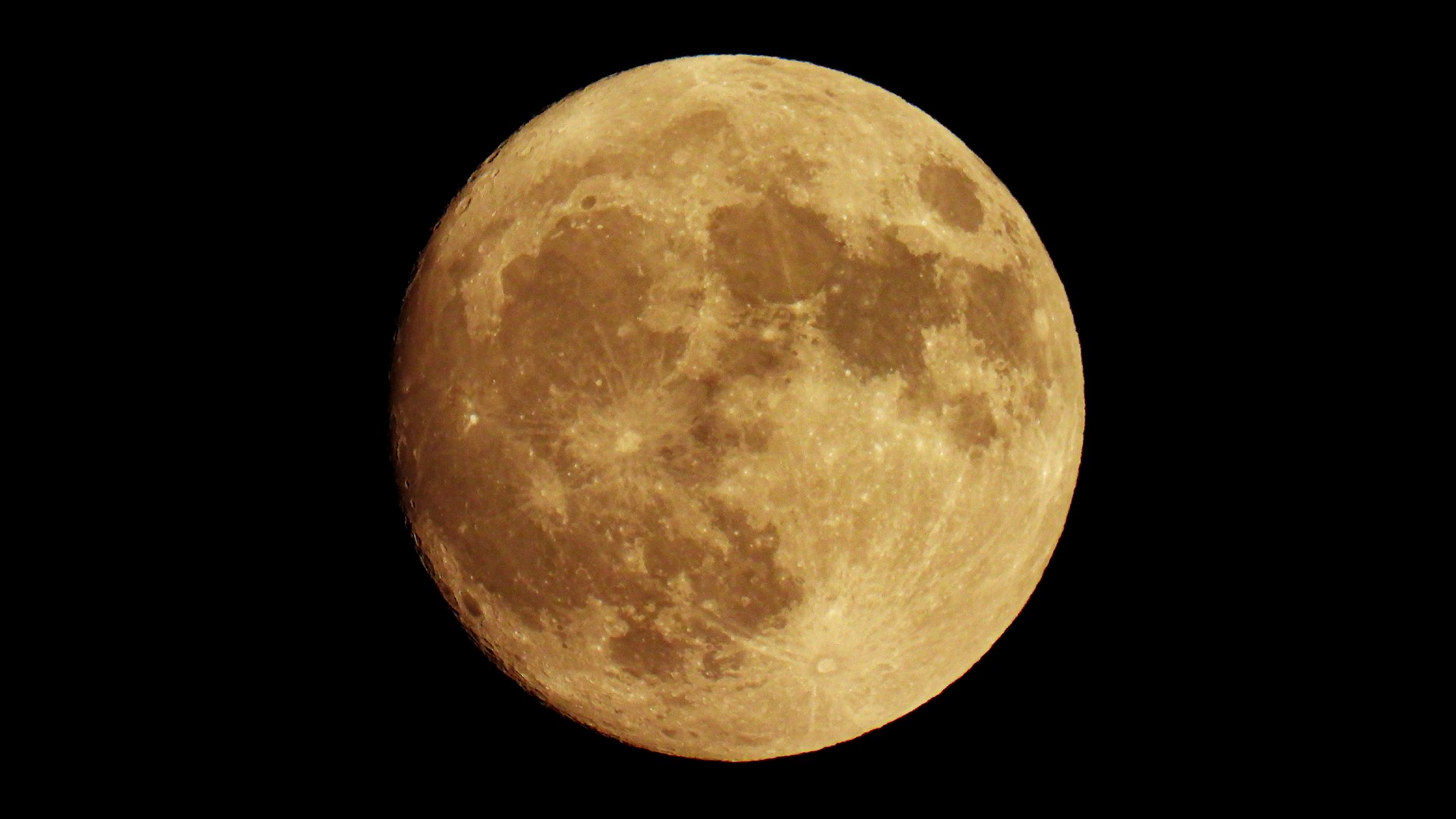
On Wednesday, Aug. 30, you'll no doubt hear the mainstream media proclaiming that on that night we will have an opportunity to witness a "supermoon." It's a term, or more specifically, a branding, of relatively recent origin. It originated not from astronomy, but astrology; first coined by an astrologer, who arbitrarily defined it as "a full moon which occurs with the moon at or near (within 90-percent of) its closest approach to Earth in a given orbit (perigee)."
Indeed, at 12 noon ET on that fifth Wednesday of August, the moon will arrive at perigee, its closest point in its orbit relative to Earth at 221,942 miles (357,181 km) away. And 9 hours and 36 minutes later, the moon will officially turn full. Although a full moon theoretically lasts just a moment, that moment is imperceptible to ordinary observation, and for a day or so before and after, most will speak of seeing the nearly full moon as "full": The shaded strip is so narrow, and changing in apparent width so slowly, that it is hard for the naked eye to tell whether it's present or which side it is.