Get all your news in one place.
100's of premium titles.
One app.
Start reading
Digital Camera World
Jamie Carter

Astrophotography in July 2026: get your camera ready to photograph meteors, the Milky Way and Manhattanhenge this month

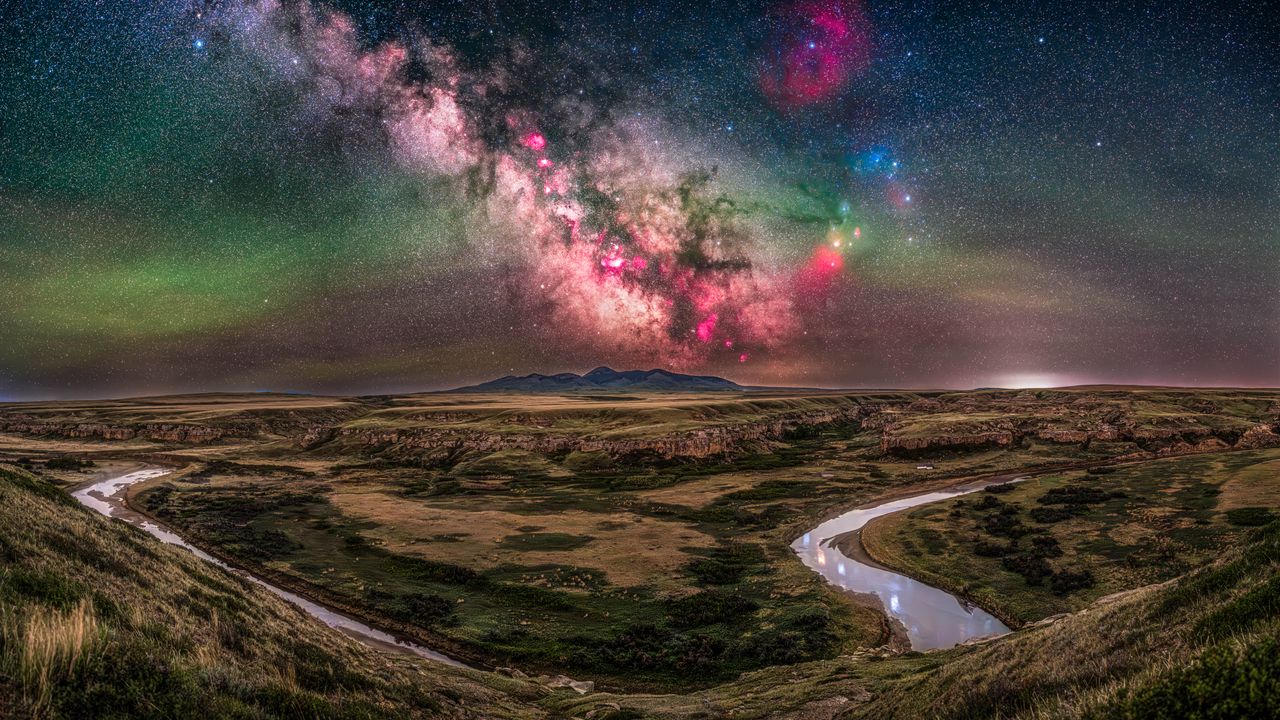
This captures a 180° panorama of the rich and colourful summer Milky Way over the iconic Sweetgrass Hills of Montana, specifically the West Butte. (Photo by: Alan Dyer/VWPics/Universal Images Group via Getty Images).

July 2026 is a month of contrasts for astrophotographers in the Northern Hemisphere. On one hand, nights are short, compressed into a narrow window between lingering twilight and early dawn. On the other hand, what darkness remains is hard to resist. This is peak season for the Milky Way’s brightest region and the last chance to image Jupiter in evening twilight. Add a well-timed new moon, a photogenic full ‘Buck Moon’ and a meteor shower, and July becomes less about quantity of darkness and more about timing. Here’s everything you need to know about astrophotography in July 2026:
Read: 10 must-shoot events for astrophotographers in 2026

July 11: Moon and Pleiades

If you can get up an hour before sunrise and you have a clear east-northeastern horizon, look for a 15%-illuminated waning crescent moon curled around the Pleiades open cluster (M45), with Mars and orangey red supergiant star Aldebaran below.

Read: When to photograph the moon

July 11-12: Manhattanhenge

Manhattanhenge takes place on July 11-12 this year (Image credit: Getty Images)

July’s best celestial photography opportunities are not confined to dark skies. Twice each year, three weeks before and after the summer solstice, Manhattanhenge occurs in New York City. On both evenings this weekend, the setting sun will align perfectly with Manhattan’s grid of streets and be framed by the borough’s skyscrapers. On 11 July, the entire disk of the sun will appear on the horizon between the skyscrapers, while on 12 July, it will be possible to capture the “kiss the grid” effect, with half the sun appearing below the horizon line as it sets directly within Manhattan’s grid. For photographers, this is about geometry and timing. Use a long lens (200mm or more) to compress the scene and position yourself along major streets such as 42nd or 34th. Arrive early, as crowds gather quickly. Bracket your shots to retain detail in both the sunlit sky and the shadowed foreground. The definitive source for details about Manhattanhenge is New York’s American Museum of Natural History.

Read How to photograph Manhattanhenge

July 17-18: Dark sky window

(Image credit: Getty Images)

Night is short enough in July without having to contend with a bright moon. So keep your attempts to image the Milky Way and anything in the deep sky to a few nights before and after the new moon on Tuesday, July 14. In mid-northern latitudes, the brightest part of the Milky Way becomes visible low in the southeast after dusk and climbs higher through the night. Use a wide-angle lens (14-24mm), a fast aperture (f/2.8 or thereabouts), ISO 800-3200 and exposures of 10-20 seconds to capture it, then use post-processing software to draw out detail. A star tracker will allow longer exposures and finer detail, revealing dust lanes and star clouds.

Read: How to photograph the Milky Way

July 17-18: Crescent moon returns

The nights after the new moon offer a chance to capture an ultra-thin crescent moon in the western twilight sky. On July 17, you can catch a 16%-illuminated waxing crescent moon close to Venus, with it slightly brighter and farther away from the planet on 18 July. You’ll need a clear horizon, precise timing and a tripod. Use a short telephoto lens (100–300mm) and expose for the crescent itself — Earthshine may be visible as a faint glow across the rest of the lunar disk.

Read: The best star tracker camera mounts

July 29: Full ‘Buck Moon’ rises

(Image credit: Getty Images)

The time to image July’s full moon — known as the Buck Moon — is at moonrise where you are as its light passes through more of Earth’s atmosphere and takes on a warm orange hue. Scout a clear southeastern horizon and use apps like The Photographer's Ephemeris and PhotoPills to align the rising moon with foreground elements such as buildings, hills or coastlines. A telephoto lens in the 200-600mm range will exaggerate the moon’s size relative to the landscape.

Read: How to photograph the full moon

July 30-31: Delta Aquariid meteor shower peaks

Delta Aquariid meteor is appearing over the Buddha statue in Kantale, Sri Lanka (Image credit: Getty Images)

The Delta Aquariids peak overnight, though this year the bright moon will significantly reduce visibility. Even so, it’s worth attempting wide-field imaging, being sure to orient the camera away from the bright moon’s glare. Meteor photography relies on persistence and volume. With a camera and a wide-angle lens on a sturdy tripod, aim away from the moon and start with ISO 800-3200, f/2.8, 20-25 seconds. Then, when you’re happy the finished image is balanced and sharp, switch to continuous shooting for a few hours.

Read: The best lenses for astrophotography

Astrophotography shot of the month: The Milky Way in H-alpha

Milky Way over Dinosaur Provincial Park, Alberta. Canon EOS Ra with RF 15-35mm f/2.8. and H-Alpha filter. 4mins at f/2.8, ISO800 (Image credit: Alan Dyer/Getty Images)

July is arguably the best month of the year to photograph the Milky Way’s brightest section visible from the Northern Hemisphere. Rising high on warm, moonless nights, the galaxy’s central regions in Sagittarius and Scorpius become prime targets for wide-field astrophotography. However, shooting the Milky Way in Hydrogen-alpha — or H-alpha — reveals a new view.

Most standard DSLR and mirrorless cameras block up to 90% of H-alpha light, which is why many astrophotographers increasingly use astro-modified cameras or narrowband H-alpha filters combined with star trackers for long exposures. Think of it as switching from ordinary night vision to an X-ray view of the galaxy’s hidden structure — suddenly the Milky Way appears alive with stellar nurseries and glowing interstellar clouds.

H-alpha filters isolate a deep-red wavelength of light emitted by glowing hydrogen gas at star-forming regions across the galaxy. The result is striking: crimson nebulae and intricate gas clouds emerge from within the Milky Way’s star fields, particularly around Sagittarius, Cygnus and Scorpius. Love it or loathe it, H-alpha images of the night sky are here to stay.

Astrophotography tools: the best camera, lenses and gear

The best lenses for astrophotography

The best star tracker camera mounts

Sign up to read this article
Read news from 100's of titles, curated specifically for you.
Already a member? Sign in here
Related Stories
Top stories on inkl right now
One subscription that gives you access to news from hundreds of sites
Already a member? Sign in here
Our Picks
Fourteen days free
Download the app
One app. One membership.
100+ trusted global sources.