
Get all your news in one place.
100’s of premium titles.
One app.
Start reading
LiveScience
LiveScience
Harry Baker

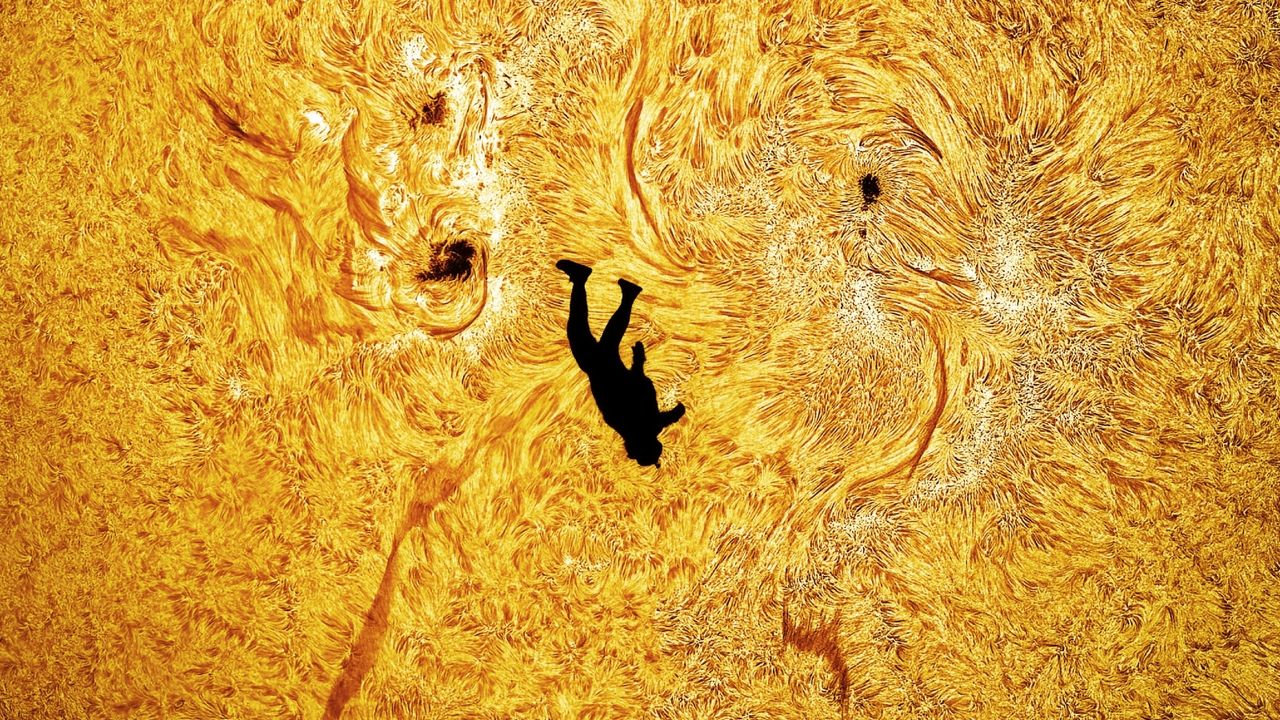
Astrophotographer snaps 'absolutely preposterous' photo of skydiver 'falling' past the sun's surface

A close up image of the silhouette of a skydiver against the fiery surface of the sun.

An astrophotographer has captured a spectacular shot of a falling skydiver perfectly aligned with the fiery surface of the sun, making it seem like the airborne adventurer is tumbling through the vacuum of space in front of our home star.

Andrew McCarthy, an Arizona-based astrophotographer who specializes in photographing the sun, captured the unlikely photo on Saturday (Nov. 8) at around 9 a.m. MST (11 am EST). The shot, dubbed "The Fall of Icarus," required an "absolutely preposterous" level of planning and "might be the first photo of its kind in existence," McCarthy wrote in a post on the social platform X.

The skydiver in the image was the YouTuber and musician Gabriel C. Brown, who jumped from a small propeller-powered craft at an altitude of around 3,500 feet (1,070 meters), around 8,000 feet (2,440 m) from McCarthy's camera. Brown shared several behind-the-scenes photos of the shoot in an Instagram post, including a video of him and McCarthy celebrating the shot.

"You can see the excitement on my face in the videos," McCarthy told Live Science. "Seeing it perfectly captured on my monitors was exhilarating."

The image was captured on the first and only jump of the day, McCarthy added. However, despite weeks of meticulous planning, it took six attempts to properly line up the aircraft with the sun. You can see the exact moment Clarke jumped in a video posted to X by McCarthy (see below).

It took six attempts to line up the aircraft with the sun before Brown finally made the leap. (Image credit: Andrew McCarthy/cosmicbackground.io)

"It was a narrow field of view, so it took several attempts to line up the shot," McCarthy added. "We only had one shot at the jump as repacking the parachute safely would take too long for another."

The biggest issue the pair faced was that the aircraft they used was a lot harder to reliably track through the sky than they first thought, McCarthy said. "Capturing the sun is something I'm quite familiar with, but this added new challenges."

McCarthy added that the new photo is comfortably one of the "top 5" he has taken during his career to date.

In the last few months, he has also captured other solar transit photos, including a "once-in-a-lifetime" shot of the International Space Station photobombing a solar flare and a SpaceX rocket appearing to cut through the solar disk.

In the past, he has also snapped an incredible shot of a 1-million-mile-long (1.6 million km) plasma plume erupting from the sun, as well as an ultra-high-definition photo of the lunar surface and a striking image of Mars being eclipsed by the moon.

Sign up to read this article
Read news from 100’s of titles, curated specifically for you.
Already a member? Sign in here
Related Stories
Top stories on inkl right now
One subscription that gives you access to news from hundreds of sites
Already a member? Sign in here
Our Picks
Fourteen days free
Download the app
One app. One membership.
100+ trusted global sources.