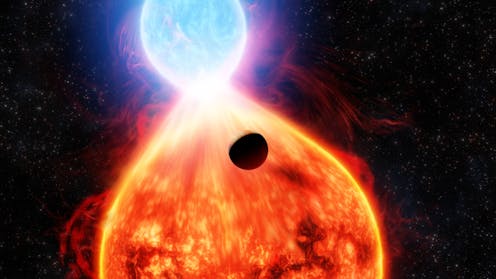
The search for planets outside our Solar System – exoplanets – is one of the most rapidly growing fields in astronomy. Over the past few decades, more than 5,000 exoplanets have been detected and astronomers now estimate that on average there is at least one planet per star in our galaxy.
Many current research efforts aim at detecting Earth-like planets suitable for life. These endeavours focus on so-called “main sequence” stars like our Sun – stars which are powered by fusing hydrogen atoms into helium in their cores, and remain stable for billions of years. More than 90% of all known exoplanets so far have been detected around main-sequence stars.