
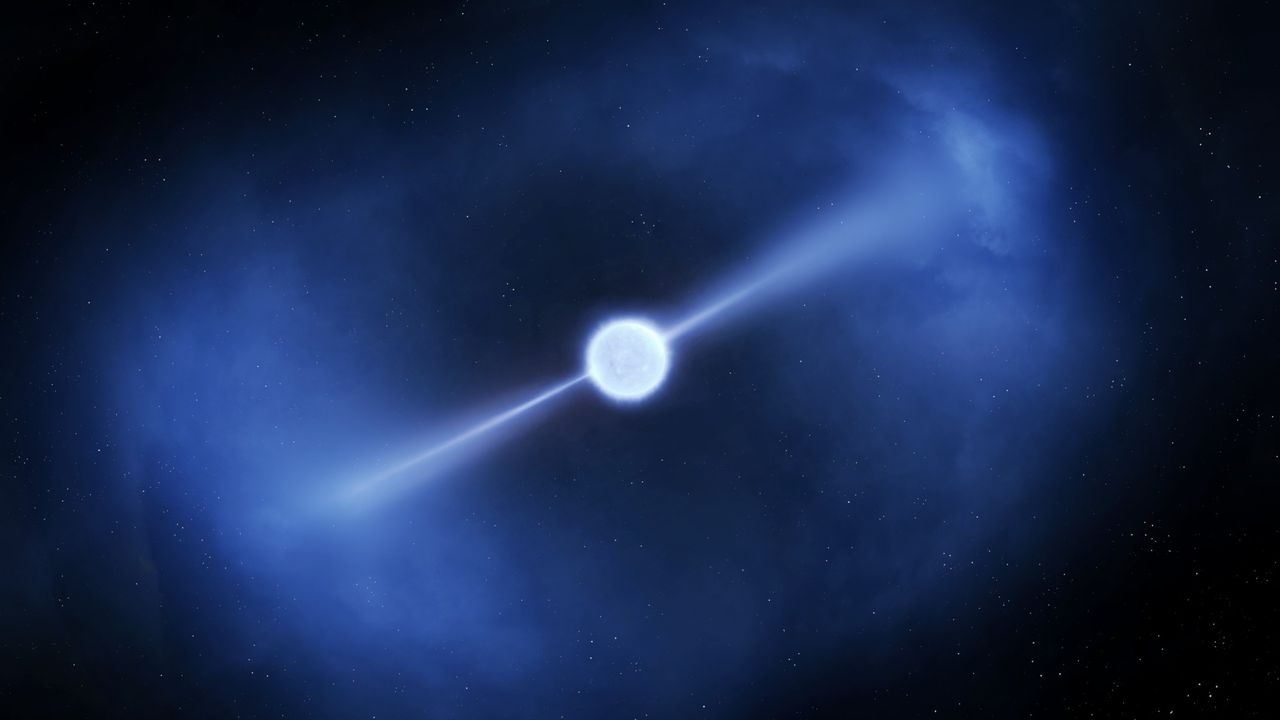
Silent neutron stars at the center of supernova blast sites may actually be whispering softly, following the detection of faint radio emissions coming from one such object for the first time. The discovery raises the prospect that there could be many more pulsars in our galaxy than we thought.
When a massive star explodes as a supernova, the devastation leads to the star's core collapsing under its own gravity to form either a neutron star or a black hole. When a neutron star is formed, it is born spinning and its magnetic field is usually powerful enough to whip up charged particles and beam them away in a jet moving at close to the speed of light. This jet emits radio waves, and as the neutron star spins we see this radio jet flashing in our direction. This makes it seem like the neutron star is pulsing, hence we call it a pulsar.