
Get all your news in one place.
100's of premium titles.
One app.
Start reading
Space
Space
Science
Robert Lea

Astronomers could use a synthetic cosmos to unravel dark matter mysteries

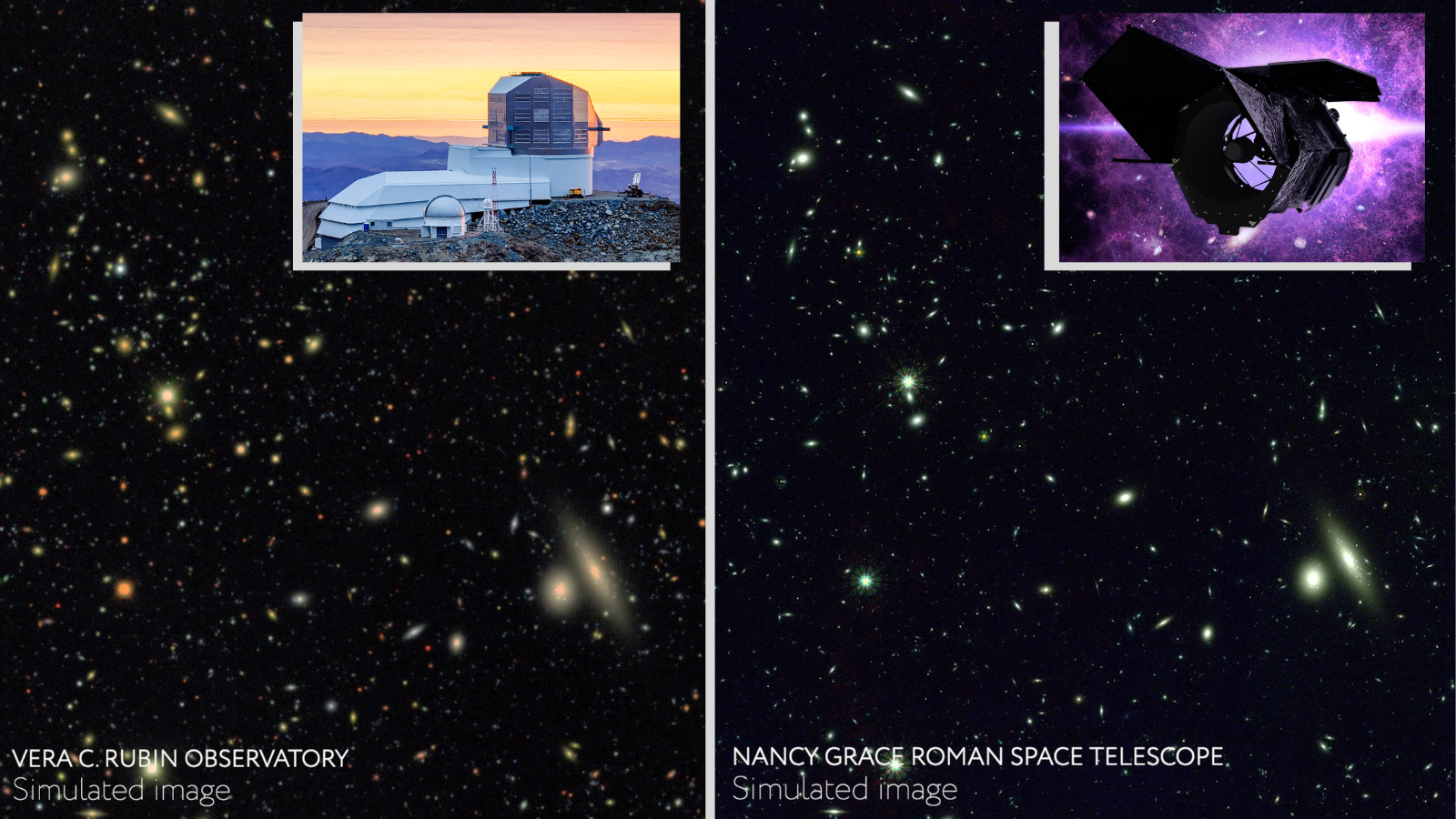
On the left side, the universe is seen through the Rubin Observatory's eyes. It's a bunch of glowing, yellowish stars and galaxies against a dark background. On the right is the universe through Roman's eyes, and it's a little more greenish looking. There are fewer speckles overall, technically.

Scientists have used supercomputers to create a "synthetic universe" that will help predict what the next generation of super-telescopes will see upon opening their eyes to the cosmos.

These telescopes will both be "dark universe" detectives in that they will investigate the two most pressing mysteries in cosmology: dark energy and dark matter, sometimes referred to collectively as the "dark universe." Notably, the news comes as the $10 billion James Webb Space Telescope (JWST) celebrates two years of delivering scientific results today, July 12. The JWST has had an immense impact on astronomy, with researchers still working to understand some of the surprising things it has seen.

Sign up to read this article
Read news from 100's of titles, curated specifically for you.
Already a member? Sign in here
Related Stories
Top stories on inkl right now
One subscription that gives you access to news from hundreds of sites
Already a member? Sign in here
Our Picks
Fourteen days free
Download the app
One app. One membership.
100+ trusted global sources.







