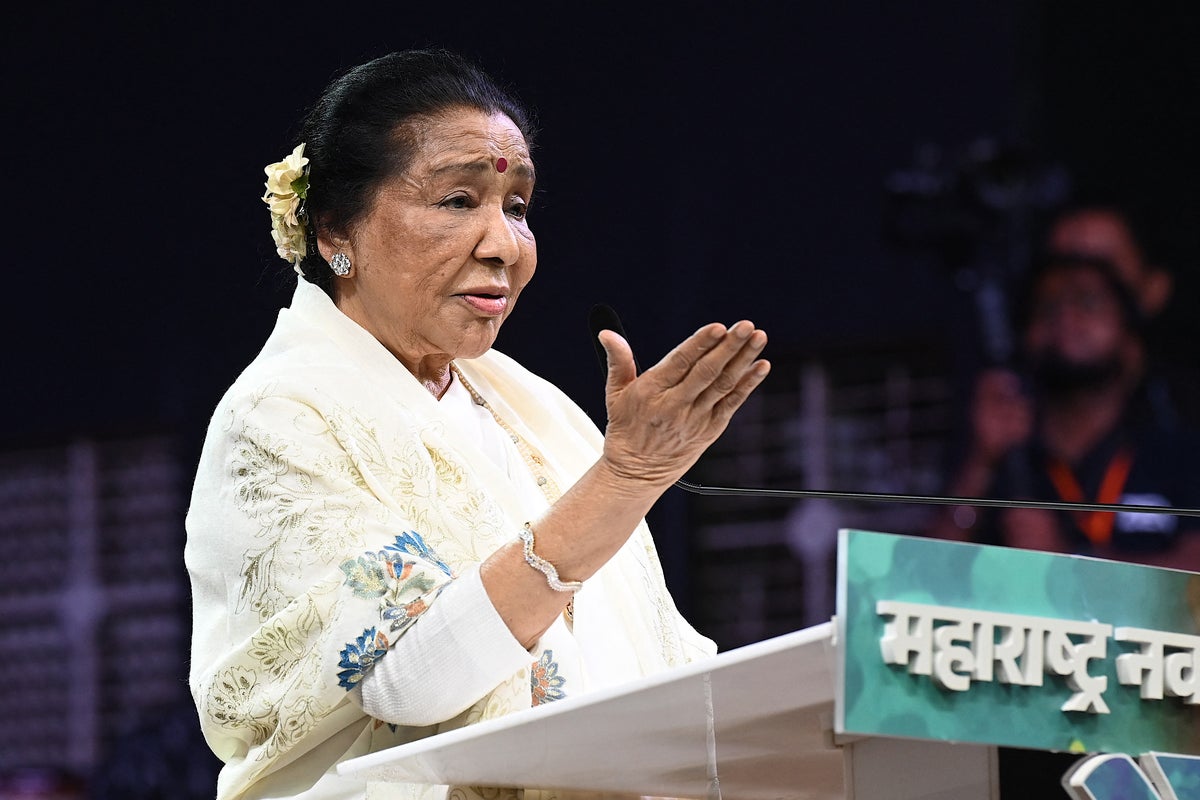
Asha Bhosle, a legendary singer who leant her voice to a generation of Bollywood movies and earned an unrivalled status in the playback industry, has died aged 92 following multiple organ failure.
She died in Mumbai on Sunday after being admitted to Breach Candy Hospital a day earlier. Her son Anand Bhosle confirmed her death to Indian media and said that members of the public would be able to pay their last respects at her residence from 11am on Monday.

Bhosle and her elder sister Lata Mangeshkar were the dominant female voices in the Hindi film industry spanning eight decades. Mangeshkar died in 2022, also at the age of 92.

The news has been met with an outpouring of emotion in India, where she was a household name and cultural icon. Indian prime minister Narendra Modi offered his condolences to the family, calling Bhosle “one of the most iconic and versatile voices India has ever known”.
Doctor Prateet Samdani, who was part of her medical team, said she had been suffering from multiple health complications and died of multi-organ failure.
Her granddaughter, the singer Zanai Bhosle, wrote on Instagram on Saturday that Bhosle had been admitted with “extreme exhaustion and a chest infection” and was undergoing treatment.
Bhosle’s career encompassed over 12,000 songs in more than 20 languages, which saw her awarded the Guinness World Record in 2011 as the most recorded artist in music history. She was honoured with some of India’s highest accolades, including the Padma Vibhushan, the country’s second-highest civilian honour awarded for exceptional and distinguished service, and the Dadasaheb Phalke Award, India’s highest honour in cinema, given for lifetime contribution to Indian film.
Her work spanned genres and included international collaborations with Boy George, Michael Stipe and even Australian cricketer Brett Lee.
She continued to work into her nineties, and featured on the track “The Shadowy Light” from the Gorillaz album The Mountain, released earlier this year.

Born Asha Mangeshkar on 8 September 1933, in Sangli in western India, she began singing as a child after her father, the classical musician Dinanath Mangeshkar, died in 1942, leaving the family in financial difficulty.
Her early years were marked by personal upheaval. At 16, she eloped with Ganpatrao Bhosle, a man two decades older, against her family’s wishes, telling Forbes India in 2011: “I always wanted to lead the life of a housewife, have kids, run a family”. However, her husband was “short-tempered” and the marriage soon turned physically abusive.
Deeply saddened by the passing of Asha Bhosle Ji, one of the most iconic and versatile voices India has ever known. Her extraordinary musical journey, spanning decades, enriched our cultural heritage and touched countless hearts across the world. Be it her soulful melodies or… pic.twitter.com/SbFrzf1Meu
— Narendra Modi (@narendramodi) April 12, 2026
She began working in films during this period, taking on small assignments before gaining recognition in the 1950s through her collaboration with the composer OP Nayyar. Songs such as “Ude Jab Jab Zulfein Teri” from Naya Daur (1957) helped establish her as a leading playback singer.
She separated from her husband in 1960 and continued her singing career, often working long hours and accepting modest fees, and said she chose playback singing largely for its financial stability.
It’s truly sad to learn about Asha Tai’s passing… her voice has been one of the pillars of Indian cinema and will continue to resonate world over for centuries to come. A talent that will outlive many, she always showered me with blessings and love and i will miss her. Rest in… pic.twitter.com/ISuOwuAzDj
— Shah Rukh Khan (@iamsrk) April 12, 2026
Conscious of comparisons with her elder sister, she deliberately reshaped her voice and repertoire. In a 2023 interview with India Today, she recalled how a producer once mistook Mangeshkar’s voice for hers, prompting her to rethink her artistic identity. “If I continue in a similar voice to didi (my sister), I will never get work as long as didi is in the business,” she said.
She went on to consciously develop a distinct style, training herself across genres including qawwali, ghazal, and Western music. “I wanted to be able to sing all kinds of songs,” she said, explaining how she began studying English films and music to expand her range.
Despite the comparisons, the sisters frequently collaborated, and she described a relationship shaped by both respect and a “healthy” competition.
स्थायी गायिका सखी जागो #AshaBhosle pic.twitter.com/i6jz4GOTBf
— Kamal Haasan (@ikamalhaasan) April 12, 2026
By the 1960s and 1970s, she had become one of the most sought-after voices in Hindi cinema, recording extensively with singers including Mohammed Rafi and Kishore Kumar. Her long association with the composer Rahul Dev Burman, whom she married in 1980, produced songs such as “Piya Tu Ab To Aaja,” “Dum Maro Dum,” and “Chura Liya Hai Tumne”.
Though they later separated, she remembered him fondly, recalling their musical collaboration as seamless: “I never had any difficulty tuning with him. I used to sing his songs very easily, but those who come now will find it difficult. They won’t be able to sing the songs that I have sung.”
Grew up listening to Asha ji… didn’t matter the mood, there was always a song of hers that fit it perfectly. So many memories, so many emotions tied to that voice. It feels like a part of our growing up has gone silent today.
— Yuvraj Singh (@YUVSTRONG12) April 12, 2026
Rest in peace Asha ji 🙏 My deepest condolences.… pic.twitter.com/tHFJeHrotF
Her versatility became her defining trait. She moved between styles, from cabaret numbers to classical-based ghazals such as “Dil Cheez Kya Hai” from Umrao Jaan (1981), which earned her a National Film Award. She won a second National Award in 1988 for “Mera Kuch Samaan” from Ijaazat.
Actor Shah Rukh Khan was among those from the Hindi film industry mourning her death on Sunday, writing on X: “Her voice has been one of the pillars of Indian cinema and will continue to resonate world over for centuries to come. A talent that will outlive many, she always showered me with blessings and love and i will miss her.”

Cricketer Sachin Tendulkar described it as a “deeply sad day for India, and for music lovers across the world. It feels as though time itself has paused. Yet through her eternal songs, she will remain timeless forever,” he said.
Composer Anu Malik told Screen: “Shattered on hearing this news. Saddened beyond words. She sang the very first song of my life in the year 1977. I called her my mother. I lost my mother in the year 2021. Now I feel I have lost my other once again. A great artiste with a heart of pure gold. She could sing any song — Rock, pop, Indian classical, ghazals. You name it, she has sung all genres of music. Truly the end of an era.”
Indian cities are seeing a Covid-style exodus of workers amid fuel crisis
India set to get first Iranian oil cargo delivery in seven years
India sentences nine police officers to death over Covid lockdown killings
India considers releasing crocodiles and venomous snakes along border with Bangladesh
Air India chief resigns 10 months after devastating Ahmedabad crash
Bangladesh’s foreign minister visits India in bid to mend strained ties