Get all your news in one place.
100's of premium titles.
One app.
Start reading
Barchart
Barchart
Pathikrit Bose

As Musk Teases Tesla-SpaceX Merger, Here's What Shareholders Should Expect

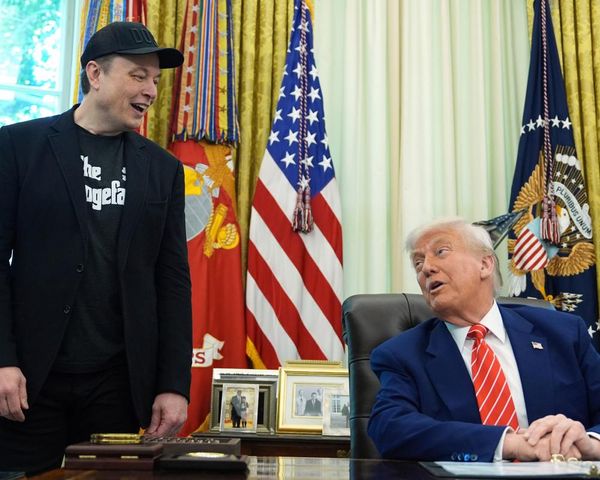
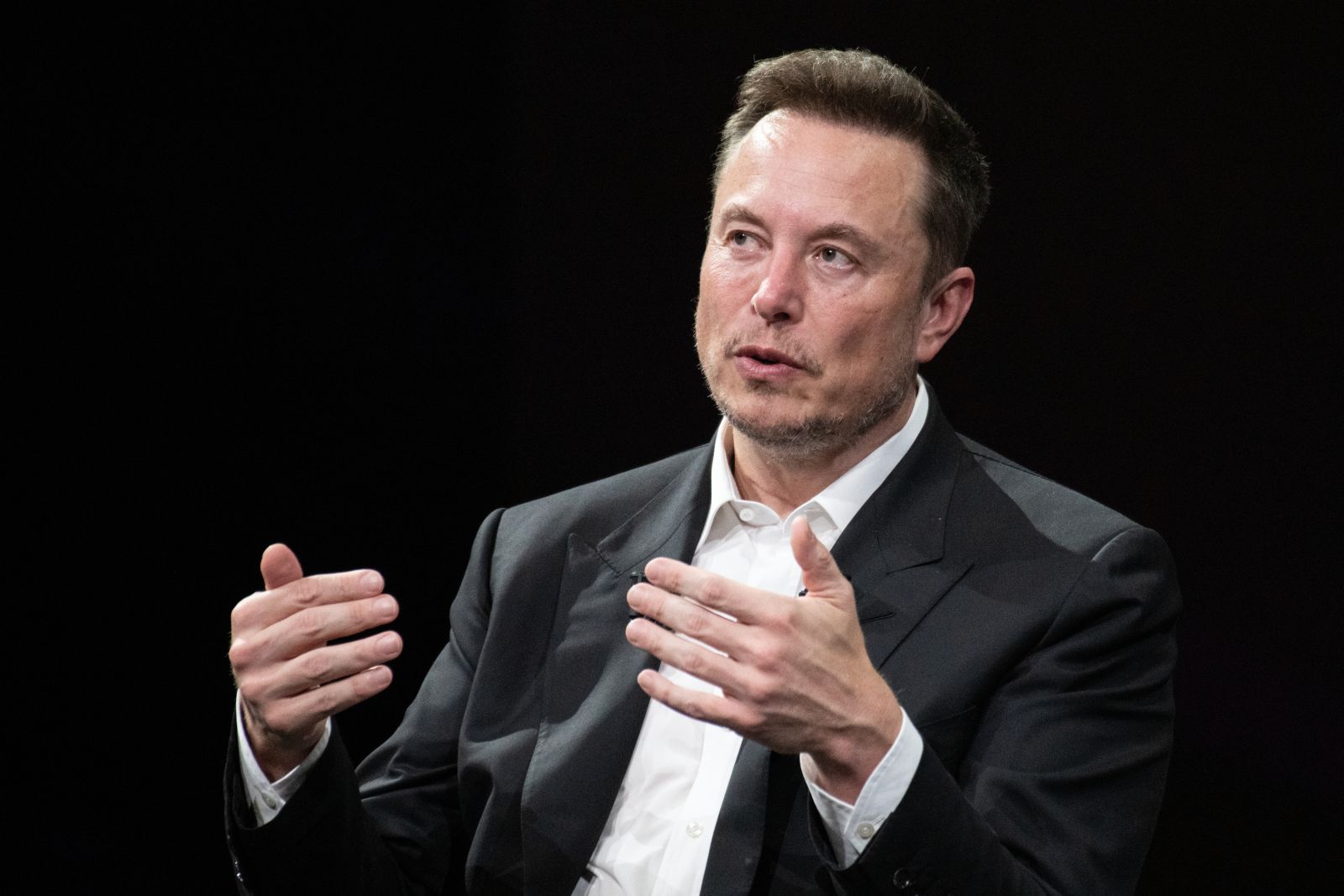
Tesla (TSLA) CEO Elon Musk may not have spelled it out explicitly, but his utterances in the company's latest earnings call gave enough hints that a merger between SpaceX (SPCX) and Tesla may be on the cards sooner rather than later. In response to a question on the subject, Musk responded, "As you can tell from the many collaborations on so many fronts with SpaceX, there's more and more overlap, especially with Terafab; that's really going to be a gigantic project. But obviously, we can't talk about combining companies and that kind of thing on an earnings call. It's got to be done with the appropriate process."

So, it's just that the forum was not appropriate and maybe not grand enough for such a huge announcement from Musk.
Prediction markets are abuzz on the matter as well. Kalshi, the prediction market platform, expects that there is a 50% chance that the merger will be done before May 1, 2027. Some analysts reckon that the chances are even higher. While Gene Munster of Deepwater Asset Management says there is a 90% chance of the merger within the next two years, Tesla and SpaceX bull Dan Ives is even more aggressive with the timeline, predicting that there is an 80% chance of the merger happening in the next year.

Thus, it is increasingly becoming a matter of “when,” not “if.” However, zooming out, what does it mean on a broader basis, and how can a combined company look? Let's try and find out.

Synergies, Control, and Value

It does not matter if you are a corporate disruptor like Elon Musk. Some things do not change. Like the rationale given for synergies when two companies become one. Musk is making the same case here, and there is some merit to it.

Tesla has an established EV and energy storage business, with the upcoming Optimus humanoid robots as another source of value unlock for the company and the revival of the Dojo Supercomputer as a trump card. On the other hand, SpaceX has its flagship Starlink satellite broadband business, its rocket launch services, and its space operations business, along with a nascent AI infrastructure business and xAI, which it acquired in an all-stock merger earlier this year, bringing social media platform X, formerly Twitter, and the generative AI tool Grok into its fold.

Thus, the case for synergies has the potential to work. For instance, automotive gross margins at Tesla have been dwindling. With Terafab, the giant semiconductor fab that Musk is building in Texas can supply chips to the cars to bring the cost of goods down and aid margins. Further, Starlink is already being built into the Cybercab, and Musk wants it in every vehicle in Starlink markets, arguing robotaxis need coverage everywhere to avoid dead zones. For a fleet sans drivers, connectivity is a non-negotiable, and getting it from a company operating under the same stable will certainly be expected to be cheaper than from a third party.

Then comes xAI. Grok is being folded into Tesla vehicles and, per Musk, into digital Optimus, so the humanoid gets a far stronger language and reasoning brain than Tesla could build alone.

However, no matter the engineering synergies, these can be worked out through partnerships and collaborations between the companies without a merger.

The strongest motivation for a merger for Musk may be control.

At SpaceX, Musk owns roughly 42% of the economics but controls about 82.4% of the voting power through Class B super voting shares that carry ten votes apiece, and he holds around 93.6% of that Class B stock. Even after the IPO diluted things, his voting control stays substantial. However, in Tesla, Musk holds only about 20% voting control, which is why he spent years pressuring the board, at one point reportedly threatening to leave, before shareholders granted him that enormous compensation package, making the asymmetry stark.

Hence, a merger structured near SpaceX's roughly $1.75 trillion valuation against Tesla's market cap around $1.6 trillion would let Musk carry his super voting structure into the combined entity, tightening his grip on Tesla's assets in a way he has never had.

Tesla's Q2 Numbers Not Liked by the Street

Having said that, the merger is a development that is for the future. Currently, TSLA stock was hammered following its Q2 2026 numbers. After yesterday's selloff of 14.5%, TSLA is down 30% this year.

www.barchart.com

Tesla reported revenue of $28.2 billion for the second quarter, marking a 26% increase from the year-earlier period and exceeding expectations by more than $2.5 billion. The core automotive segment advanced 23% to $20.5 billion, while services revenue grew 50% to $4.6 billion, and the energy business rose 13% to $3.1 billion.

Earnings per share declined 18% to $0.33, falling short of the consensus estimate of $0.53 and representing the fifth miss in the last nine quarters. Gross margins contracted slightly to 16.8% from 17.2% in the prior year period. Operating expenses rose to $4.3 billion from $2.9 billion, driven largely by a 49.2% increase in research and development spending, which may yield benefits in coming periods.

Net cash from operating activities reached $4.7 billion for the quarter, reflecting an 85% improvement from the previous year. However, free cash flow turned negative at $1.1 billion, a point of attention given the chief financial officer's confirmation of capital expenditures exceeding $25 billion for 2026. The company closed the quarter with $43.5 billion in cash, well above its short-term debt balance of $1.4 billion.

Vehicle deliveries totaled 480,126 units, up 25% year-over-year (YoY) and ahead of the consensus forecast of 406,000. Production increased 10% to 451,758 vehicles. Energy deployment grew to 13.5 gigawatt hours from 9.6 gigawatt hours in the year-ago quarter. Full Self-Driving subscriptions rose 56% to 1.48 million. Supercharger stations expanded 18% to 8,704, while connectors increased 17% to 82,357.

Despite these operational metrics, TSLA continues to trade at premium valuations. The forward P/E ratio of 283.21 times, P/S multiple of 14.81 times, and P/CF multiple of 142.28 times all remain substantially above the respective sector medians of 15.98 times, 0.90 times, and 10.51 times.

Analyst Opinion on SPCX and TSLA Stocks

Overall, analysts remain cautiously optimistic about TSLA stock, attributing to it a rating of “Moderate Buy” with a mean target price of $418.06. This denotes a potential upside of about 35% from current levels. Out of 43 analysts covering the stock, 15 have a “Strong Buy” rating, two have a “Moderate Buy” rating, 21 have a “Hold” rating, and five have a “Strong Sell” rating.

www.barchart.com

And for SPCX, analysts have assigned a rating of “Moderate Buy” as well. The mean target price of $231.83 denotes a potential upside of 105%. Out of 33 analysts covering the stock, 22 have a “Strong Buy” rating, two have a “Moderate Buy” rating, eight have a “Hold” rating, and one has a “Moderate Sell” rating.

www.barchart.com
Sign up to read this article
Read news from 100's of titles, curated specifically for you.
Already a member? Sign in here
Related Stories
Top stories on inkl right now
One subscription that gives you access to news from hundreds of sites
Already a member? Sign in here
Our Picks
Fourteen days free
Download the app
One app. One membership.
100+ trusted global sources.