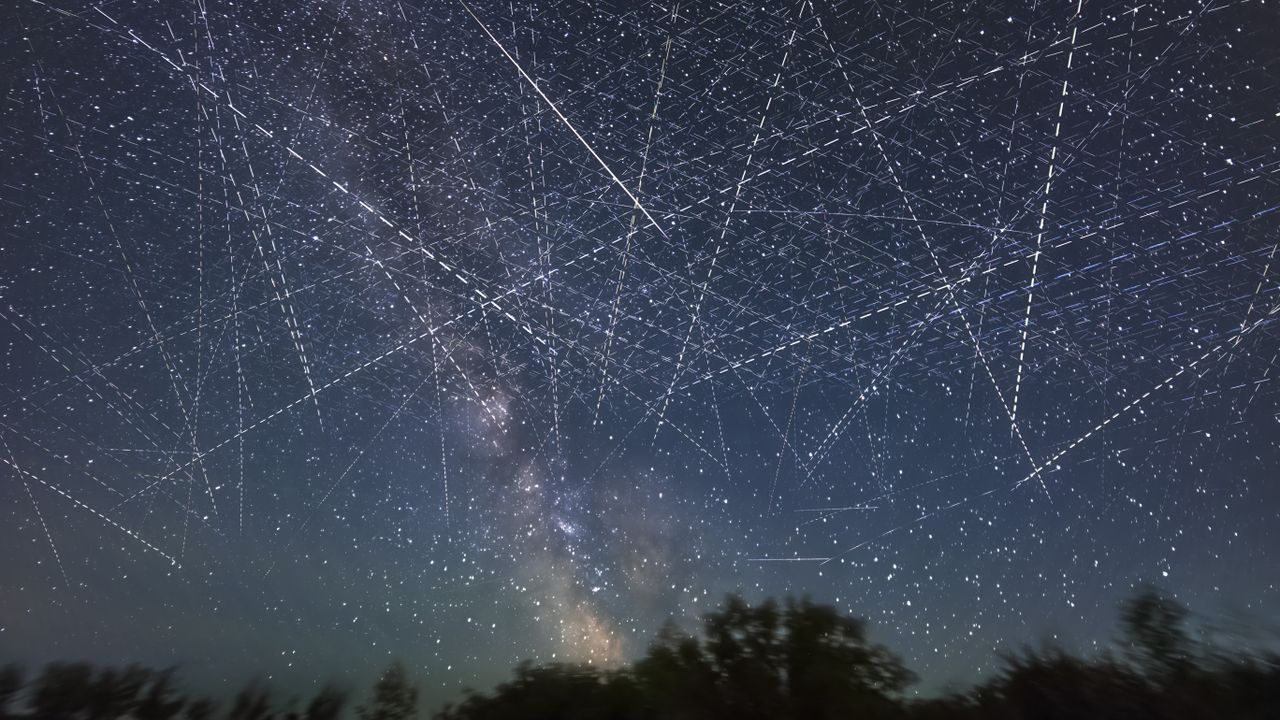
As a hobbyist astrophotographer, this photograph is breaking my heart. Composite image graphically illustrates the growing number of satellites creating light pollution in the night sky
This depicts the satellite-filled sky that is now a reality and getting more crowded every week! This adds together exposures taken over just 30 minutes on an early June night when, from my latitude of 51° N satellites even in low Earth orbit are lit all night by sunlight. Many of the parallel streaks heading generally horizontal west to east (right to left) may be from groups of SpaceX Starlinks. Others traveling vertically north-south are more likely from Earth observation satellites. There is at least one natural streak in the image — a meteor at centre, caught by chance on one frame. It appears as a colored and tapered streak. Other uniform undashed streaks may be from high-altitude satellites moving much more slowly. By comparison, most satellites appear as dashed lines because the image is a blend of many 2-second-long exposures with a gap of one second between exposures when the camera shutter was closed. So the motion of the satellites and image stacking turns them into dashes. The longer the dashes, the faster the satellite is traveling, with the fastest satellites being the lowest. This is looking due south and all the trails disappear low in the south above the trees, as that's where the Earth's shadow is, even on this June night. So the satellites aren't lit when they are in that small part of the sky. They emerge from the shadow heading north and disappear into the shadow heading south. The shadow creates the obvious boundary of where satellite trails are visible. At other times of the year low-orbit satellites are visible only after sunset or before sunrise, especially from lower latitudes. But not near summer solstice, and from higher latitudes. The field of view is about 100° by 75°. (Photo by: Alan Dyer/VWPics/Universal Images Group via Getty Images).
I’ve always found a fascination with the night sky – there’s something incredibly calming about standing under the stars with a camera. But a growing number of points of light that I see in the sky aren’t even stars at all, which is why this photo grabbed my attention.
Alan Dyer captured this photograph last summer to illustrate how many satellites cross the night sky in a 30-minute time span. The image is a composite, which means that the photographer left his camera shooting for about 30 minutes and blended all the light trails together, so unlike a typical astrophotography shot that’s only a few seconds long, Dyer’s photo represents 30 minutes of the night sky.
Sign up to read this article
Read news from 100's of titles, curated specifically for you.