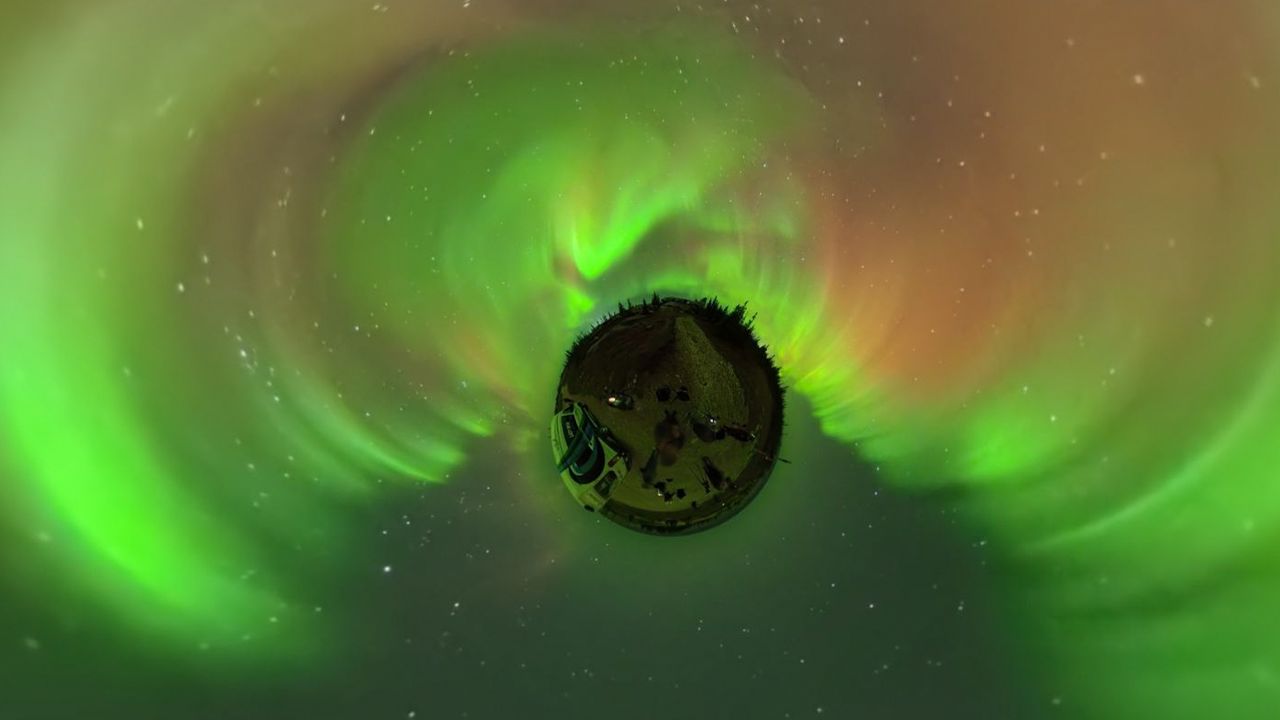
Can 360-degree cameras be used in the dark to image the night sky? Astrophotographers have been using circular fisheye lenses to capture the Milky Way for decades, while astronomers regularly employ 180-degree (whole-sky) lenses to image fleeting “shooting stars” and, in the case of the Swedish Institute of Space Physics (IRF), produce an all-night timelapse of auroras (see this example). Whether consumer 360 cameras — essentially two 180-degree fisheyes mounted back-to-back — are capable of true astrophotography is another matter.
In 2025, two key models appeared with improved low-light potential: the Insta360 X5 and GoPro Max 2. Both claim 8K resolution and AI-assisted noise reduction. With the GoPro Max 2 unavailable at the time, I took the X5 to Churchill, Manitoba, to see how it performed under the Canadian Northern Lights.