Archaeologists in Germany’s Bavaria have unearthed an elaborately constructed but empty circular stone grave they suspect to be an “extremely rare” Roman-era burial mound.
The stone circle was uncovered during construction work next to an old Roman road in the town of Eichstätt, researchers said.
Further excavations revealed a “particularly remarkable” 12m-wide circular structure with carefully fitted stones, indicating it was indeed a Roman burial mound or tumulus, a type that has rarely been documented in this ancient province.
The contents of the burial mound, which archaeologists described as “yawning emptiness”, also raised questions.
Since there were no signs of skeletons or grave goods inside the structure, they assumed this could have been a symbolic grave or cenotaph built as a memorial tomb to commemorate a person buried elsewhere.
"The tomb was both a place of remembrance and an expression of social status... We hadn't expected to discover a funerary monument of this age and size here,” said Mathias Pfeil, curator general of the Bavarian State Office for Monument Preservation.
“Although several Roman burial sites are known from the Augsburg region (of Germany), tumuli with stone ring walls of this scale are extremely rare in the former province of Raetia,” researchers wrote in a translated statement, referring to a province of the Roman Empire.
Central Europe and Italy already had a long tradition of such burial mounds. In the northwestern provinces of the ancient Roman empire, including parts of modern-day Germany, they appear from the first century AD onwards, archaeologists say.
Previously discovered burial mounds in and around this region of Europe usually date to the older Bronze and Iron Ages.
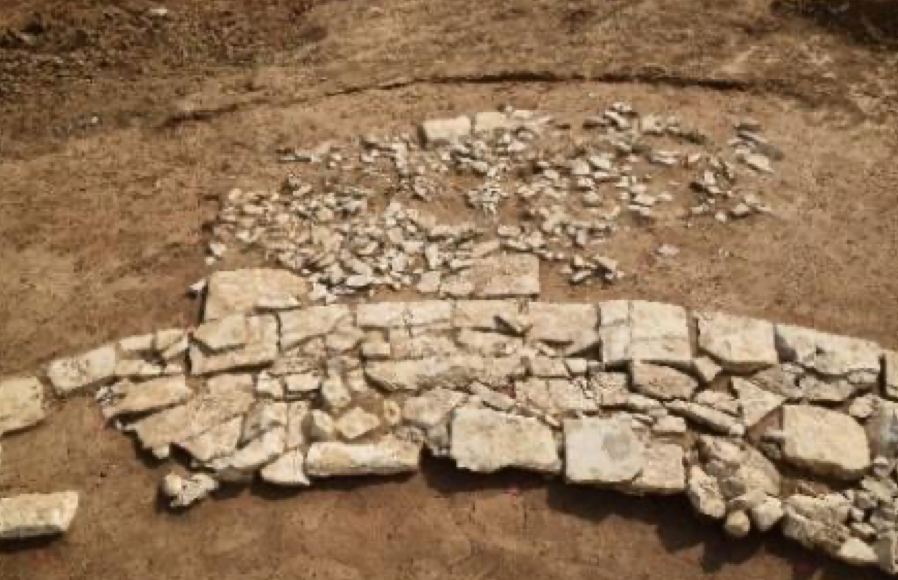
However, the kind of stone base walls seen in the latest excavation seems to follow later Mediterranean models.
Based on these findings, researchers suspect that it could point to a deliberate revival of pre-Roman, especially Celtic, burial customs.
The burial mound’s location directly beside an already known Roman-era road leading from Nassenfels into the Altmühl Valley, as well as its proximity to a Roman country estate, supports this interpretation, experts say.
“The Roman tomb of Wolkertshofen is therefore of special importance for future research on Roman life in Bavaria,” researchers write.