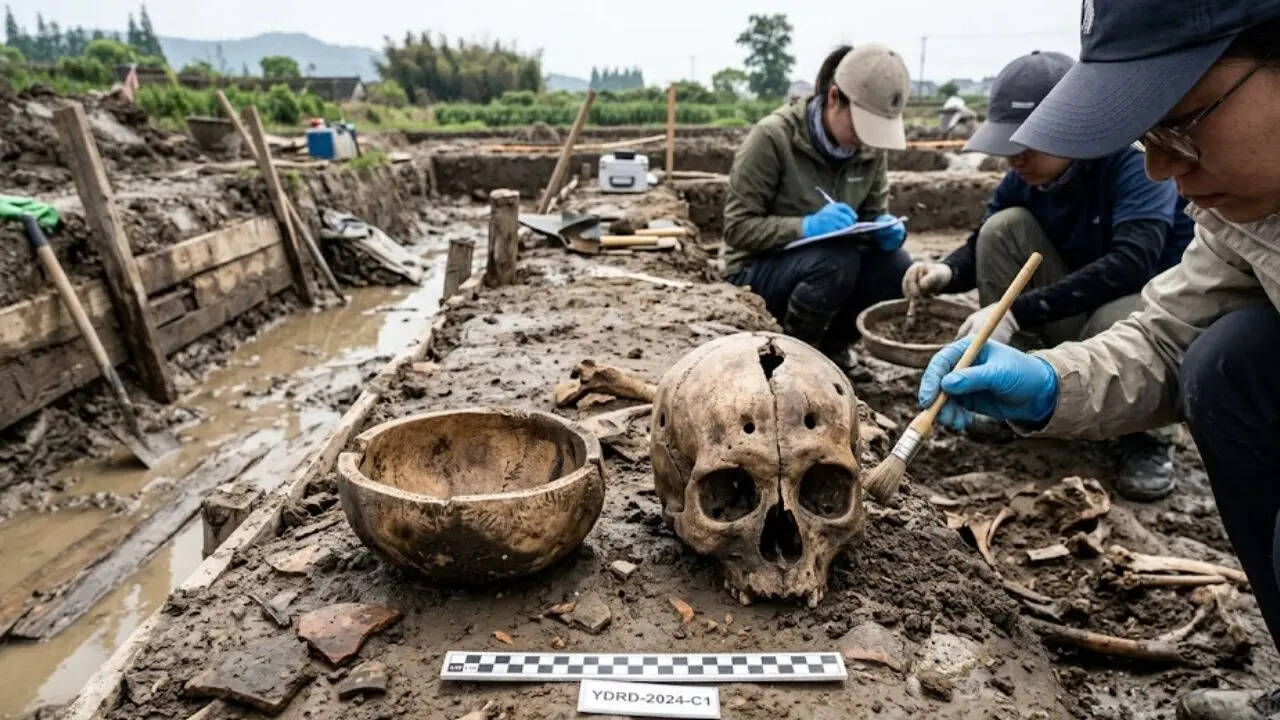
Recent archaeological excavations in the Yangtze River Delta, China, have revealed the complex socio-cultural practices of the Neolithic Liangzhu civilisation, dating back about 5000 years. Using remains from the Zhongjiagang site, researchers have found that human bones were routinely used as a source of functional and ritualistic objects like ‘skull cups’ and ‘skeleton masks’. Unlike typical burials, where the dead were given respect, these bones were found deposited in urban canals, suggesting that there was a major change in how early urban dwellers viewed human remains.
The results of this study, published in Scientific Reports, demonstrate that as Liangzhu grew to become urban, remains became a ‘raw material’ for functional uses, and symbolic craft items, rather than being viewed as the remains of sacred ancestors. This shift highlights a profound cultural transformation, where the pragmatism of burgeoning city life seemingly outweighed traditional ancestral reverence within this sophisticated ancient riverine society.