
Get all your news in one place.
100’s of premium titles.
One app.
Start reading
Digital Camera World
Adam Juniper

APS was the glory standard, and everything was luxe – now when I hear the term it's just negging from the 'full frame' brigade!

APS Jessops box.

When I started clearing my loft, I discovered a box of old photos in APS format. No, I don't mean they were taken with a camera with an APS-C-sized sensor. I mean that they were taken on an APS camera. Onto APS film.

It struck me that some folk might not remember the last hurrah of the film era, because it never really got close to unseating 35mm before digital cameras came along and did that instead. Now we remember APS and its three different sizes more through reference to image sensor size than we do the film itself.

That size – as well as its timing – was definitely an Achilles heel. But there were more than a few bits of brilliance about it, and one of them was very visible in my old box. That is just how well the photography developers treated APS camera consumers. Well, at least at first. I'll explain what I mean in a moment, but first a quick reminder of what APS was all about.

The APS film canister with it's four positions – this is developed so the rectangle, 4, is colored in white. (Image credit: Future)

APS was launched in 1996 by all the big names in photography, including Kodak, Fujifilm, Canon, Minolta, and Nikon, and the idea was to make photography easier; film went inside a cartridge that was a little smaller than a 35mm canister, and had markers at one end to indicate whether the film was new, part exposed, exposed, or exposed and developed. Pretty nifty.

Even better, the film also had a magnetic strip to record data on. This wasn't quite the beginning of the metadata era, as some cameras could already expose the date & time (in LCD-like patterns) onto the front of pictures. This, however, was a more technically elegant solution – it allowed the processing lab to print stuff on the back without spoiling the shot. Far nicer for consumers.

The frame could also contain cropping data – Should it be the standard APS-HD, or cropped at the sides to 'Classic' 3:2 shape (APS-C)', or 'Panoramic'? The upshot? Massive boxes of different sizes of prints. Pretty cool, though this is where the system starts to fall down a bit too, because especially the panoramic mode really, er, exposes the problem of film resolution.

How luxe is this Jessops box compared to a normal envelope? (Image credit: Future)

At this point, consumer cameras were doing a pretty good job of making 35mm film reasonably easy to use, and it had a frame size of 36x24mm. APS-HD (the biggest) was 30.2x16.7mm – that's quite the 'crop factor'. The point was to allow for smaller consumer cameras – I had a Canon IXUS, which (and you don't hear this in marketing terms a lot these days) was "Smaller than a cigarette packet."

This wasn't unheard of in consumer cameras before either – 110mm cartridge cameras existed before and I remember that my grandmother proudly used one. I also remember that, back on the old film stock, the results were pretty dreadful. Mind you that's far enough back that flash cubes were disposable items; film had got better – but of course those improvements were also evident in the bigger 35mm. As the 'full frame' brigade will cheerfully point out, a larger film area or sensor does have its advantages.

Nonetheless, a compact camera I could shove in my backpack when I went travelling around Europe as a student in the late 1990s, or document my student days with did help keep the idea of photography alive in me before it was something a phone might want to do (my first cell phone, in 1997, did not have a camera!)

Even the side of the Jessops box helped create the 'hardback book' feel. (Image credit: Future)

What were you saying about luxe?

So, yeah, when I took my film to be developed at Jessops, a high street photography store in the UK, I would be treated to a pretty generic envelope for a 35mm film, with the developed negatives tucked in a pocket at the front. Meh. But when I took my first APS film things were very much more impressive.

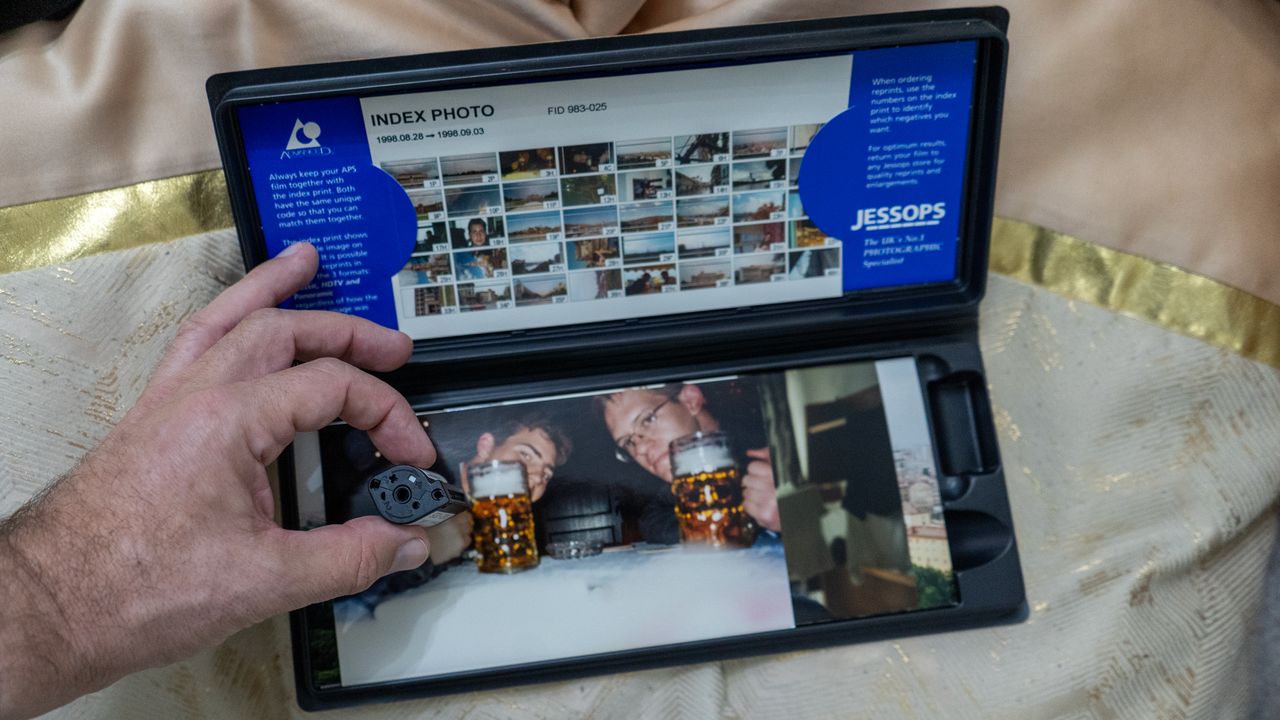
I found myself with a massive case containing the full 40 exposures (APS films came in 15, 25, or 40). It has to be long enough to accommodate the panoramic prints which, as I've mentioned, my camera allowed me to choose with a switch on the back and then noted the request on the film for the developer. It felt like a big step up from 35mm, and (at first) I didn't really understand why they looked so grainy in comparison. The innocence of youth, eh?

The whole case, which felt like a glossy hardcover book, had Jessops and the APS logo in gold foil on, and plastic inside with a recess for the film canister. It was "So extra!" as some younger folks I know might put it, by comparison, but it was also a clever solution to the problem developers faced – they couldn't just smash open the canister any more and return film because the cartridge was meant to remain sealed forever.

Index photo, all the prints of different sizes, and the film cartridge in the classy box. (Image credit: Future)

Over time, had digital not caught up anyway, there might have been issues with that. The film cartridges were a bit thicker than developed negatives. Certainly, I remember some developers opted for less impressive solutions – boxes with trays and the like.

But I'll always remember those early boxes because they made me feel like royalty when picking up photo prints, and it took me quite a while to realise that APS might not actually be a photographer's dream, more of a clever bit of consumer tech. The format came out at more or less the same time as early digital cameras so, in truth, it never really had long to live – but those amazing high-quality Jessops boxes? They kept my prints in perfect condition for more than a quarter of a century.

You might also like

Check our guide to the best photo albums or read I designed 16 photo albums to find the best.

Sign up to read this article
Read news from 100’s of titles, curated specifically for you.
Already a member? Sign in here
Related Stories
Top stories on inkl right now
One subscription that gives you access to news from hundreds of sites
Already a member? Sign in here
Our Picks
Fourteen days free
Download the app
One app. One membership.
100+ trusted global sources.