
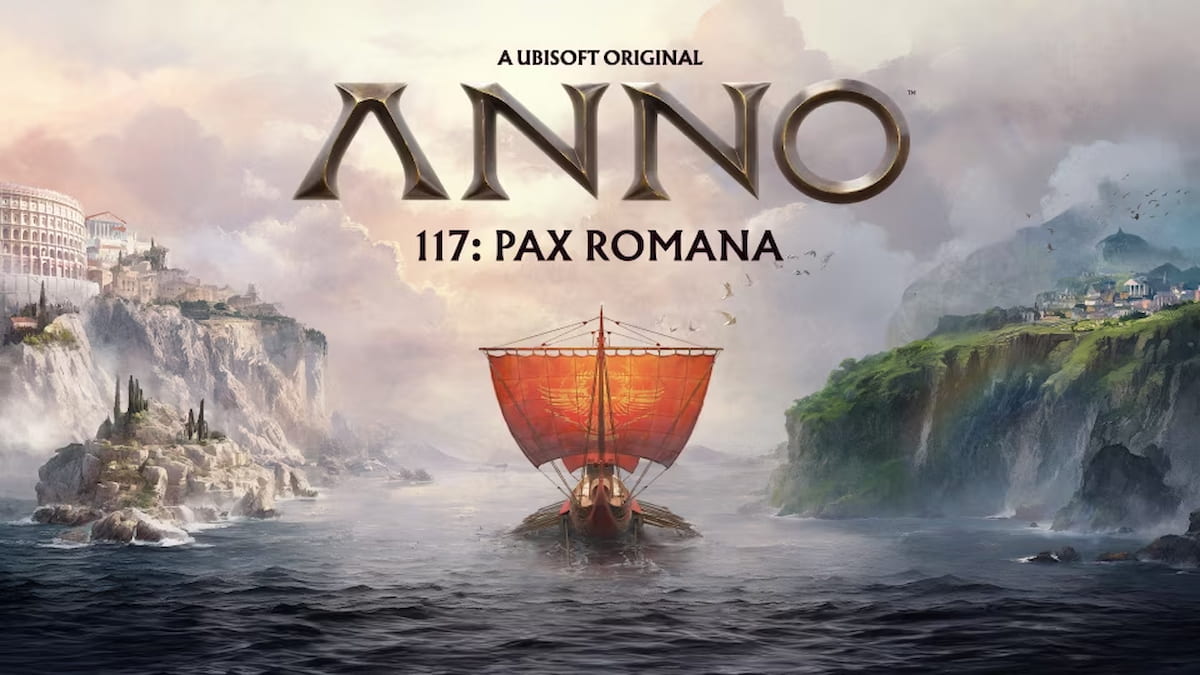
The latest mainline entry to the series, Anno 117: Pax Romana is coming in hot, rewinding the clock some 1700 years earlier than its predecessor and taking us into the semi-mythical lands of Ancient Rome.
It builds on the formula perfected by Anno 1800, arguably the best title in the series, and does not fall far from the tree. All the recognizable and established gameplay elements are there, with some improvements and simplifications to make the early and mid games more bearable, alongside the massive jump into the past that lends itself beautifully to a unique and different style of city building.

Anno 117 is a major achievement for Ubisoft Mainz, and will be played for many years on, much like its older brothers.
Here is our full review.
Ave Caesar!

Anno 117: Pax Romana takes place in a semi-fictional Roman Empire where you are granted governorship of two up-and-coming provinces, Albion and Latium. One is on the fringe of the Empire, now at the peak of its power, whereas the other lies at its very heart of Europe's boot.
Their geographical disparity is reflected in their cultures, as Anno 117 allows you to construct Celtic, Roman, or Celto-Roman settlements and cities, either sticking to the traditions of the land or mixing together the cultures to form something entirely new.
This level of dynamism and player agency is a direct upgrade over Anno 1800, which did not offer a choice of national and cultural heritage, and adds to the level of replayability and variance between each settlement. Some of your Albionic islands might be true to nature and adhere to the Druidic ways, while a spell of sea away lies a proper Roman theater where dramas unfold on a grand stage enshrouded by the scent of olives and wine.
Romans are fond of cheese and beer as well, so another town might be comprised of both Romans and Celts, living side-by-side in a more hopeful universe, as such intermingling in the region was rarer than a diamond in our war-torn history.

A duality appears in the campaign, too, where you can play as either Marcia, married to a governor but met with a dramatic turn of events, or Marcus, a man awarded unexpected governorship and set down a strange path. This reflects Ubisoft's striving towards providing both a male and a female main character, much like how several Assassin's Creed games did.
It's good to have choices, and I wholeheartedly welcome this approach.
The story isn't all that great, however, but it does follow a proper narrative thread with generally fleshed out characters and stories that are oftentimes intriguing. Marcia's story in particular deals with some fairly serious themes, while the overall narrative has lots of twists, great cutscenes, and interesting characters that drive the plot forward, even if it isn't the main part of the game.
I never cared for the story in Anno or similar games, but it's still an option for those who want to learn the ropes before hopping into the actual game, i.e., the sandbox mode.
It is Anno - and that means comfort

The gameplay itself is much of what you'd expect from Anno: you are given a starting island, some money, and a dream to turn the wildlands into an urban center of culture and trade. You progress through various population types by fulfilling their needs, producing the goods they want, and keeping them satisfied.
You also get two full provinces to play with in the sandbox, each with its own set of rivals and islands, as well as unique products.
Other rival nations are doing the same, which could lead to diplomacy and trade, or outright war and conflict.
Nothing in Anno 117 is drastically different from 1800 or other games in the series, as Ubisoft Mainz has sought to remain faithful to the formula and only alter some production pipelines, allowing resources to be more easily accessed by your island. Additionally, there are no dramatic upticks in population decline or financial crashes, which in Anno 1800 could end an entire run in minutes.
Making money is much easier, keeping the pops happy is also streamlined, and the progression is much smoother and more direct, if not faster than in 1800. This is a good way to make the game more approachable for newcomers and allows for better city building rather than economy management, the latter never really being part of the Anno experience.
You can build amazing things in this game, which is in no small part elevated by the sensational assets that are some of the best in franchise history. From aqueducts to theaters to colosseums, the buildings look phenomenal and give a sense of grandiosity to your settlements, unlike most other constructions in the series.
I would even go as far as to argue that you can make the prettiest cities in Anno history, and I cannot wait to see what people way more creative than little ol' me come up with.

One major bone to pick that I had with Anno 117 is that fertility in islands is often so scarce that searching for additional ones (which often end up being unbearably expensive) is more annoying than fun. Sure, looking for a proximal island or two to exploit for, say, Herbs is all fun and games, but if you have to do it for just about every need from the second tier onward, it does become a chore.
Additionally, some resources can only be produced in a particular province, meaning you have no way of obtaining them in the other provinces except for exporting. Setting up shop in a whole other place is jarring to say the least, and is a lot of effort for something so trivial.
I didn't find this to be so fun, but it did make sense and gave me a purpose to expand my influence across the provinces. It wasn't so far removed from exactly the same mechanic as other Anno games either, so I guess it's fine.
Overall, Anno 117 is Anno in more than just its name, and you will feel right at home if you're coming to it after 1800, 1404, or others. It's a good game with great mechanics taken from its predecessors that haven't aged a bit, and you can expect to find an awesome experience that is only bound to get better as Ubisoft inevitably expands it with more content and DLCs.
The post Anno 117 Review – When in Rome appeared first on Destructoid.