Get all your news in one place.
100's of premium titles.
One app.
Start reading
The Economic Times
The Economic Times

Ancient Egyptian crocodile mummies reveal surprising secret about a lost species worshipped over 2,000 years ago

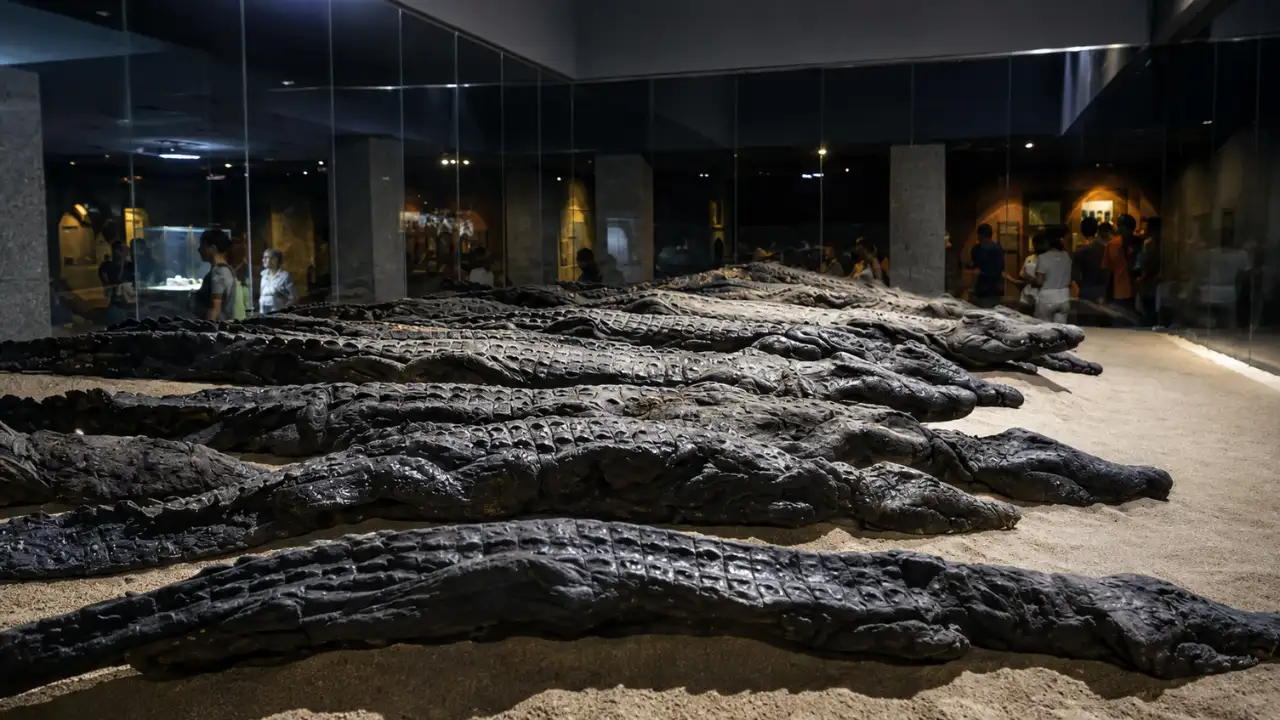
For more than 2,000 years, Egypt's Temple of Kom Ombo was one of the most important centers of crocodile worship. Dedicated to Sobek—the crocodile-headed god associated with the Nile, fertility and royal power—the temple received hundreds of mummified crocodiles as sacred offerings. Now, modern DNA testing and advanced imaging are uncovering remarkable secrets hidden inside these ancient reptiles.

Archaeologists have discovered hundreds of crocodile mummies at Kom Ombo, from hatchlings to fully grown adults. For decades, researchers debated whether these animals were raised specifically for religious rituals or captured from the wild. Two recent scientific studies have now provided surprising answers.

DNA reveals a forgotten crocodile species

A study published in the Journal of Archaeological Science: Reports analyzed DNA from an adult crocodile mummy recovered at Kom Ombo. Instead of belonging to the familiar Nile crocodile ( Crocodylus niloticus ), the animal was identified as the West African crocodile (Crocodylus suchus) .

The discovery suggests this lesser-known species played a much larger role in ancient Egyptian religion than previously believed.

Researchers, including Evon R. Hekkala, say the findings support centuries-old observations. Greek historian Herodotus described different kinds of crocodiles in Egypt, while French zoologist Étienne Geoffroy Saint-Hilaire proposed in 1807 that multiple crocodile species once lived along the Nile. The new genetic evidence strengthens those claims and indicates that Crocodylus suchus once inhabited ancient Egypt before disappearing from the region, likely due to environmental changes and the gradual drying of the Sahara.

Wild crocodiles were hunted for sacred rituals

Another study, titled Wild Crocodiles Hunted to Make Mummies in Roman Egypt: Evidence from Synchrotron Imaging , examined a separate crocodile mummy using high-resolution imaging technology.

Scientists found injuries and preserved stomach contents showing the animal had lived freely in the wild before being killed and mummified. The evidence suggests that at least some crocodiles offered to Sobek were hunted from their natural habitats rather than bred in temple enclosures.

The findings point to more diverse religious practices than researchers had previously assumed.

Ancient mummies are rewriting Egypt's natural history

The crocodile cemeteries surrounding Kom Ombo are proving to be much more than archaeological treasures. They also preserve valuable biological evidence from an ecosystem that has changed dramatically over thousands of years.

By combining archaeology, ancient DNA analysis and advanced imaging, scientists are reconstructing how ancient Egyptians interacted with the Nile's wildlife. These mummified reptiles are helping researchers trace the distribution of crocodile species, understand environmental shifts across North Africa, and uncover how religion and nature were deeply intertwined in one of history's greatest civilizations.

More than two millennia after they were buried as sacred offerings, the crocodiles of Kom Ombo continue to reveal extraordinary insights into ancient Egypt's faith, biodiversity and changing landscape.

Sign up to read this article
Read news from 100's of titles, curated specifically for you.
Already a member? Sign in here
Related Stories
Top stories on inkl right now
One subscription that gives you access to news from hundreds of sites
Already a member? Sign in here
Our Picks
Fourteen days free
Download the app
One app. One membership.
100+ trusted global sources.