
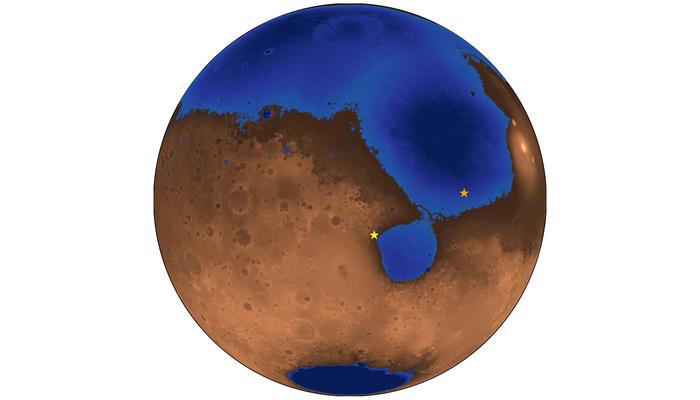
Today, Mars is a chilly desert of rock and dust — but 4 billion years ago, the planet had rivers, lakes and even oceans with sandy beaches. Data from China's Zhurong rover recently revealed the first evidence of one of those long-lost Mars beaches, finding shallow sandy slopes perfectly preserved about 33 feet (10 meters) beneath the Martian surface. Ground-penetrating radar aboard the rover measured thick layers of sand, sloping gently upward toward the rocky shore, as if washed up by ocean waves.
"The structures don't look like sand dunes. They don't look like an impact crater. They don't look like lava flows. That's when we started thinking about oceans," Michael Manga, a University of California, Berkeley, professor of earth and planetary science and co-author of the study, said in a statement. "The orientation of these features are parallel to what the old shoreline would have been. They have both the right orientation and the right slope to support the idea that there was an ocean for a long period of time to accumulate the sand-like beach."














