Image Credit: Pexels
A new analysis found that long lines, high prices and poor service are driving grocery complaints in several U.S. cities.
The worst grocery trips are rarely caused by one thing.
A long checkout line is annoying. A high bill is stressful. A rude or unhelpful interaction can make the whole errand feel worse. Put all three together, and a routine grocery run becomes the kind of experience shoppers remember for the wrong reasons.
A new analysis shows where Americans are most likely to complain about each part of that experience.
Solitaired reviewed more than 11.1 million Google business reviews from 4,898 grocery stores across 75 U.S. cities for its 2026 grocery store line and complaint analysis. The study looked at negative reviews and searched for patterns around long lines, high prices and poor customer service.
Cincinnati ranked No. 1 for grocery store lines, with a long line score of 95.0. Aurora, Colorado, followed with a score of 84.9, while Baltimore ranked third at 80.7. Reno and Memphis rounded out the top five.
For grocery prices, Jersey City, New Jersey, ranked worst, with a high-price score of 95.0. New York City came next at 92.2, followed by Reno, Boston and Oakland.
For customer service complaints, Aurora ranked worst with a bad service score of 95.0, followed by Denver at 93.2. Cincinnati also appeared near the top of the service complaint ranking.
Together, the results offer a broader picture of grocery frustration in 2026. Shoppers are not just asking whether they can find what they need. They are asking whether the store respects their time, their budget and their patience.
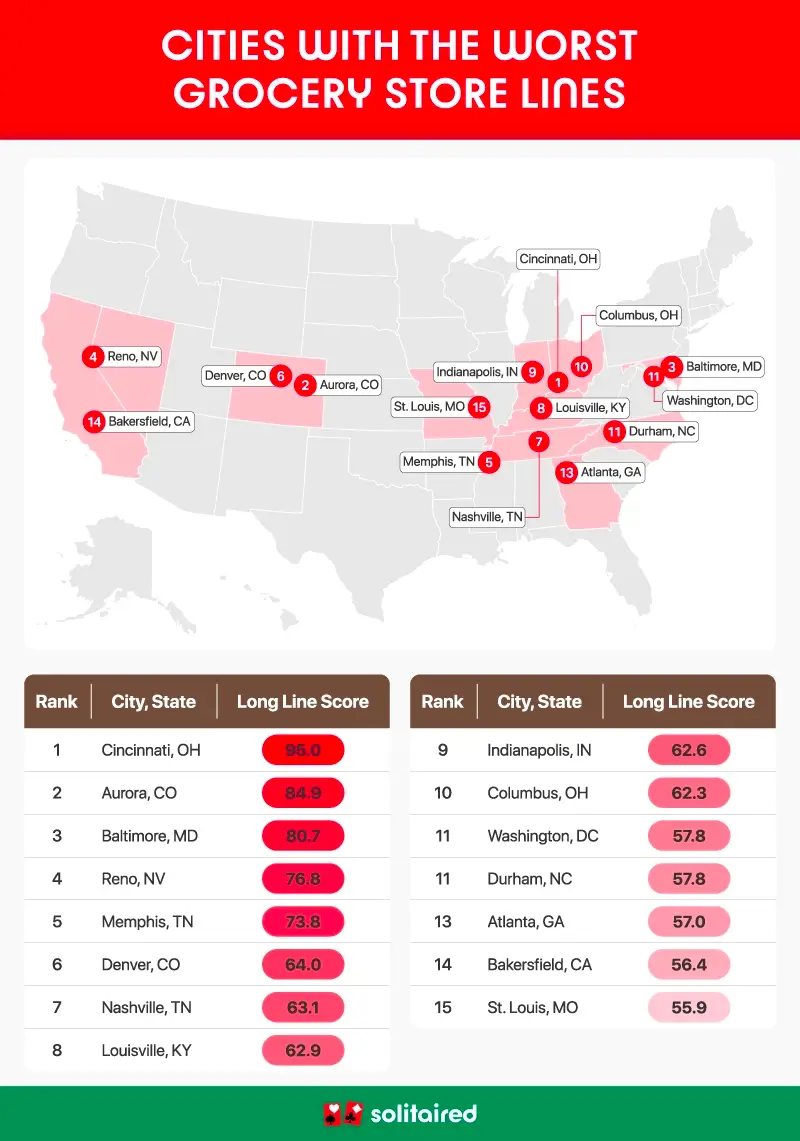
Image credit: Solitaired
That matters because in-store grocery shopping still plays a major role in American life.
FMI’s 2026 U.S. Grocery Shopper Trends report found that 54% of grocery shoppers always shop in-store at their primary store. The report also found that shoppers value in-person grocery trips because they provide a greater sense of control, confidence and efficiency, particularly when selecting perishable items.
But that sense of control can disappear quickly when checkout lanes are backed up, prices feel too high or staff are hard to find.
FMI found that 73% of shoppers want a clean, neat store, while 69% want an easy shopping experience. Another 69% want to find aisles and departments easily. Those expectations show that consumers are judging grocery stores as experiences, not just places to buy food.
Long lines are especially damaging because they come at the end of the trip. By the time shoppers reach the register, they have already invested their time. If the line is slow, there is no easy way to recover the experience.
That is why checkout speed is more than an operational metric. It is emotional.
The American Customer Satisfaction Index Retail and Consumer Shipping Study 2026 found that supermarkets slipped 1% to an ACSI score of 78. The study said speed of checkouts tied for the worst-rated supermarket customer experience benchmark.
ACSI also found that Trader Joe’s overtook Publix to lead the supermarket category, while H-E-B improved and Wegmans declined. The report noted that customers were less pleased with Wegmans’ in-store experience, including layout, staff courtesy and checkout speed.
The lesson for grocers is clear: customer experience is interconnected.
If a store has strong prices but long lines, shoppers may still complain. If the checkout is fast but shelves are confusing, the trip still feels difficult. If prices are high and customer service is poor, even a short line may not save the experience.
Solitaired’s chain-level findings also suggest that the issue reaches across formats. Among large grocery chains, WinCo Foods had the highest share of long-line complaints in negative reviews, followed by Kroger, Safeway, Walmart and Publix.
Those are very different retailers, which suggests long lines are not simply a discount-store problem or a premium-store problem. They are a traffic, staffing, process and customer expectation problem.
For shoppers, the data may confirm what they already feel: the best grocery store is not always the closest or cheapest one. It is the one that makes the weekly errand feel manageable.
For retailers, the warning is more serious. In a competitive grocery market, customers have options. They can switch stores, order pickup, use delivery or split their shopping across multiple chains.
A long line may not lose a customer once. But if it happens repeatedly, it trains the customer to go somewhere else.
Grocery shopping will never be completely frictionless. People will still compare produce, check prices, search for items and wait their turn. But the stores that win loyalty are the ones that remove the avoidable frustrations.
In 2026, that may mean treating the checkout lane not as the end of the trip, but as one of the most important parts of it.