Get all your news in one place.
100’s of premium titles.
One app.
Start reading
Tom’s Hardware
Tom’s Hardware
Technology
Mark Tyson

AMD’s K6-III ‘Sharptooth’ debuted this week in 1999 with on-die L2 cache to savage the Intel Pentium II — it also held the line against the Pentium III

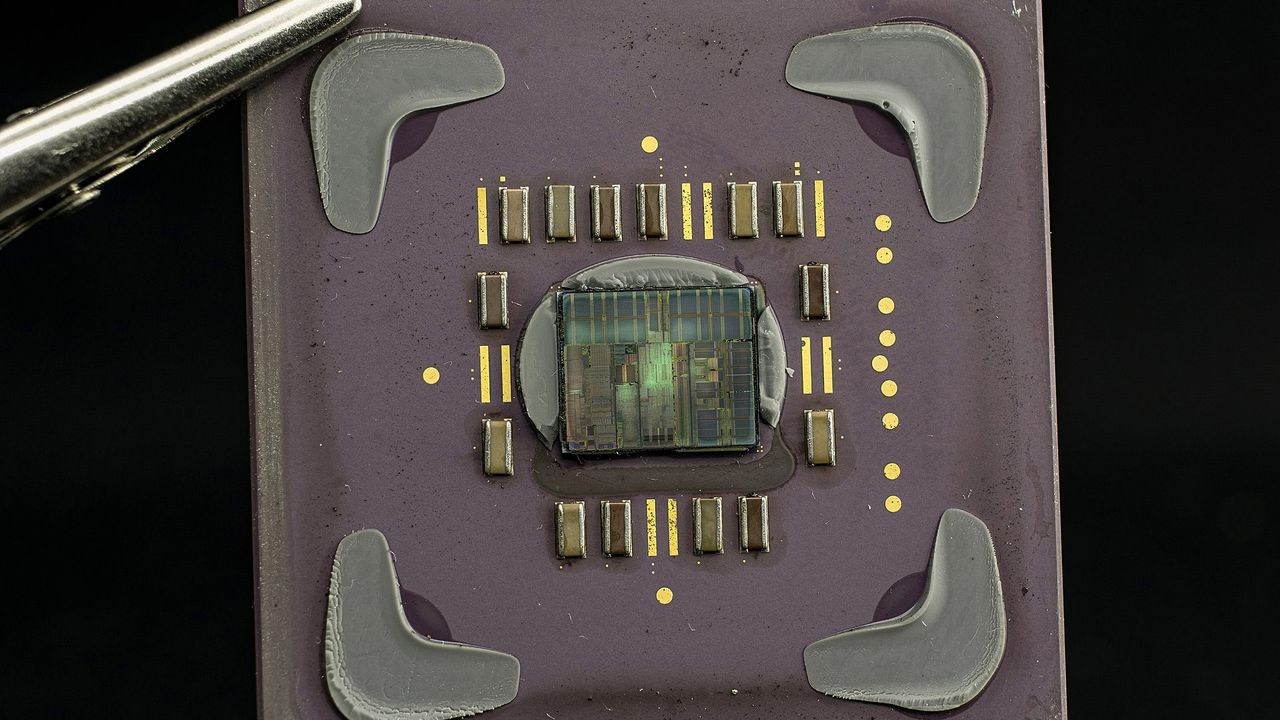
Delidded K6-III.

AMD launched its first processors with on-die L2 cache this week in 1999, heralding the beginning of the Super Socket 7 era. With its new K6-III CPUs, AMD presented a major architectural leap above the popular K6-2 line, and knocked the Intel Pentium II 450 off its fastest processor perch. Intel would quickly follow up with its first Pentium III Katmai CPUs, but the K6-III could still outclass its pricier foe in cache latency-sensitive apps.

The Sharptooth scene

Intel abandoned Socket 7 in 1997, with the Pentium II series moving to the rather unusual Slot 1 motherboard interface. However, AMD persevered with Socket 7, pleasing PC builders and upgraders for several more years. The K6-III was an important move for AMD in keeping Socket 7 alive.

The new AMD K6-III with on-die cache launched in 400 and 450 MHz SKUs on Feb 22, 1999. AMD positioned it as a pre-prepared answer to Intel’s upcoming Pentium III (Feb 26 launch). Reviews and comparisons from the time show that AMD’s gambit largely paid off – maintaining the red team’s price-performance competitive edge until the K7 Athlon series tech could trickle down to the mainstream.

(Image credit: AMD)

The notable change arriving in the K6-III was the L2 on-die cache, which replaced the slower ‘backside’ L2 cache used by its direct predecessor and rival Intel Pentium II/III chips.

Key specs of the AMD K6 III chips were as follows:

Technology

K6 NextGen architecture

Instruction sets

x86, MMX, 3DNow!

Cores

1C / 1T

Node

0.25um

Clocks

400 and 450 MHz

Caches

64KB L1, 256KB L2 on-die

Super Socket 7 era

AMD’s open, inexpensive Socket 7 era ended on a high note with the Super Socket 7 motherboards. These offered features like a 100 MHz front side bus, AGP support to elevate them from their legacy roots, and more flexible voltage controls.

In 2026, good condition Super Socket 7 boards are prized by retro enthusiasts for their wide-ranging CPU support, spanning Intel Pentium P54 and P55C, AMD 5k86, AMD K5, AMD K6, AMD K6-2, and K6-III (and +) chips, as well as rarer x86 artifacts like the Cyrix MII, IDT WinChip 2, and Rise mP6. They also deliver excellent DOS compatibility, AGP support for legendary GPUs like the Voodoo3, TNT2, and others, plus flexibility with RAM (EDO, SDRAMM) and storage controllers.

AMD’s successor to the K6-III, the Athlon K7, arrived at 500 MHz later in the same year. However, the K6-III would remain available through 2003. That’s quite an overlap, but keeping the older chip/motherboards available for mainstream users, and the new Athlons and Socket A motherboards for high-end desktop and workstation users, helped smooth the transition for AMD.

Follow Tom's Hardware on Google News, or add us as a preferred source, to get our latest news, analysis, & reviews in your feeds.

Sign up to read this article
Read news from 100’s of titles, curated specifically for you.
Already a member? Sign in here
Related Stories
Top stories on inkl right now
One subscription that gives you access to news from hundreds of sites
Already a member? Sign in here
Our Picks
Fourteen days free
Download the app
One app. One membership.
100+ trusted global sources.