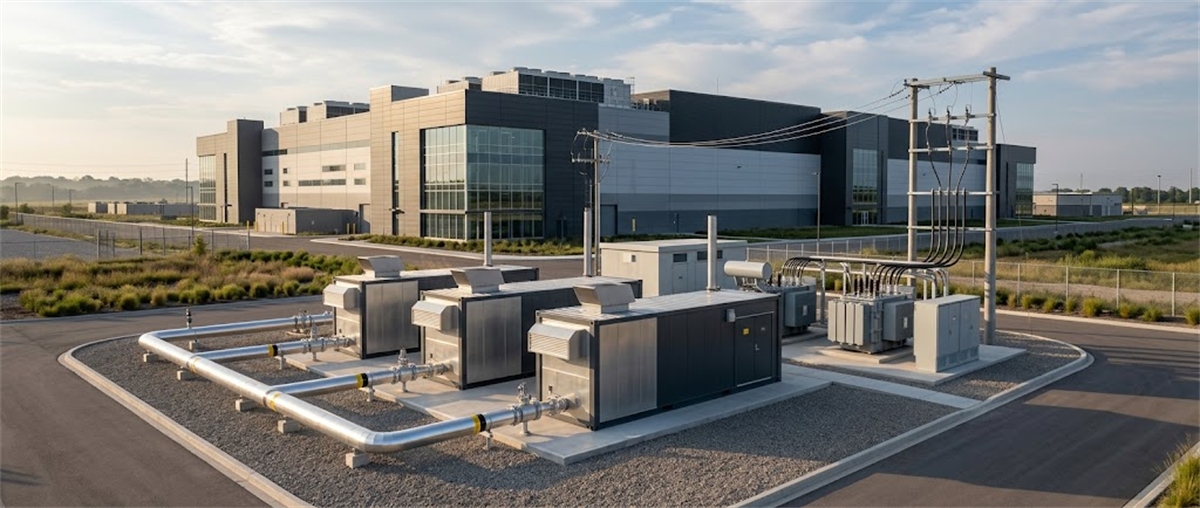
The physical constraints of artificial intelligence (AI) are no longer bound by silicon or compute capacity. Today, the singular bottleneck choking global technology expansion is electricity. Hyperscale data centers require staggering amounts of continuous power, and national utility grids lack the infrastructure to deliver gigawatt-scale loads on the timelines technology developers demand. Grid interconnection queues often stretch for years, forcing tech giants to seek immediate alternatives outside the traditional utility framework.
This structural crisis has activated an entirely unexpected sector. Legacy oilfield service providers are aggressively stepping in to fill the capacity gap, rerouting existing fossil fuel hardware to deliver modular natural gas power directly to data center sites. Investors observing this shift are witnessing a rare moment in which heavy industrial assets are the primary enablers of next-generation technology.

Drilling for Data Center Solutions
The July 2026 strategic alliance between SLB (NYSE: SLB) and Liberty Energy (NYSE: LBRT) illustrates this fundamental market shift. By combining modular infrastructure with integrated natural gas power generation, SLB and Liberty Energy are positioning themselves as critical capacity vendors for the technology sector. The partnership bridges the gap between compute infrastructure and immediate power generation, creating a non-cyclical revenue vertical that equity markets have yet to fully digest.
Rather than viewing SLB and Liberty Energy strictly as traditional upstream oilfield operators, market participants should begin evaluating them as essential infrastructure providers for the artificial intelligence ecosystem. This pivot offers a compelling blueprint for how legacy energy expertise can solve immediate macroeconomic bottlenecks.
Behind-the-Meter Economics Take Charge
To understand the economic gravity of this partnership, investors should examine the mechanics of behind-the-meter power.
Generating electricity behind the meter means producing power on-site, completely independent of the traditional utility transmission grid. For a data center developer, this eliminates multi-year delays waiting for utility lines to be built and approved by local regulators.
SLB brings deep project execution capabilities and prefabricated modular infrastructure to the table. SLB has already shipped more than 1.3 gigawatts of infrastructure for data center projects since April 2024. Management expects cumulative global deliveries to exceed two gigawatts by the end of 2026. This is not speculative research and development. It is an active and monetized pipeline.
Liberty Energy steps in to provide the actual power generation systems and intelligent power controls through its Liberty Power Innovations arm. Liberty Energy targets deploying roughly three gigawatts of power projects by 2029.
The underlying margin tailwind for this venture rests on feedstock economics. North America possesses an abundance of structurally cheap natural gas.
Tapping into this localized and inexpensive fuel source to run modular turbines makes the solution provided by SLB and Liberty Energy economically superior to grid-tied utility power while completely bypassing bureaucratic utility timelines.
Mispriced Multiples and Cash Flow Visibility
Despite this strategic pivot toward secular growth, the market misprices energy service companies. Institutional capital largely treats them as cyclical fossil-fuel operators rather than as emerging technology infrastructure plays. SLB currently trades near $47, with a market capitalization of roughly $70.13 billion.
SLB operates with a trailing price-to-earnings ratio of 20.49 and a forward price-to-earnings ratio of 18.13. Backed by a solid operating cash flow of $4.65 per share, SLB supports a reliable 2.52% dividend yield. While SLB trades at a premium valuation relative to legacy peers like Baker Hughes (NASDAQ: BKR) and Halliburton (NYSE: HAL), the stock remains heavily tied to international rig counts and Middle East capital expenditures rather than its digital and new energy initiatives.
Liberty Energy presents a more complex valuation puzzle for fundamental investors. Priced near $24.50 with a $4 billion market capitalization, Liberty Energy trades at a trailing price-to-earnings ratio of 27.14. Its forward price-to-earnings ratio is heavily distorted at 102.68. This multiple expansion occurs because analysts are modeling a sharp contraction in forward earnings per share, driven by immediate pricing headwinds in the core North American hydraulic fracturing market.
This valuation distortion creates an asymmetric opportunity. The market is pricing Liberty Energy strictly on the cyclical weakness of its legacy completion services, entirely discounting the high-margin cash flows emerging from its natural gas power generation pipeline. While awaiting broader market recognition, investors are supported by a newly authorized quarterly cash dividend of 9 cents per share, yielding 1.47%.
Seeing Past the Fracking Short Squeeze
Institutional sentiment across both equities reflects this foundational misunderstanding of the evolving business models. SEC filings show a recent pattern of measured insider selling across both boards, including the Chief Financial Officer of Liberty Energy, who divested shares in early July 2026.
Short sellers are heavily targeting Liberty Energy, driving the short interest ratio to bearish levels. Wall Street analysts remain fixated on a 25% year-over-year decline in adjusted earnings before interest, taxes, depreciation, and amortization from Q1 2026. That decline was a direct result of the cooling domestic frac spread market, but it ignores the forward-looking growth engine. SLB faces a healthier short interest profile but continues to weather analyst price target reductions tied to global drilling fluctuations rather than its emerging capacity to power data centers.
When institutional capital stubbornly anchors to legacy metrics, observant investors gain a distinct advantage. The broader oilfield services sector is actively rerouting hardware to address technology infrastructure bottlenecks. Once revenue from behind-the-meter data center power eclipses traditional upstream operations, SLB and Liberty Energy will likely experience aggressive multiple expansion as the market correctly categorizes them.
What to Watch as the Grid Transition Scales
The immediate proving ground for this fundamental thesis arrives with the upcoming Q2 2026 earnings reports. Liberty Energy takes the stage on July 22, 2026, followed closely by SLB on July 24, 2026.
Analysts will undoubtedly press management on core legacy operations, but the true value for forward-looking investors lies in the commentary surrounding the new joint venture. Initial contract bookings, projected margins on power generation units, and the speed at which Liberty Energy can scale its three-gigawatt pipeline will dictate how quickly institutional investors begin re-rating the stocks.
Investors monitoring the artificial intelligence infrastructure boom might consider adding SLB and Liberty Energy to their watchlists as earnings season approaches. Those comfortable absorbing near-term commodity cyclicality could view the current valuation distortion as an optimal entry point before Wall Street fully prices in the shift from fossil fuel service providers to gigawatt-scale technology vendors.
The article "AI’s Power Crunch Fuels a Pivot for These 2 Oilfield Stocks" first appeared on MarketBeat.