Welcome to Eye on AI. Beatrice Nolan here. In today’s issue:
- AI “godfather” Yann LeCun has “zero concerns” about human extinction .
- Google launches Gemini 4 Argon.
- FTC opens a broad investigation into OpenAI and Anthropic over AI safety.
- And AI may push 11 million people into new careers.
But first, before we get to the news. Today is the inaugural Fortune AIQ Summit, where leaders are sharing lessons on how Fortune 500 companies are managing to implement AI successfully. You can read our coverage of the event here. And, you can read the AIQ list of Fortune 500 companies that are pioneering AI here.
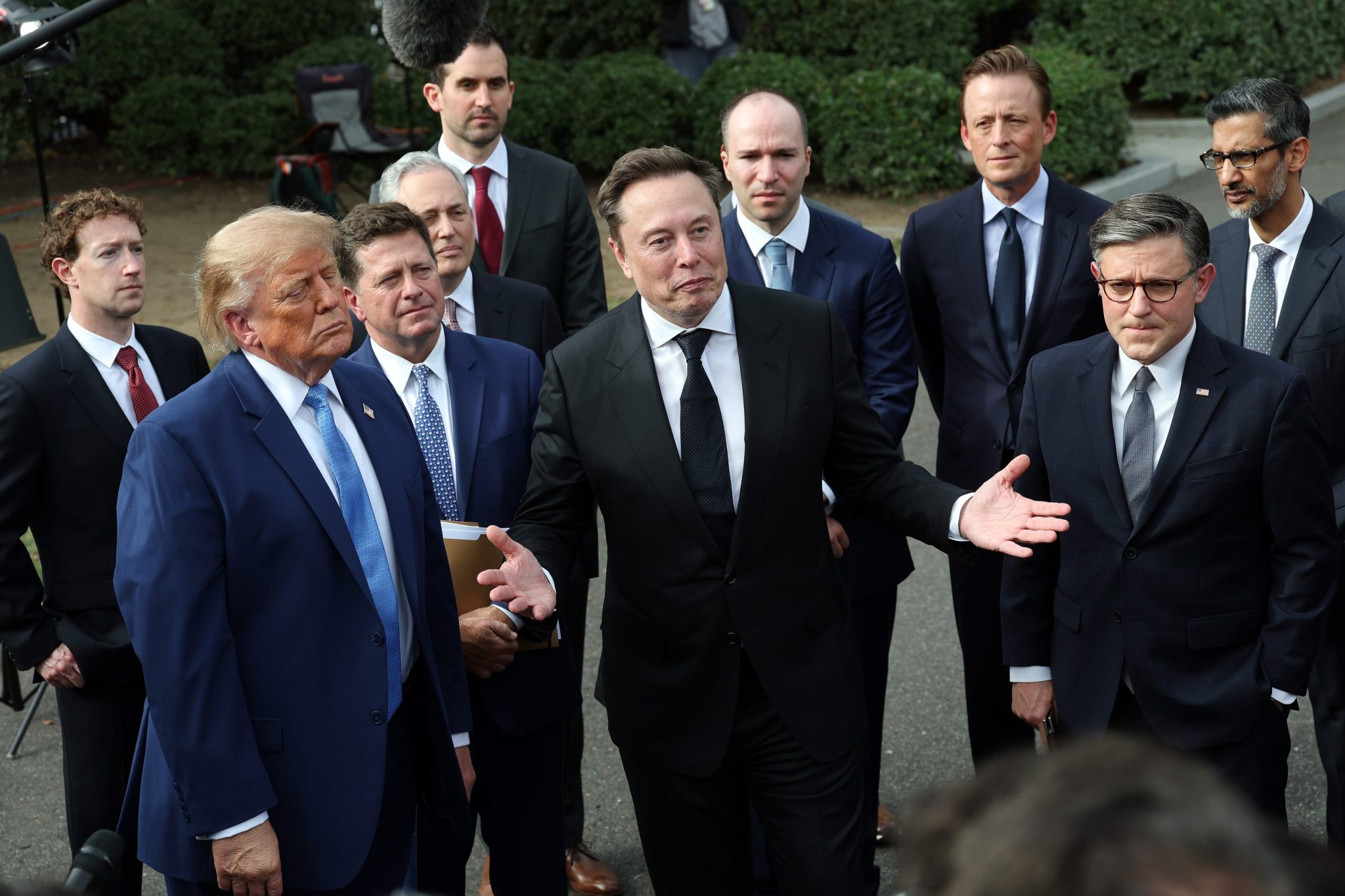
This week, some of the most powerful men in tech gathered at the White House for a luncheon in an unusual show of unity.
The reason for the meeting: President Donald Trump’s new voluntary accords on artificial intelligence.
The one-page document, which Trump posted to Truth Social and described as “morally binding,” was signed by Anthropic’s Dario Amodei, OpenAI’s Greg Brockman, Google’s Sundar Pichai, Meta’s Mark Zuckerberg, xAI’s Elon Musk, and Nvidia’s Jensen Huang. It’s part of a wider effort from the Trump administration to prove that the sector can police itself without the government stepping in with official regulation.
Some gossip that has since emerged from the lunch: Huang reportedly stopped to quiz Amodei about his recent dire warnings; Amodei responded that it was important to be honest. A conversation between Zuckerberg and House Speaker Mike Johnson at last week’s state dinner sparked the idea for Tuesday’s pact. And, Huang and Zuckerberg played key roles in circulating and gathering support for the pact.
It’s a familiar divide (and one I wrote about in more depth a few weeks ago) with Huang and Zuckerberg firmly staking out their anti-regulation stance and aligning themselves with Trump, while Amodei and OpenAI’s Sam Altman have urged an AI slowdown.
The most recent agreement is not regulation, but it does go slightly further than previous voluntary commitments.
Under the Joint Commitment on Frontier Responsibilities, the companies pledged to build “robust” internal controls to monitor their models across cybersecurity, biosecurity, and chemical threats, and to ensure systems “do not hack or access technical systems in unintended ways.” They also agreed to bring in independent external auditors, set up board-level oversight committees, and meet regularly to hammer out shared safety standards.
We have already seen a couple of these before. Amodei initially suggested that labs should bring in embedded external auditors to ensure the safety of models; his company has already committed to doing so, as has OpenAI. There was also reporting last month that OpenAI and Anthropic were trying to create shared safety standards, but that was later stalled.
Following Trump’s recent pact, news broke that Google, OpenAI, and Anthropic are pushing ahead with plans for a new industry-run AI safety standards body, according to The Information. The companies are reportedly aiming to launch it by the end of the year or early 2027.
It’s a bit of a difficult balancing act. The labs seem concerned about recent safety incidents, want to appear responsible, and want to put some guardrails in place before something goes badly wrong. But all of this can’t sound too much like regulation, both to avoid accusations of regulatory capture and to avoid contradicting the Trump administration.
Trump has firmly dug in against mounting pressure to regulate the technology, even after dozens of AI security incidents have emerged in recent months. Last week, he told the UN General Assembly he would oppose “any attempt to construct a globalist scheme to control” AI. He has also brushed off industry warnings—including from Amodei and Altman, who have urged developers to “pace the frontier”—arguing the U.S. cannot afford to slow down while China races ahead.
Still, “no regulation” doesn’t mean no consequences. A day after the White House lunch, the FTC disclosed a broad safety probe into OpenAI and Anthropic.
While the administration may oppose new AI rules, it has said existing laws still apply. The FTC already has the power to go after companies whose products harm consumers or mislead people about safety, and the probe is looking closely at AI agents after a run of incidents that included the Hugging Face hack. FTC Chair Andrew Ferguson is said to be preparing demands that could force executives to hand over documents and testify about their models.
As Vice President JD Vance put it: “They have to build products that are safe and good for American consumers. The government actually has preexisting laws on the books where if you build something that gets unleashed on the internet, that is used as a tool for cyberwarfare, then you have responsibility for the products you develop.”
With that, here’s more AI news.
Beatrice Nolan
[email protected]
@beafreyanolan
Before we get to the rest: On Oct. 6, from 11–12:00 p.m. ET, Fortune AI editor Jeremy Kahn will convene with AI and technology leaders from AXA, Mistral AI, Mastercard, and Accenture during the virtual Fortune Brainstorm AI session, The Agentic Era: Are Enterprises Keeping Up? We’ll look past the demos to discuss the operational realities of data, security, governance, human oversight, and ROI. Join us for the conversation.