
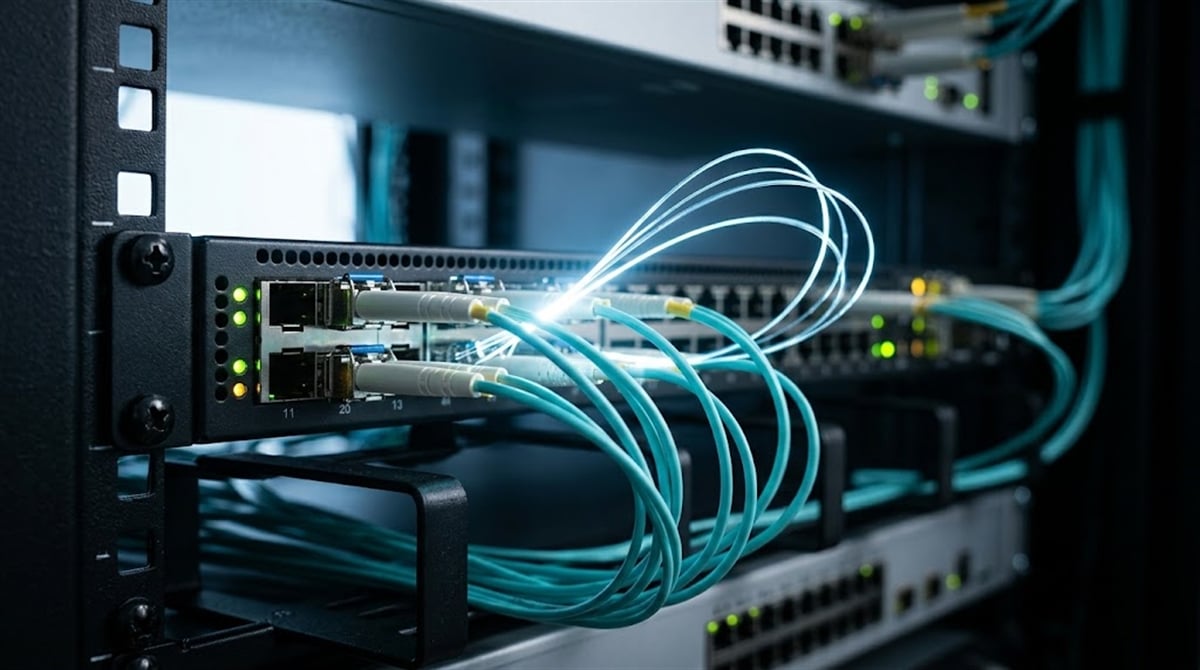
The AI infrastructure buildout is colliding with a geopolitical reality. The Federal Communications Commission is weighing a measure to ban the import of new Chinese optical transceivers into domestic data centers.
This regulation would fundamentally alter the landscape for physical networking architecture. Optical transceivers, historically viewed as commoditized hardware, could rapidly become tightly regulated national security assets.
Optical transceivers are the critical hardware that convert electrical data signals into light. This conversion enables information to travel across fiber-optic cables at incredible speeds. Chinese manufacturers currently account for roughly 60% of global optical datacom transceiver revenue.
Blacklisting Chinese supply could sever a key hardware artery for U.S. hyperscalers overnight. For investors, though, it could trigger a highly lucrative capital rotation toward Western companies capable of filling the void.
Melting Point of the Copper Age
Understanding the magnitude of this shift requires looking at the physical constraints of modern computing. When hyperscalers deploy AI superclusters, they stack tens of thousands of GPUs together to train large language models. The immense data density required to keep these processors fed pushes traditional copper interconnects past their physical limitations. Copper generates excessive heat and suffers from severe signal degradation over short distances within a server rack.
This physical ceiling is likely to accelerate a migration to high-speed 800G and 1.6T optical modules. Optical transceivers solve the heat and distance problems, making them key for next-generation data centers. If regulatory mandates prevent Chinese firms from supplying domestic tech sector giants, a substantial infrastructure deficit would emerge immediately.
Technology leaders like Microsoft (NASDAQ: MSFT) and Alphabet (NASDAQ: GOOGL) have aggressive capital expenditure budgets that must be deployed to maintain their dominance in artificial intelligence. These corporations are effectively forced buyers of optical components. They cannot afford to delay supercluster deployments while waiting for geopolitical tensions to cool.
These mandates force those hyperscaler funds directly into the balance sheets of domestic manufacturers. The physical infrastructure cannot function without these optical links, effectively removing price sensitivity from the equation for buyers who need operational clusters today.
Western Tech Absorbs the Capital
The primary beneficiaries of this geopolitical friction are Lumentum Holdings Inc. (NASDAQ: LITE) and Coherent Corp. (NYSE: COHR). These two firms are the two most viable Western replacements capable of producing advanced co-packaged optics and continuous-wave lasers at the scale required by modern superclusters.
Both stocks have demonstrated relative strength in recent trading sessions. Sustained upward momentum has characterized recent trading blocks, with heavy institutional capital rotation driving healthy year-to-date gains.
The fundamental data support this aggressive repricing.
Coherent reported revenue of about $1.81 billion in its most recent fiscal quarter, an increase of approximately 20% year over year. Gross margins expanded to roughly 39%, driven by acute manufacturing efficiencies.
Notably, Coherent's datacenter and communications segment rose by more than 30%, and this division now accounts for nearly three-quarters of total corporate revenue.
Lumentum has exhibited a similar acceleration. The company posted a nearly 90% year-over-year revenue surge to roughly $808 million in a recent quarterly report.
Valuation models reflect this aggressive growth trajectory.
Lumentum currently trades at a premium multiple, with a price-to-earnings ratio hovering around 144, but Wall Street anticipates rapid earnings expansion as more orders hit the books.
Prominent investment banks maintain aggressive upside targets for LITE, with analysts pushing projections to a rapidly rising street high of $1,400.
Lumentum and Coherent are entering this potential mandated monopoly with peak pricing power and rapid margin expansion already underway. Options market pricing indicates highly elevated implied moves for both companies' upcoming earnings reports.
This signals that speculative capital is aggressively positioning ahead of management commentary on Federal Communications Commission regulatory tailwinds. Sympathetic upward movements are also visible across the broader domestic optical networking periphery. Businesses like Applied Optoelectronics Inc. (NASDAQ: AAOI) often catch secondary bids as institutional managers diversify their exposure to the domestic infrastructure thesis.
The Assembly Line Bottleneck
While the macroeconomic tailwinds are profound, executing this supply chain pivot would involve severe structural friction. The data center component market is deeply intertwined. This creates a complex bill-of-materials vacuum.
Leading Chinese transceiver manufacturers rely heavily on digital signal processors and cutting-edge lasers manufactured by domestic tech developers like Marvell Technology Inc. (NASDAQ: MRVL) and Broadcom Inc. (NASDAQ: AVGO).
An abrupt import ban on finished Chinese modules would create an immediate vacuum in demand for Broadcom and Marvell. Western transceiver assembly lines cannot absorb that component capacity overnight. Lumentum and Coherent possess the requisite 1.6T transceiver technology and silicon photonics leadership, but they currently lack the raw manufacturing footprint to replace 60% of global volume in a single quarter.
To counter this capacity limit, both companies are rapidly expanding six-inch Indium Phosphide wafer production. Indium Phosphide is the critical substrate for manufacturing continuous-wave lasers for advanced photonics. Scaling this semiconductor fabrication process requires substantial capital and precision. Improving output yields takes time, and facility expansions cannot be rushed without sacrificing quality control.
Supply chain checks indicate that a complete ban on Chinese supply would likely trigger acute hardware shortages across the industry. The lead times for securing 800G and 1.6T transceivers could stretch from weeks into multiple quarters. This dynamic suggests sustained pricing power for Lumentum and Coherent, but it carries the systemic risk of temporarily stalling the broader buildout of domestic hyperscalers' artificial intelligence infrastructure.
Pricing in a National Security Premium
The transition of physical data center layers into sovereign territory presents a generational structural shift. Geopolitics is effectively doing the heavy lifting for domestic optical networking margins. Regulatory frameworks are forcing a highly specific capital rotation regardless of broader macroeconomic conditions. The artificial intelligence supercycle demands high-speed optical connectivity, and federal mandates are actively dictating exactly who gets to build that hardware.
Investors may want to add Lumentum and Coherent to their watchlists as supply chain dynamics shift. Paying close attention to both companies' management commentary on capacity expansion and forward guidance during upcoming earnings calls will provide critical clues. Pullbacks related to broader market volatility often present strategic entry windows into infrastructure assets positioned to benefit from mandated federal tailwinds.
The article "AI Cold War Catches Light: Federal Friction in the Server Rack" first appeared on MarketBeat.