Get all your news in one place.
100's of premium titles.
One app.
Start reading
Euronews
Euronews
Quirino Mealha

AI bidding wars: The talent making a fortune as Big Tech firms fight it out

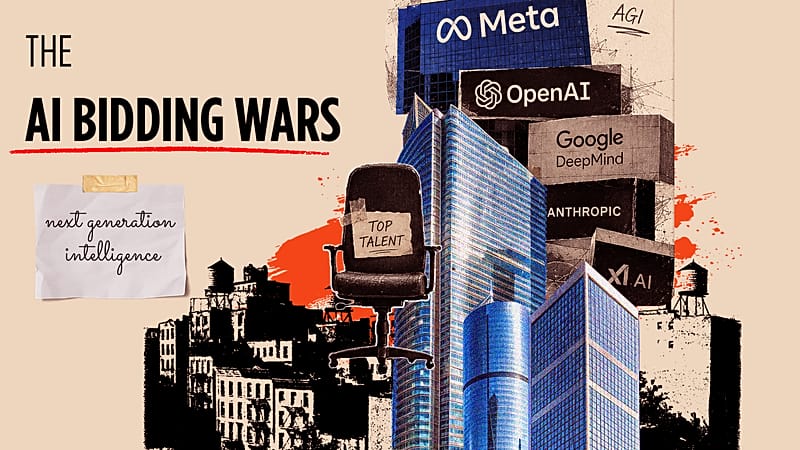
The emerging AI industry has created a labour market unlike anything Silicon Valley has seen since the dot-com boom, except this time, there are perhaps only a few hundred people currently capable of building frontier AI systems at scale.

OpenAI, Meta, Google DeepMind, Anthropic, xAI, Safe Superintelligence and a new and growing number of AI start-ups are all competing to attract an incredibly small pool of highly skilled talent.
As a result, in the last two years, reports have emerged of nine-figure compensation discussions, massive equity grants and recruiting campaigns personally led by CEOs such as Mark Zuckerberg and Sam Altman.

Some figures circulating online are disputed or unverified, so this article focuses on the top individuals whose recruiting value and market demand have been credibly reported by major publications or personally confirmed by individuals involved in the negotiations.

Below are five of the most renowned AI engineers and researchers in the world today in no particular order, whose stories reflect the different kinds of bidding wars unfolding inside the AI industry.

Ilya Sutskever

Few figures in the AI sector command more respect than Israeli-Canadian computer scientist Ilya Sutskever.

As a co-founder and former chief scientist of OpenAI, Sutskever helped drive breakthroughs behind GPT models and was widely viewed as one of the key intellectual architects of the generative AI boom.

Before OpenAI, he worked at Google Brain, which was the precursor to Google DeepMind, and contributed to some of the foundational breakthroughs that helped kick off the deep learning revolution.

Following OpenAI’s dramatic 2023 governance crisis involving Sam Altman’s temporary removal as CEO, Sutskever eventually departed the company and co-founded Safe Superintelligence (SSI) in 2024.

SSI immediately became one of the most closely watched AI start-ups in the world, and despite not having yet released a commercial product, it was privately valued at around $32 billion (€27.5bn) in 2025.

FILE. Co-founder and Chief Scientist of Safe Superintelligence Ilya Sutskever during an interview in December 2025 (FILE. Co-founder and Chief Scientist of Safe Superintelligence Ilya Sutskever during an interview in December 2025)

It was later reported that Meta explored acquisition talks involving SSI and aggressively attempted to recruit talent associated with the company during Mark Zuckerberg’s AI hiring push in 2025.

Last week, Sutskever also confirmed holding a $7 billion (€6bn) stake in OpenAI during his testimony for the high-stakes trial between Elon Musk and the ChatGPT creator, marking the second newly revealed OpenAI billionaire after president Greg Brockman testified to holding a near $30 billion (€25.8bn) stake.

Sutskever’s value comes from an unusually rare combination of scientific credibility, frontier-model experience and leadership ability. Many investors regard him as one of the very few individuals capable of leading an AGI-scale research organisation.

Mira Murati

Another major talent to leave OpenAI was former chief technology officer Mira Murati, who quit the company in 2024.

The Albanian-American engineer and business executive played a central role during the launches of ChatGPT, DALL-E and GPT-4, emerging as one of the public faces of the AI revolution. She also previously worked as a senior product manager at Tesla.

After leaving OpenAI, Murati launched Thinking Machines Lab, which quickly attracted former OpenAI researchers and became a major new player in the AI start-up ecosystem.

Just like Sutskever's SSI, the firm has not released a product yet, but it reportedly achieved a valuation exceeding $5 billion (€4.3bn) shortly after launch. It focuses on human-AI collaboration instead of solely focusing on making fully autonomous AI systems.

Just last week, Thinking Machines Lab previewed its "interaction models" which people will supposedly be able to entirely control by speaking and that have native access to the user's screen among other things, making the interface experience reputedly seamless.

Mira Murati arrives at the 12th Breakthrough Prize Ceremony in Santa Monica, California, 18 April 2026 (Mira Murati arrives at the 12th Breakthrough Prize Ceremony in Santa Monica, California, 18 April 2026)

Meta also aggressively attempted to recruit elite researchers connected to Murati and Thinking Machines Lab as the start-up has managed to gather engineers who worked on ChatGPT, Character.ai, Mistral, PyTorch, as well as other AI models and frameworks.

Murati’s strategic value is derived from the fact that she has become one of the few executives capable of attracting top-tier researchers at scale.

In the AI sector, that recruiting gravity itself is now a competitive advantage, especially as companies realise elite AI talent is becoming increasingly concentrated among a relatively small number of frontier labs.

Alexandr Wang

In contrast with Sutskever and Murati, who both started at OpenAI and then left to launch their own start-ups, the second-generation Chinese-American engineer Alexandr Wang rose to prominence as a founder and then moved to Meta.

Wang launched Scale AI all the way back in 2016, a company that built critical infrastructure for machine learning systems through data labelling, evaluation, and model assessment tools.

Scale AI became embedded in the generative AI ecosystem by working with governments, enterprises and leading AI labs. In 2025, Meta reportedly acquired a 49% non-voting stake in the firm for $14.3 billion (€12.3bn) valuing it at $29 billion (€25bn).

Alexandr Wang was brought into a leadership role within Meta Superintelligence Labs, the AI division of Mark Zuckerberg's company.

Alleged document leaks suggest his compensation is among the largest in Silicon Valley history with a $1 million (€860,000) base salary, multi-million-dollar bonuses and $100 million (€86m) to $150 million (€129m) in equity vesting over five years.

FILE. Scale AI founder and CEO Alexandr Wang poses for photos at the company's office in San Francisco, California, May 2023 (FILE. Scale AI founder and CEO Alexandr Wang poses for photos at the company's office in San Francisco, California, May 2023)

The move was widely interpreted as part of Zuckerberg’s attempt to accelerate Meta’s AI capabilities after the company lagged behind OpenAI in public perception.

Unlike pure academic researchers, Wang became valuable because of his operational understanding of how frontier AI systems are built and scaled. His expertise spans infrastructure, datasets, evaluation pipelines and organisational execution.

This all-encompassing knowledge is increasingly important as AI systems become larger and more expensive to teach and manage.

Demis Hassabis

Similar to Wang, Demis Hassabis also started his path in the AI sector as a founder before moving to a Big Tech company.

The British engineer of Greek, Cypriot, Chinese and Singaporean descent, spent years building DeepMind into one of the world’s premier AI research organisations which became famous for breakthroughs including AlphaGo, a model that mastered the ancient Chinese board game of Go, and AlphaFold which predicts protein structures.

In 2024, the AlphaFold2 model solved a 50-year-old challenge by accurately predicting the three-dimensional structures of proteins which led to Hassabis being awarded the 2024 Nobel Prize in chemistry.

DeepMind was originally founded in London and acquired by Google in 2014 which led to the creation of Google DeepMind that still operates today as the core AI division of the Big Tech firm.

The exact final purchase price was never officially confirmed but reports indicate it was bought for anywhere between $400 million (€344m) and $650 million (€559m) at a time when AI was still a distant thought in the technology sector.

FILE. Demis Hassabis holds his Nobel laureate in chemistry during the Nobel Prize ceremony in Stockholm, Sweden, Dec. 2024 (FILE. Demis Hassabis holds his Nobel laureate in chemistry during the Nobel Prize ceremony in Stockholm, Sweden, Dec. 2024)

Hassabis' base salary is not publicly disclosed but as the CEO of Google DeepMind, his annual total compensation is estimated to be in the millions.

He has reportedly earned specific performance rewards such as a significant $3 million (€2.58m) bonus for his achievements with the Gemini AI project. Hassabis' estimated net worth is approximately $600 million (€516m).

After the launch of ChatGPT intensified the AI arms race, Google consolidated more of its AI efforts around Google DeepMind under Hassabis’s leadership. The company suddenly found itself competing more aggressively with OpenAI, Anthropic, and Meta for both talent and public relevance.

Hassabis occupies a uniquely valuable role because he combines founder status, elite scientific credentials and organisational leadership.

Retaining DeepMind’s core researchers became strategically critical for Google as compensation expectations across the AI industry escalated.

Andrej Karpathy

Andrej Karpathy rounds off the list as another co-founder of OpenAI.

After helping to launch the major AI firm, the Slovak-Canadian computer researcher moved on to become head of AI at Tesla where he helped lead the development of neural-network-based autonomous driving systems from 2017 to 2022.

Karpathy later returned briefly to OpenAI before launching Eureka Labs in 2024.

There is no disclosed private valuation of the company as it pursues independent educational and startup initiatives.

FILE. Andrej Karpathy delivering a keynote speech at the Train AI conference in San Francisco, California, May 2018 (FILE. Andrej Karpathy delivering a keynote speech at the Train AI conference in San Francisco, California, May 2018)

However, Karpathy's net worth is estimated to be between $50 million (€43m) and $150 million (€129m) due to his previous jobs.

Although he has not publicly been associated with the largest compensation rumours in the same way as other frontier-lab researchers, Karpathy remains one of the most strategically valuable AI figures because of his ability to shape developer communities and attract talent due to his historical influence in engineering culture.

Sign up to read this article
Read news from 100's of titles, curated specifically for you.
Already a member? Sign in here
Related Stories
Top stories on inkl right now
One subscription that gives you access to news from hundreds of sites
Already a member? Sign in here
Our Picks
Fourteen days free
Download the app
One app. One membership.
100+ trusted global sources.