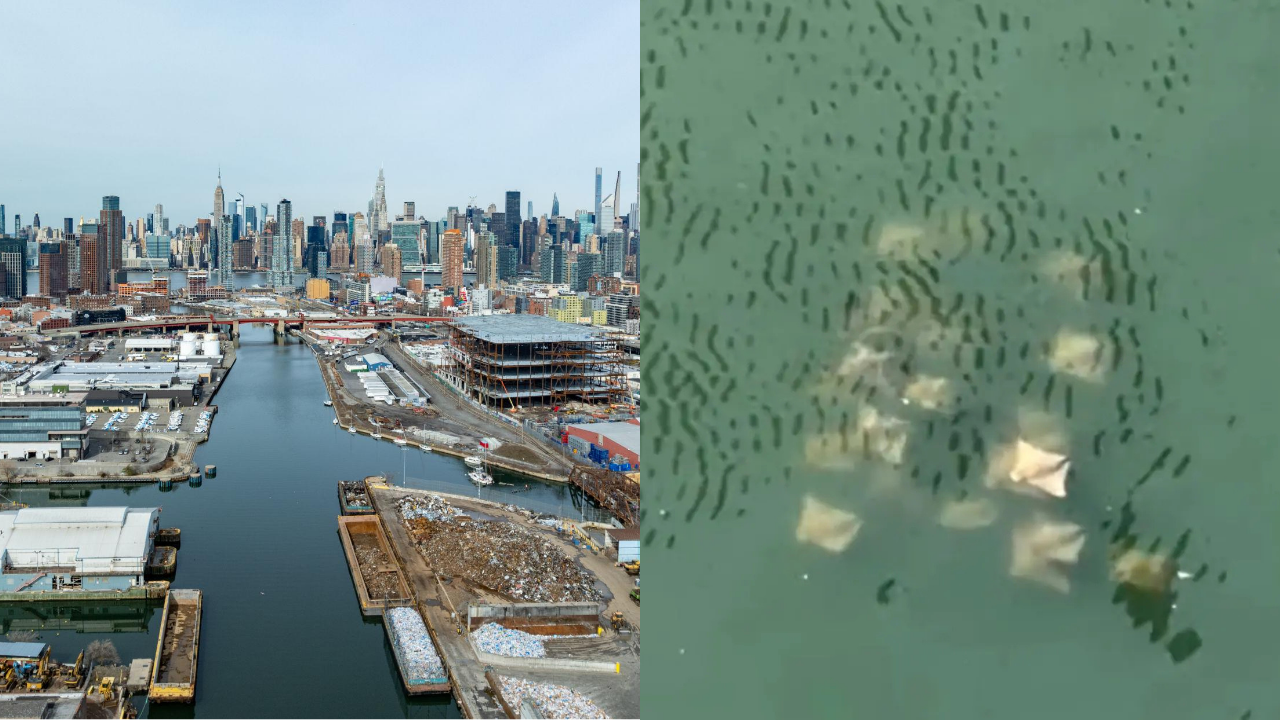
A school of rays has appeared in one of New York City's most polluted waterways, offering an unexpected sign that decades of environmental restoration may be making a difference. The animals, believed to be cownose rays, were recently spotted swimming through Newtown Creek, the industrial estuary separating Brooklyn and Queens that has long been associated with toxic pollution and one of the largest oil spills in US history. Conservationists say it is the first documented sighting of rays in the creek, although scientists caution that a single observation does not prove the ecosystem has fully recovered. Even so, the appearance of these marine animals has renewed optimism that years of cleanup efforts are slowly helping restore life to the waterway.
Get breaking news anytime, anywhere. Download the TOI app now!

Why a school of rays in Newtown Creek is significant
The sighting was recorded by the Newtown Creek Alliance, a nonprofit organisation dedicated to restoring the waterway. Executive Director Willis Elkins said he had never previously heard of rays being seen in the creek. The group observed the animals swimming together in what is known as a "fever" of rays, behaviour that often suggests they are searching for food.
Experts believe the animals were likely cownose rays, a species native to the western Atlantic Ocean that migrates north along the US East Coast during the warmer months. Their appearance suggests that parts of the creek may now support enough marine life to attract larger predators, although scientists say more observations will be needed before drawing firm conclusions.
How Newtown Creek became one of America's most polluted waterways
Situated between Brooklyn and Queens, Newtown Creek became a centre of heavy industry during the nineteenth century. Oil refineries, petrochemical facilities, paint manufacturers, fertilizer plants and shipyards lined its banks, releasing pollutants into the water for decades.
The creek's environmental problems gained national attention after the discovery of the Greenpoint oil spill in 1978. Investigators found that an estimated 17 to 30 million gallons of petroleum products had leaked into the surrounding area over several decades, making it one of the largest oil spills ever recorded in the United States.
The long cleanup that is still underway
Recognising the scale of contamination, the US Environmental Protection Agency (EPA) designated Newtown Creek a Superfund site in 2010. Since then, federal and state agencies have been working to remove contaminated sediment, investigate pollution sources and restore habitats along the waterway.
Despite the progress, the creek is far from fully restored. Heavy rainfall continues to overwhelm New York City's combined sewer system, allowing untreated sewage to enter the creek through combined sewer overflows. In 2022, the EPA extended parts of the cleanup timeline, with major restoration work expected to continue into the 2030s.
More wildlife is beginning to return
The rays are not the only encouraging wildlife visitors recorded this year. According to the Newtown Creek Alliance, horseshoe crabs and American eels have also been spotted in and around the creek during 2026. These sightings suggest that portions of the ecosystem may be gradually becoming more hospitable to aquatic life.
Scientists caution, however, that occasional wildlife appearances do not necessarily mean the creek has fully recovered. Species can enter tidal waterways temporarily while following food or seasonal migration routes, making long-term monitoring essential.
Cownose rays are important predators within coastal ecosystems. They feed on shellfish, crabs and other bottom-dwelling animals, helping maintain ecological balance in estuaries and coastal waters. Because they occupy a relatively high position in the food chain, their presence can indicate that enough prey species exist to support larger marine animals.
Although researchers cannot yet say whether the rays will become regular visitors to Newtown Creek, their appearance has given conservationists fresh encouragement that the decades-long restoration effort may be improving conditions beneath the water's surface.
What the sighting means for New York's waterways
The appearance of a school of rays does not mean Newtown Creek has fully recovered, nor does it erase more than a century of industrial pollution. Instead, it serves as a reminder that damaged ecosystems can begin to rebound when pollution sources are reduced and restoration projects are sustained over many years. For the organisations and volunteers who have spent decades working to restore one of New York City's most contaminated waterways, the unexpected arrival of the rays represents something increasingly rare: tangible evidence that nature may slowly be finding its way back.