Get all your news in one place.
100's of premium titles.
One app.
Start reading
The Economic Times
The Economic Times

After Apollo 11 returned to Earth in 1969, Neil Armstrong spent his 39th birthday behind a glass wall from his wife; NASA kept him in a 3-week quarantine while scientists investigated a Lunar threat that probably never existed

After successfully landing back on Earth, Neil Armstrong, the first human to walk on the Moon, could not immediately go home, meet crowds or even hug his family. Instead, just days after returning from the most famous journey in human history, Armstrong spent his 39th birthday in quarantine.

On August 5, 1969, less than two weeks after Apollo 11 splashed down in the Pacific, Armstrong celebrated his birthday inside NASA's Lunar Receiving Laboratory in Houston. He, Michael Collins and Edwin “Buzz” Aldrin were still being kept in biological isolation, along with the spacecraft and the lunar samples they had brought home.

The reason sounds almost like science fiction today: NASA could not completely rule out the possibility that the Moon had microorganisms capable of harming life on Earth.

The risk was considered remote. But the consequences, if such an organism did exist, could have been enormous. So NASA chose caution. The astronauts who had just returned from making history were treated, for three weeks, as potential carriers of something no scientist had ever encountered.

Why were Apollo 11 astronauts quarantined after walking on the Moon?

Apollo 11 ended its historic mission on July 24, 1969, when Armstrong, Collins and Aldrin splashed down in the Pacific Ocean aboard the Command Module Columbia.

But the mission did not immediately end for NASA's scientists. The astronauts had spent time on the lunar surface, collected rocks and soil and returned to Earth carrying material from a world whose biological environment was almost completely unknown.

NASA had to consider an extraordinary possibility: what if the lunar surface contained microorganisms, toxins or other biological hazards that could survive the journey back to Earth?

There was no evidence that such organisms existed. NASA scientists largely considered the possibility remote. But because nobody had ever brought lunar material back to Earth before, there was no way to eliminate the risk with certainty.

NASA therefore established a 21-day quarantine program designed to prevent possible “back-contamination” of Earth by lunar microorganisms. The quarantine began from the astronauts' exposure to the lunar environment, rather than simply from the moment they landed back on Earth.

In other words, the first humans to walk on another world returned home only to be placed behind a biological barrier.

Also Read: An Idaho game warden in 1948 put a male beaver named ‘Geronimo’ in a parachute box and dropped it from a plane; 76 beavers later faced the same fate and eventually transformed a landscape

Armstrong returned from the Moon, but not to his family

The contrast was extraordinary. Armstrong had just become the first person to step onto the lunar surface. Millions of people around the world were celebrating Apollo 11. Yet when the astronauts returned, they were not allowed to simply walk into a crowd or reunite with their families as usual.

Following splashdown, the astronauts underwent a carefully designed recovery procedure. They donned Biological Isolation Garments, protective suits designed to reduce the possibility of transferring lunar material or microorganisms to people around them. The suits were worn until the astronauts entered the Mobile Quarantine Facility aboard the recovery ship.

They were then placed inside the Mobile Quarantine Facility, or MQF, a highly modified 35-foot Airstream trailer equipped for biological isolation.

It was essentially a portable quarantine unit. The Apollo 11 MQF housed the three astronauts along with NASA personnel during their journey from the recovery ship to Houston. The facility was transported from the USS Hornet through Hawaii and eventually to Ellington Air Force Base before the astronauts and the unit were taken to the Lunar Receiving Laboratory.

By the early hours of July 27, Armstrong, Collins and Aldrin had arrived at the Lunar Receiving Laboratory at what was then the Manned Spacecraft Center in Houston, now NASA's Johnson Space Center.

A birthday party behind glass

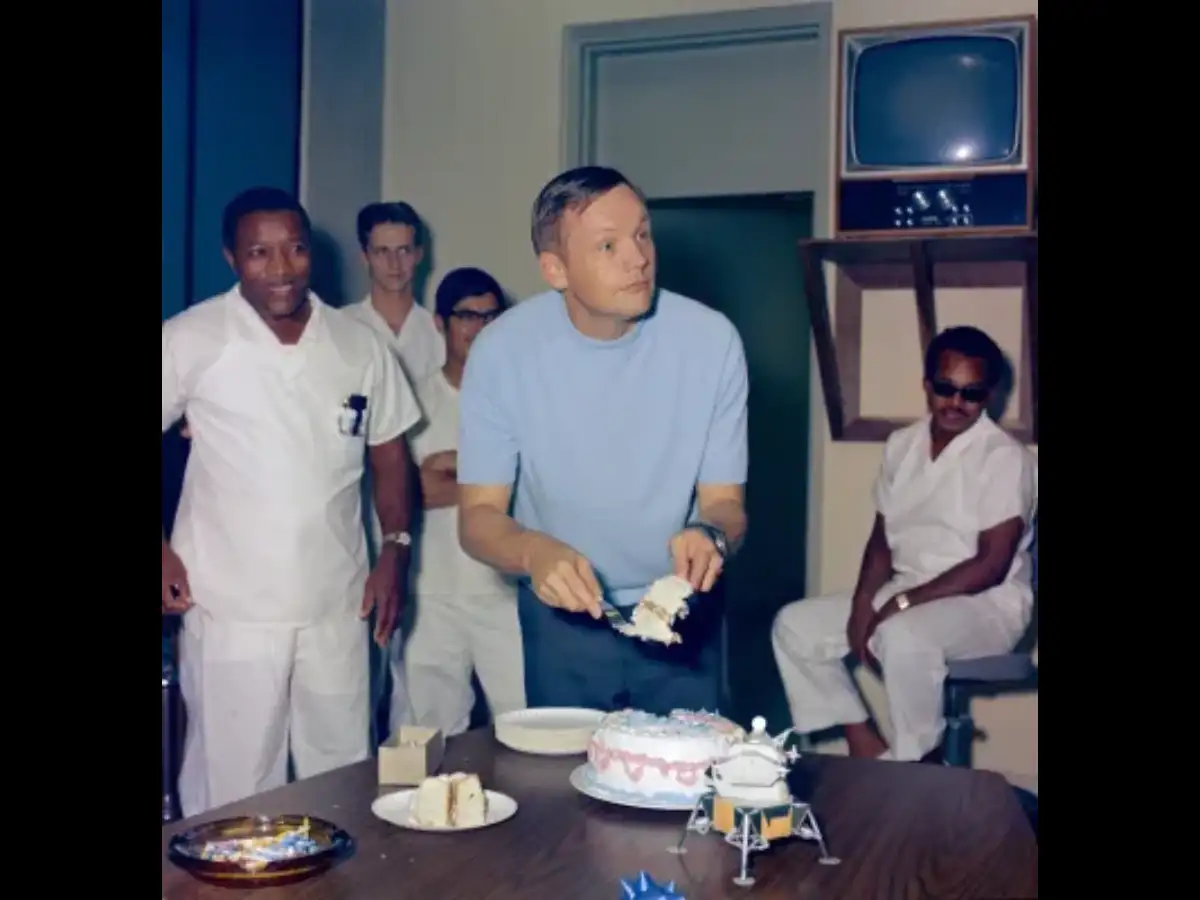
Armstrong turned 39 on August 5, 1969. He was still in quarantine. NASA personnel, however, did not let the extraordinary circumstances completely overshadow his birthday.

Workers inside the Lunar Receiving Laboratory prepared a surprise celebration. The kitchen staff baked and decorated a birthday cake, complete with candles. Armstrong blew them out and sliced the cake for the LRL personnel. His wife, Janet, and the other astronauts' wives watched from the other side of a glass partition. Armstrong even jokingly pretended to pass pieces of cake through the glass. Watch the clip of the celebration.

Sign up to read this article
Read news from 100's of titles, curated specifically for you.
Already a member? Sign in here
Related Stories
Top stories on inkl right now
One subscription that gives you access to news from hundreds of sites
Already a member? Sign in here
Our Picks
Fourteen days free
Download the app
One app. One membership.
100+ trusted global sources.