
Get all your news in one place.
100's of premium titles.
One app.
Start reading
T3
T3
Technology
Mike Lowe

After 9 years, Sony has proven once again why cameras still matter

Sony RX10 V.

Many years ago, I principally reviewed cameras – seeing literally hundreds of different models over the years. My job evolved to covering wider consumer tech, as the humble camera market became less and less relevant.

In time, the best phones became the best cameras for many of us. After all, as the famed Chase Jarvis quote goes: "The best camera is the one you have with you". Phone-makers saw the opportunity, invested heavily, even signing lucrative collaborative deals with the likes of Hasselblad and Leica.

But while dedicated camera sales have declined 90% since 2010, this month – after a 9-year hiatus – Sony has proven once again why cameras truly still matter. The Japanese giant's reveal of the RX10 V puts dedicated superzooms back on the map, showing there's a market for what phone cameras frankly cannot deliver.

Superzooms are back

(Image credit: Sony)

Now, I know what you're thinking: "A £/$2,200 bulky camera – who's going to want that?!". But given its unique position in this market, Sony's release of this product at this moment asserts there's a demand.

It's fair to call it niche, but a camera such as this can do so much more than any mobile phone. That's down to a number of factors, with the lens – able to deliver a 24-600mm equivalent zoom – and 1-inch sensor size being particularly vital.

True enough, some camera-focused phones, such as the Oppo Find X7 Ultra and, more recently, Xiaomi 17 Ultra, have used 1-inch sensors to up their game. But such a physically large sensor in a phone has the knock-on effect of making for a much larger device overall. And for phones that's simply not desirable.

It's also true that phone-makers have been pursuing greater zoom capabilities from clever designs, with the Oppo Find X9 Ultra, for example, delivering a first-of-its-kind quintuple prism mechanism for a 10x zoom (equivalent to 230mm). Still, that's not a patch on the RX10 V's 600mm at its fullest extension.

A large sensor without an over-the-top resolution has the benefit of capturing more light per 'pixel', which gives advantages for cleaner processing and results. Sony's choice to maintain a 20.1-megapixel chip only heightens that – as there's less division than the 50MP sensor used in both the Oppo and Xiaomi phones.

AI can't solve all

(Image credit: Sony)

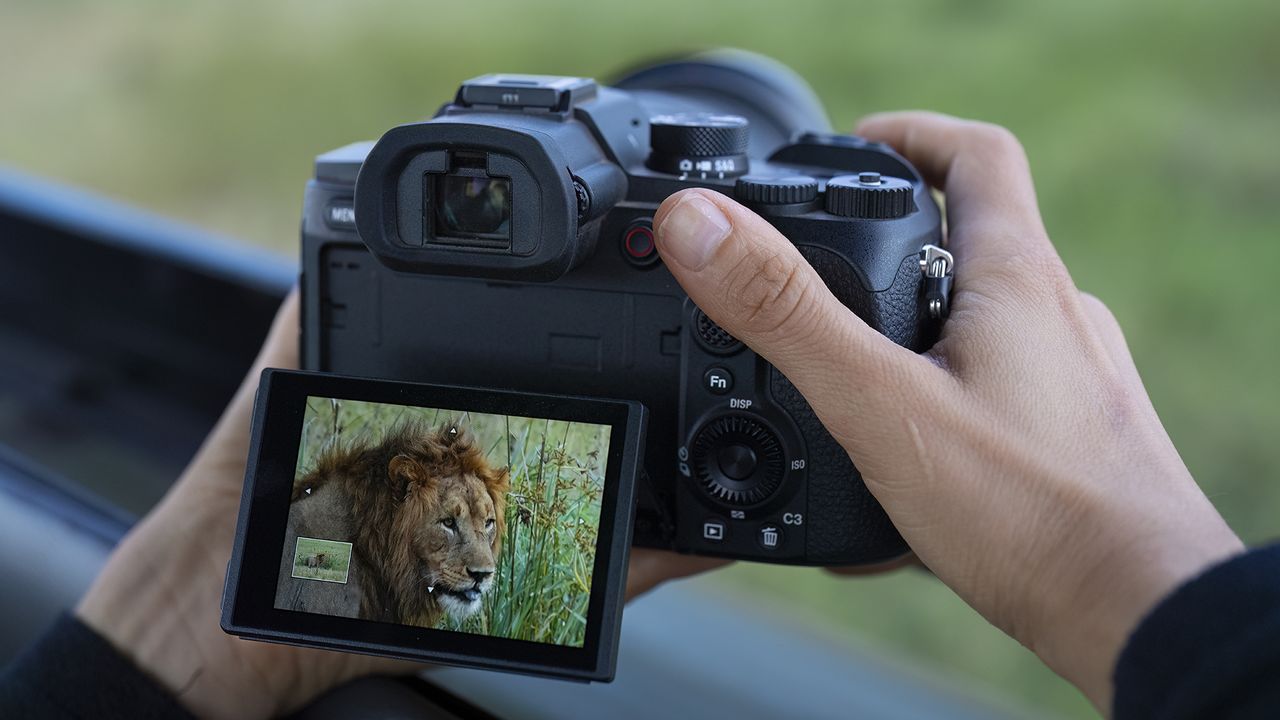
There's more about the RX10 V that appeals too. There are design fundamentals to consider, for example, with the pull-out LCD display on the rear allowing for more creative framing. It also features a built-in OLED viewfinder, which you can press against your face when shooting, adding stability to compositions and helping to nail sharper images.

Those physicalities can't be replaced by artificial intelligence (AI), which is where the phone-makers are going all-in with applying AI to processing. The concept makes sense, as AI can analyse an image's context, but the processing can sometimes get outlandish – and effectively 'create' small parts of a scene that don't truly exist. Sometimes this can look downright wrong.

Sony doesn't lean on AI for this kind of processing. Instead it relies on deep knowledge and experience in the imaging industry – after all, it's been producing electronic cameras since the 1990s; its purchase of Konica Minolta in 2006 birthed what would become Sony Alpha; and since the brand has gone on to dominate in the mirrorless market and in production of high-end lenses.

The RX10 V acquires much of that know-how in a single-body solution. It does use AI, but for scene context – for recognising people, birds or other animals, for example, and quickly assisting with focus. Again, no phone-maker has got anywhere near the kind of autofocus systems that Sony can offer.

Much as I love the best phone cameras on the market and applaud the ongoing innovations in that space, for me Sony's launch of the RX10 V after almost a decade-long hiatus is such a stellar move. It shows there's still a need for dedicated cameras and that design, features, autofocus, sensor type, processing and zoom still simply can't be matched by something you can slip into your pocket. And I'm just fine with that.

Sign up to read this article
Read news from 100's of titles, curated specifically for you.
Already a member? Sign in here
Related Stories
Top stories on inkl right now
One subscription that gives you access to news from hundreds of sites
Already a member? Sign in here
Our Picks
Fourteen days free
Download the app
One app. One membership.
100+ trusted global sources.