Get all your news in one place.
100's of premium titles.
One app.
Start reading
The Economic Times
The Economic Times
Shreya Biswas

A wildlife photographer’s 4-year quest ended with a coyote image that looks like a glitch and defies physics

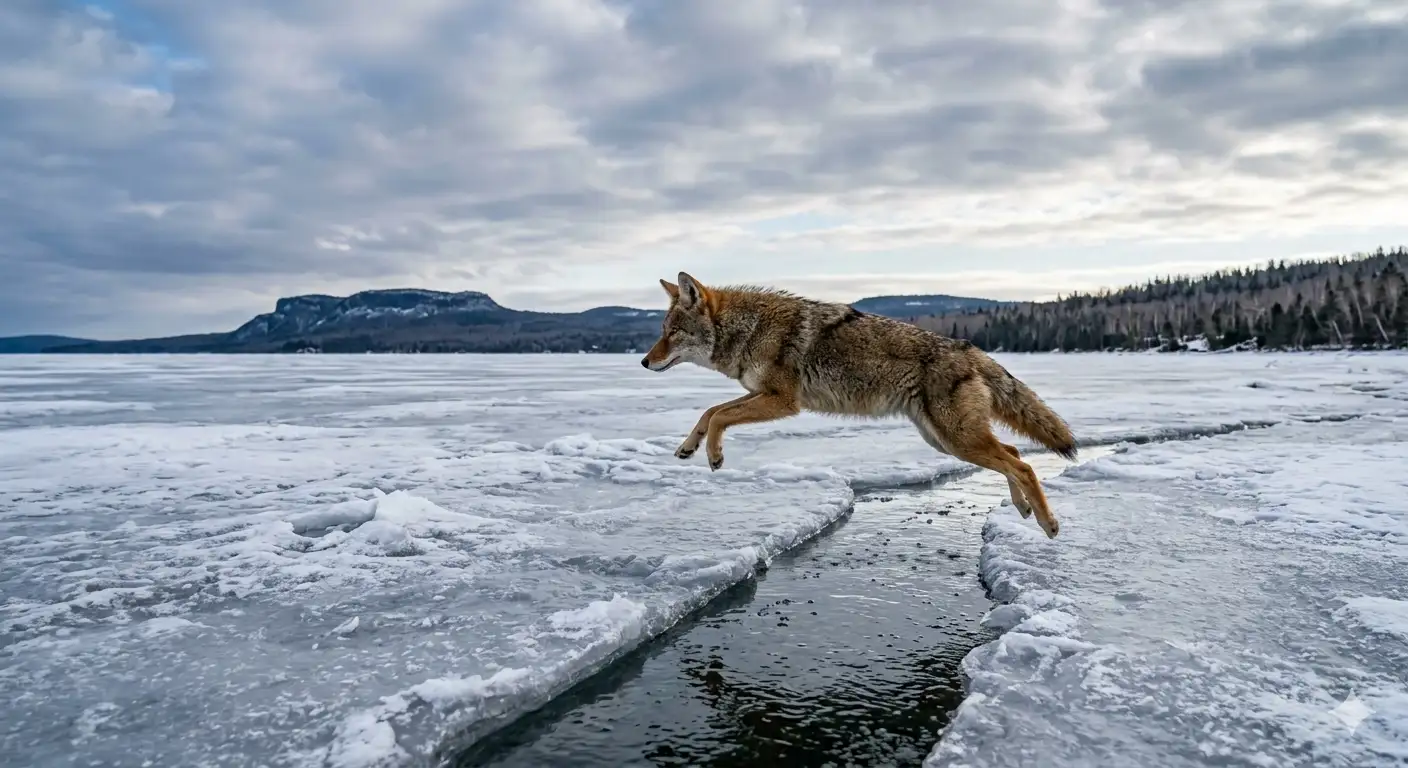
Coyote jumping ice photo : A coyote suspended in midair above a narrow crack in frozen water. A clean, split-second leap over the ice on Lake Superior’s northern shore in northwestern Ontario, Canada and far in the background, the Sleeping Giant sitting quietly over the winter landscape, as per a report. At first glance, the image almost feels unreal, like a moment that shouldn’t quite hold together.

But behind that “glitch-like” frame is not chance alone. It is the result of years of returning to the same icy shoreline, waiting for the exact conditions where coyotes are known to reach open water in winter.

A Four-Year Wait on Frozen Shores

Photographer Jamie Ruggles, based in Thunder Bay, had been working toward this kind of shot for years. He described it as, in a sense, a four-year wait, built from repeated visits to winter drinking spots where open water remains accessible even when everything else is frozen, as per an Eco News report.

The idea for the photograph was not sudden. It developed over time, along with close observation of how animals move through the ice-dominated landscape.

Ruggles also recalled advice from a National Geographic editor to simply “spend the time in the field,” a process that often meant long waits in cold conditions with nothing happening at all, as per the Eco News report.

READ ALSO: Chinese proverb of the day: 'Distant water will not quench a fire near, distant relations are not so good as...' - motivational life lessons on importance of neighbours, community support and why proximity in relationships matters in times of crisis

Why Coyotes Move Across the Ice

Coyotes, which are widely distributed across North America, are highly adaptable animals. Their diet can include small mammals, fish, frogs, insects, snakes, fruit, and grass, and their lighter body weight allows them to move efficiently across snow and ice.

In this case, the coyote was not necessarily hunting. According to Ruggles’ account, the location is one where coyotes come in winter because open water allows them to drink.

A crack in the ice becomes more than just a break in the surface. It becomes a survival point in an otherwise frozen environment.

Lake Superior as a Winter Stage

Lake Superior adds scale to the moment. It is the largest and deepest of the Great Lakes, reaching depths of up to 1,333 feet, and is also the second largest lake in the world by surface area.

The Sleeping Giant visible in the distance anchors the image geographically. It is part of Sleeping Giant Provincial Park, a 60,300-acre protected area known for its trails and boreal forest wildlife.

Together, the ice, water, shoreline, and distant landform turn a brief animal movement into a wider winter scene shaped by geography and season.

READ ALSO: Could a simple stick be the secret to better balance? New research says yes

A Split-Second That Took Years to Reach

What appears in the final photograph is a coyote mid-leap over a narrow opening in the ice, a fraction of a second frozen in time.

Ruggles described the experience as being in the right place at the right time, as per the Eco News report. But that moment depended on years of returning, watching, and understanding where and when coyotes might cross these frozen gaps.

It also depended on patience, including many days when nothing appeared at all.

Even after capturing the image, Ruggles’ reaction was not final satisfaction, but immediate reflection on how the moment might be improved in the future, as per the Eco News report.

Wildlife Kept Wild

The photograph also sits alongside a reminder from Ontario guidance on coyote interactions. Coyotes are common in the region, especially in late winter, and should be observed from a distance without feeding or interference.

FAQs

What is the coyote photo about?

It shows a coyote mid-leap over a crack in frozen Lake Superior water.

Where was the image captured?

On the northern shore of Lake Superior in northwestern Ontario, Canada.

Sign up to read this article
Read news from 100's of titles, curated specifically for you.
Already a member? Sign in here
Related Stories
Top stories on inkl right now
One subscription that gives you access to news from hundreds of sites
Already a member? Sign in here
Our Picks
Fourteen days free
Download the app
One app. One membership.
100+ trusted global sources.