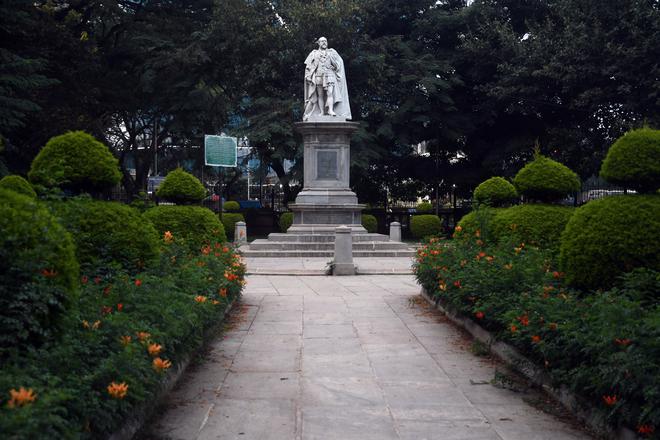
“Here is Mark Cubbon,” says Siddharth Raja, the founder of Nandi Valley Walks, pointing to the equestrian statue of the former Chief Commissioner of Mysore and Coorg, after whom the park was named. The bronze statue, hewn by sculptor Baron Carlo Marochetti, depicts Cubbon seated on a horse with all four hooves firmly planted on the ground.
Siddharth then proceeds to explain the symbolism of it. If a person is seated on a horse with rearing front legs, it indicates the rider has died in battle, while if one front leg is up in the air, it indicates that he was wounded or died later of battle wounds. “If both legs are planted, it means he died outside of battle,” he says. While this symbolism is often dismissed as an urban legend, it is indeed true that Cubbon, a keen horseman, died on a ship in the Suez Canal while returning to England after nearly 60 years spent in India. “He was a British officer who dedicated his life to India,” says Siddharth.