Get all your news in one place.
100's of premium titles.
One app.
Start reading
The Economic Times
The Economic Times

A TV show on a detached piece of Russian land triggers nuke warning

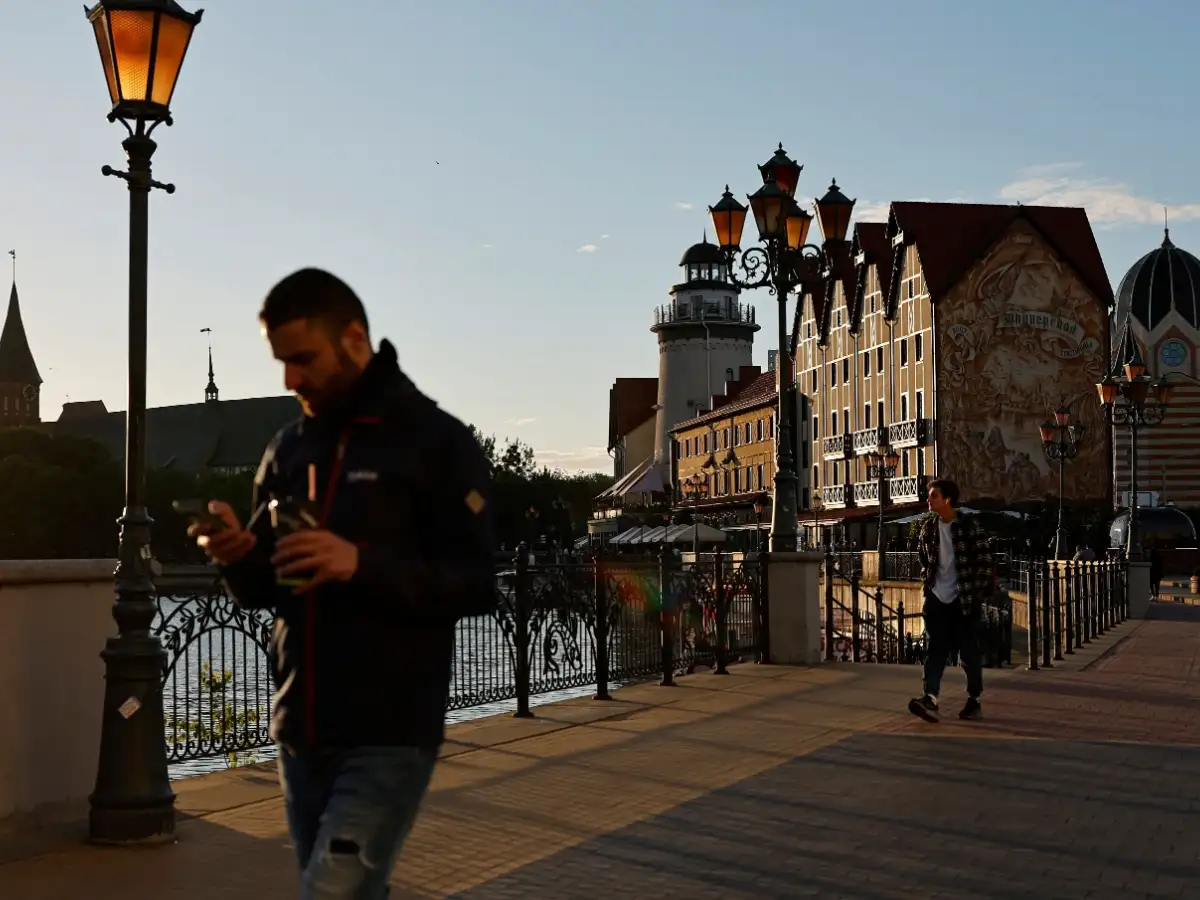
A recent TV show on a fictional British war game has become entangled with a very real nuclear warning from Russia. At the centre of the drama is Kaliningrad, a small Russian territory wedged between NATO members Poland and Lithuania and separated from Russia by hundreds of kilometres.

Russian embassies have explicitly invoked Western discussion of a possible attack or blockade of Kaliningrad, while Moscow has sent NATO a separate diplomatic note warning that an attempt to isolate it could trigger strikes on alliance decision-making centres and even nuclear use.

The unusual geography of Kaliningrad

Kaliningrad was not historically Russian territory. For centuries it was Königsberg, a major German city and the capital of East Prussia. The city was associated with Prussia and later the German Empire, and became famous as the home of philosopher Immanuel Kant.

Also Read: Russia warns NATO of a possible nuclear response if Kaliningrad is cut off

The geography changed after the Second World War. Soviet forces captured Königsberg in April 1945 during the final battles in East Prussia. At the Potsdam Conference that summer, the United States and Britain agreed in principle to the Soviet proposal to transfer Königsberg and the surrounding area to the Soviet Union, pending a final peace settlement. The rest of East Prussia was divided largely between Poland and the Soviet Union.

The German population was subsequently expelled or fled. Soviet authorities repopulated the region with people from Russia and other parts of the Soviet Union. In 1946 Königsberg was renamed Kaliningrad, after Soviet politician Mikhail Kalinin.

For the Soviet Union, the territory had an obvious military value. It provided an ice-free Baltic port and a forward position for the Soviet Baltic Fleet. During the Cold War it was heavily militarised and effectively closed to foreigners.

The oddity became much greater in 1991. When the Soviet Union collapsed, Lithuania and Belarus became independent states. Kaliningrad therefore ceased to be connected by land to the rest of Russia.

What Kaliningrad means for Russia and NATO

Kaliningrad is not large, but its position gives it an importance far beyond its size. It sits on the Baltic Sea between Poland and Lithuania, close to the sea lanes linking the Baltic states with the rest of Europe.

Just to its south is the Suwałki Gap, the roughly 65-kilometre corridor between Poland and Lithuania. It is the only land connection between these Baltic states and the rest of NATO. Access to Kaliningrad is a key Russian concern while access across the Suwałki Gap is a corresponding NATO concern. That produces an uncomfortable strategic symmetry. NATO worries that in a conflict Russia could use Kaliningrad together with Belarus to threaten the Suwałki corridor and make reinforcement of Estonia, Latvia and Lithuania difficult. Russia, meanwhile, worries that NATO could exploit the Baltic geography to restrict its access to Kaliningrad.

Also Read: Russia's long-range bomber crashes on a training mission, killing 6 crewmembers

Military planners on both sides, therefore, study essentially the same piece of geography from opposite directions.

A military platform, not just an exclave

Russia has spent years turning Kaliningrad into a heavily armed forward military position. Russian forces there have included advanced air-defence systems and anti-ship missiles. The enclave has also been associated with Iskander ballistic missiles, which can carry conventional or nuclear warheads.

The strategic concept is often described as anti-access/area denial, or A2/AD. The idea is to make it dangerous for an adversary to operate aircraft or naval forces within a particular area. CSIS has described Kaliningrad as one of the main concentrations of Russia's A2/AD capabilities in Europe.

Its location means those systems can influence operations across much of the southern Baltic. In a major war, NATO would therefore have to account for Russian missiles and air defences in Kaliningrad even if no Russian troops moved out of the exclave.

This is also why some Western military analysts have argued that NATO could eventually have to suppress or destroy Russian military systems there in a Baltic conflict. That is contingency planning, however, not evidence that NATO has decided to attack Kaliningrad.

NATO has been planning around Kaliningrad for years

The current Russian warning did not emerge from nowhere. NATO exercises and military planning have long considered the vulnerability of the Baltic states and the Suwałki Gap. Russia itself has also conducted exercises involving Kaliningrad and the surrounding region. Russia's Zapad exercises have included scenarios involving attacks on Kaliningrad and operations around the Suwałki area.

Western military analysts have similarly modelled scenarios in which Russian forces could try to close the Suwałki corridor. Keeping that corridor open is a central problem of NATO in defending the Baltic states.

How a TV war game provoked nuke warning

Sky News of the UK recently broadcast 'The Wargame', a fictional scenario involving a Russian attack on Britain and the subsequent decisions facing the British government and military. Kaliningrad became part of the discussion about how Britain and its allies might respond.

Russian diplomatic missions seized on that coverage. The Russian embassy in London explicitly referred to the programme while warning about the consequences of military action against Kaliningrad. Other Russian embassies issued similar warnings about NATO exercises and scenarios involving the enclave.

The Kremlin described the diplomatic messages as an effort to “cool down hot heads” in Europe.

Also Read: Russia accuses Europe of seeking to thwart Ukraine talks

From Russia's point of view, an actual Western television production indicates that discussion of attacking or isolating Kaliningrad is no longer confined to obscure military planning circles. But the programme itself was fictional. There is no evidence that it represented a NATO decision to blockade Kaliningrad.

Moscow's communication to NATO

According to Reuters, Moscow's diplomatic note to NATO warned that Russia would be prepared to use its entire arsenal, including nuclear weapons, if NATO countries attempted to isolate Kaliningrad. It also warned of possible Russian strikes against NATO decision-making centres at the outset of a conflict. NATO responded that its exercises are defensive and do not threaten Russian territory.

The Financial Times reported that Moscow was interpreting NATO exercises and the Baltic Sentry mission as preparations for a possible blockade. However, NATO has rejected that interpretation.

So, Russia is warning about what it says NATO might do and it is not responding to an announced NATO decision to blockade Kaliningrad.

Why Russia's warning still matters

The danger lies in the interaction between real military planning and hypothetical scenarios. NATO has genuine reasons to prepare for a conflict involving the Baltic states. Russia has genuine reasons to regard Kaliningrad as strategically vulnerable because it is physically separated from the Russian mainland. Both sides therefore conduct exercises and develop contingency plans that the other side can interpret as evidence of offensive intentions.

American think tank RAND has warned that the lack of strategic depth in the Baltic region can reduce warning time and increase fears of pre-emption. That is the deeper significance of the latest episode. A fictional war game did not create the Kaliningrad problem but landed on top of a decades-old military dilemma that has become sharper since 2022 when Russia invaded Ukraine.

The result is a particularly dangerous form of escalation. A hypothetical Western scenario is treated by Moscow as evidence of hostile intent, while Russian warnings about nuclear weapons are treated in Europe as evidence that Moscow is preparing for a wider confrontation. Neither interpretation necessarily means a Russia-NATO war is imminent but each side's reaction can make the other's contingency planning more aggressive.

Sign up to read this article
Read news from 100's of titles, curated specifically for you.
Already a member? Sign in here
Related Stories
Top stories on inkl right now
One subscription that gives you access to news from hundreds of sites
Already a member? Sign in here
Our Picks
Fourteen days free
Download the app
One app. One membership.
100+ trusted global sources.