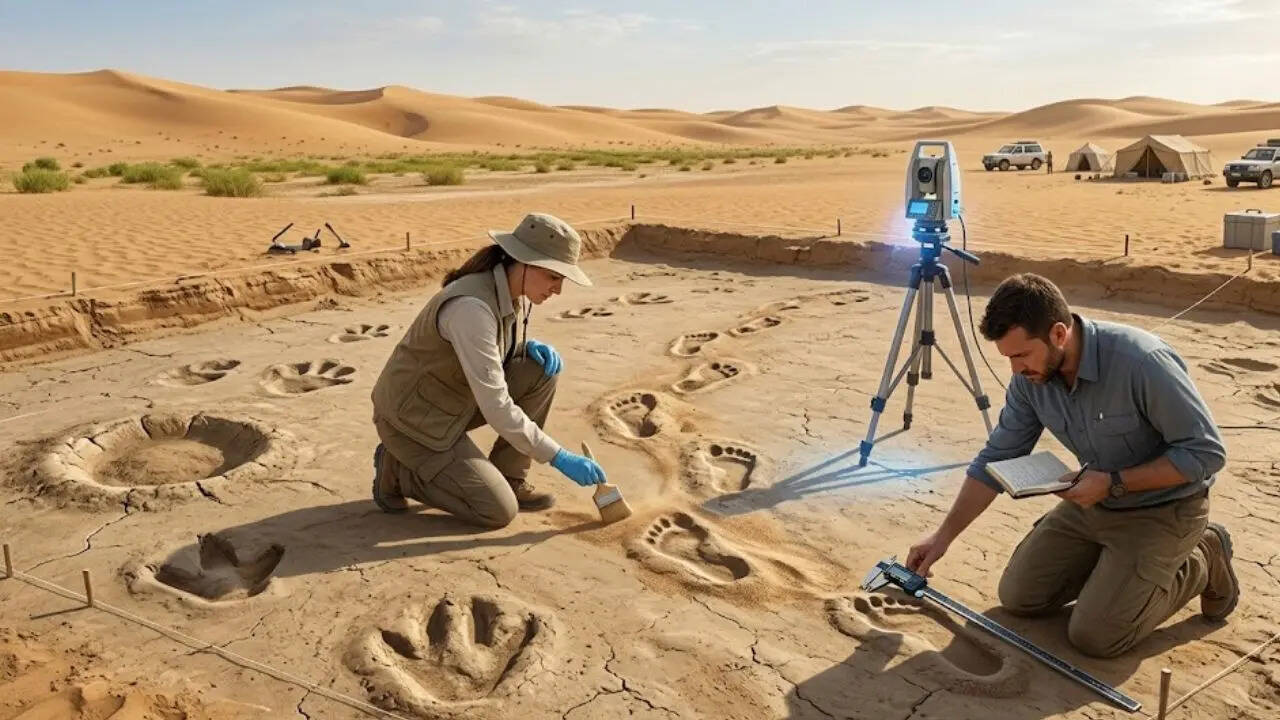
Archaeologists have identified 120,000-year-old human footprints at the ancient lake site of Alathar in the Nefud Desert, Saudi Arabia. Ancient human artefacts discovered in the Nefud Desert demonstrate a long history of human habitation in the region. According to the research published in Science Advances, the site includes 120,000-year-old human footprints found at Alathar (an ancient lake), providing the oldest dated example of Homo sapiens on the Arabian Peninsula, pushing back the timeline of human migration from Africa.
During the Last Interglacial, before the area became arid, it was called ‘Green Arabia,’ complete with large lakes and abundant plant and animal life. Many of the 120,000-year-old footprints were discovered collaboratively by archaeologists from the Max Planck Institute and the Saudi Heritage Authority. These footprints provide evidence that early humans, who used the inland lake systems as excellent habitat areas and migration corridors, lived and migrated with prehistoric elephants and hippopotamus for about 15,000 years when climatic conditions allowed for good living and good migration.