
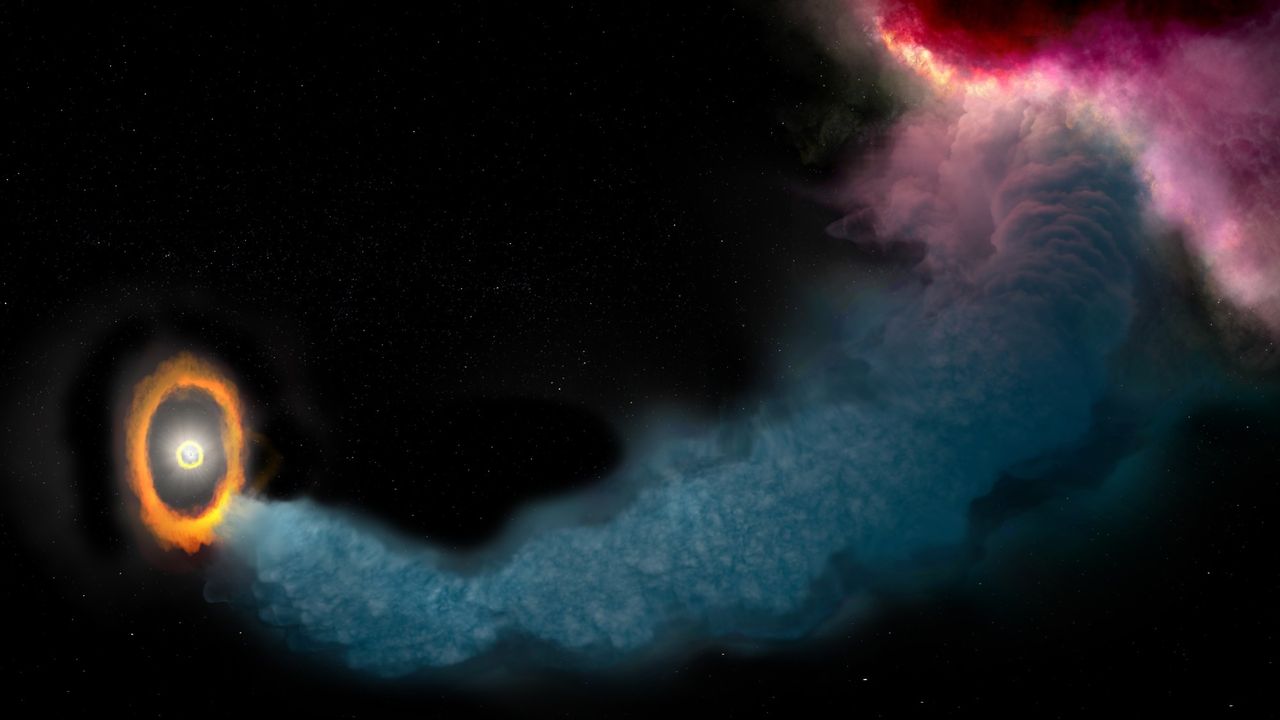
A rare planet-forming disk around a young triple-star system in the Orion constellation has been tipped over by a river of gas over 1 trillion miles (1.6 trillion kilometers) long. The discovery, made at radio wavelengths with ALMA, the Atacama Large Millimeter/submillimeter Array in Chile, could explain why astronomers keep finding planets with orbits that are drastically misaligned with the rotational axes of their stars.
GW Orionis is a triple system consisting of three pre-main sequence stars, meaning that they are still forming and contracting and have not yet initiated fusion reactions of hydrogen in their core. The stars are located roughly 1,300 light-years away, in the Lambda Orionis star-forming molecular ring in the constellation of Orion, the Hunter. Finding a planet-forming disk of gas and dust encircling all three stars in a system is very rare, and finding a disk consisting of three rings with misaligned orbits is even stranger.