Get all your news in one place.
100's of premium titles.
One app.
Start reading
The Economic Times
The Economic Times
Shreya Biswas

A historic textile mill narrowly escaped demolition; developers preserved its historic elements and transformed the site into a mixed-use development

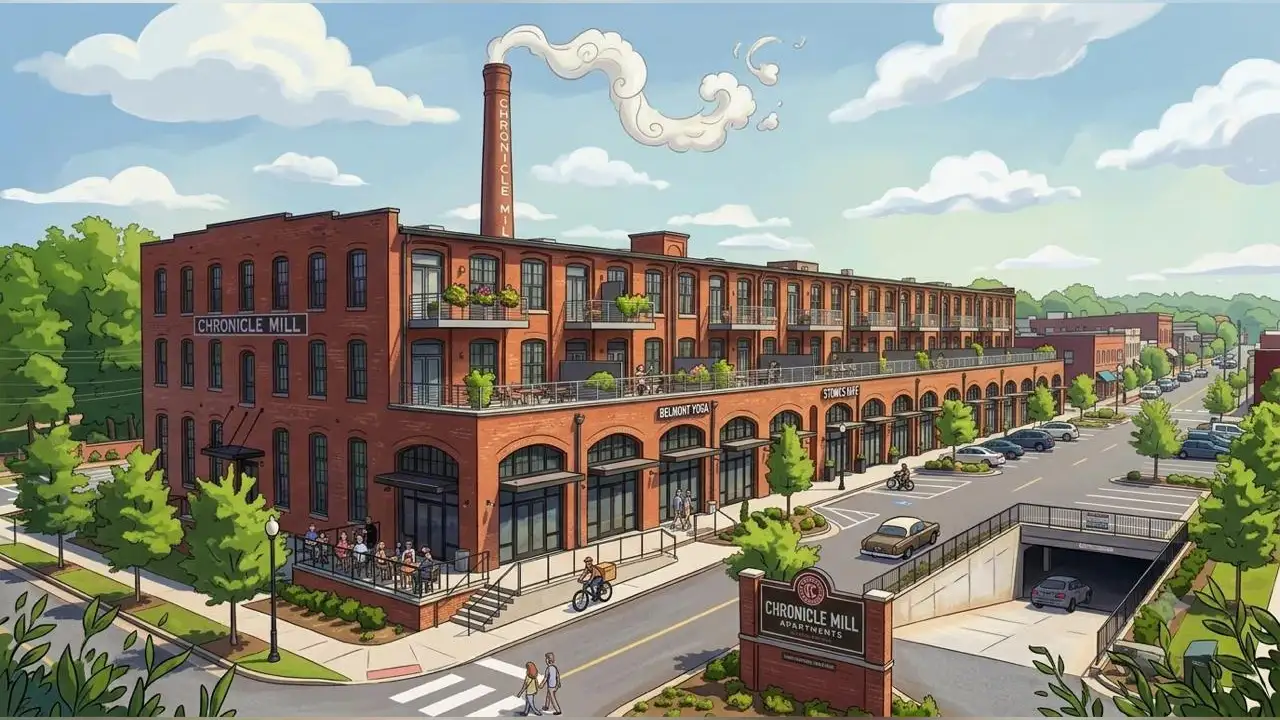
A former textile mill in Belmont, North Carolina, that produced its last skein of yarn in 2010 and narrowly escaped demolition has been restored through a partnership with Armada Hoffler Properties Inc into a mixed-use development, as per a Nareit report. The redevelopment retains an important part of the town's history while creating a development with housing and retail space.

Historic textile mill was initially headed for demolition

John and Jennifer Church, owners of Centra Properties, a commercial real estate company based in Belmont, purchased Chronicle Mill in 2013. John Church said their initial plan was to tear down the 110,000-square-foot, 120-year-old textile building and sell the seven acres.

However, as demolition began, the Churches recognized the potential to redevelop the historic property as a reimagined mixed-use addition to complement Belmont's revitalizing downtown. Church said the value that could be created by continuing the property's legacy within the community became their primary goal.

The Churches brought Virginia Beach, Virginia-based Armada Hoffler in as a partner in 2018. Nareit said that 10 years after the Churches purchased the property, their vision for Chronicle Mill was realized with Armada Hoffler as a partner.

READ ALSO: Ryan Reynolds bought a stake in Aviation Gin in 2018 and oversaw its creative direction; 2 years later, Diageo acquired the brand in a deal worth up to $610 million

Chronicle Mill redevelopment preserved historic elements

Chronicle Mill was founded in 1902 by R.L. Stowe Sr. and Samuel Pinckney Stowe, according to Nareit. It was one of multiple textile facilities that closed in the region as the textile industry slowed and moved overseas, Donny Hicks, executive director of the Gaston County, North Carolina Economic Development Commission, said.

Hicks said many former textile properties were razed, resulting in the loss of millions of square feet and lots of history.

The redevelopment required substantial structural work. Shawn Tibbetts, COO of Armada Hoffler, said the 120-year-old mill had to be stripped down and reinforced to handle its new function.

Tibbetts said the development team wanted to preserve the beauty of the old wood and brick in the existing walls while integrating new and efficient systems into the mill. He credited Armada Hoffler's in-house construction and development team with restabilizing the foundation and restoring as much as possible of the pre-existing elements.

One of the biggest challenges was getting electrical and plumbing conduits through the pre-existing structure without impacting its integrity, Tibbetts said.

Mixed-use development includes 244 apartments and retail space

Chronicle Mill has 244 apartments, two live-work units and 9,000 square feet of retail space, according to Nareit. The property achieved stabilization within six months instead of the anticipated 18 months, Tibbetts said.

The live-work units are two-level spaces. Tibbetts said the lower-level living area faces a garden, while the work area is on the street level to provide visibility for the business.

Armada Hoffler anticipated that the retail space would include a small fast-casual restaurant, a brewery, a yoga studio or similar businesses. These were described as anticipated uses rather than confirmed tenants.

The building is within walking distance of Belmont's downtown, according to Tibbetts.

READ ALSO: In 2020, Willie Nelson turned his 500-acre Texas Luck Ranch into a regenerative farm using managed grazing. 6 years later, it continues alongside rescued horses and native-grass work

Belmont textile mill redevelopment faced pandemic-era challenges

The adaptive reuse project involved construction and infrastructure challenges. Tibbetts said converting the mill into residences was difficult and that the project was executed during the pandemic, when materials and construction prices were unstable and climbing.

Church said the project also involved a brownfield agreement, zoning restrictions, intrusive utility easements and procuring entitlements. The team had to work around the power grid that fed the mill and relocate utilities. It also had to conduct a traffic study and address parking.

Armada Hoffler used the site's topography to add a one-story parking deck, Hicks said.

Tax credits and local incentives helped the project

Hicks said Armada Hoffler used state tax credits and funds for mill renovations and brownfield redevelopment tax credits to assist with the project's challenges. He also said the city of Belmont and Gaston County provided incentives to move the Chronicle Mill project forward.

Tibbetts said the support from city and county officials made it easier to get stakeholders moving in the same direction. He also said there were concerns about parking and the impact on surrounding residential neighborhoods.

READ ALSO: In 2024, the EU-funded REWIND project began developing blade reuse and recycling methods. 2 years later, more than 20 square metres of recovered sections supported new applications

Chronicle Mill reached stabilization in six months

Tibbetts said the demographics showed that the market needed this type of housing because Charlotte had been growing quickly, particularly after COVID-19. He said there was a market for young professionals who wanted to live close to Charlotte while maintaining a slower pace of life.

Tibbetts also said the rapid run-up in apartment rents during the period when Armada Hoffler was remodeling Chronicle Mill offset the construction cost increases the project faced.

Hicks said Chronicle Mill's fast lease-up provided proof that a market exists for higher-end multifamily communities in Gaston County. He also said several more adaptive reuse projects were on the way in the county.

Former textile mill connects Belmont's past with future growth

Hicks said Belmont residents are proud of the town's history in the textile industry. He described Chronicle Mill as a project that ties the community's past to its future growth.

Church said Chronicle Mill had been reactivated in downtown Belmont and would be part of the community for many generations to come. He described the project as an example of a community coming together to build an enterprise that lasts beyond what its original creators envisioned.

READ ALSO: Japanese mindset: 'Wisdom and virtue are like the two...' - this inspiring saying teaches powerful life lesson on knowledge, character and how to make better decisions in life

Sign up to read this article
Read news from 100's of titles, curated specifically for you.
Already a member? Sign in here
Related Stories
Top stories on inkl right now
One subscription that gives you access to news from hundreds of sites
Already a member? Sign in here
Our Picks
Fourteen days free
Download the app
One app. One membership.
100+ trusted global sources.