
As a historic heat wave gripped Paris this week, fashion houses tried to keep their guests cool with ice packs, mist machines and iced Evian on silver platters.
It wasn’t enough: some venues still sweltered, water ran short and air conditioning was absent or inadequate.

Then they sent their models down the runway in leather, neoprene and wool.
That was the contradiction at Paris Fashion Week Men’s, where a heat wave turned spring-summer fashion into a test of whether luxury can dress — or act — for the warming world it claims to address.
“I honestly thought I was going to pass out,” said Ben Freeman, a London-based fashion critic from Australia.
Some in the front row said Paris may have to consider moving fashion week away from the height of summer if climate change keeps bringing more frequent and intense heat waves.
“I don’t know how the models did it this week in some of the leather and knit coats,” said fashion student Thomas Levy, 24, outside one show.
“The heat rarely seems to make it into the clothes. It shows up in the sets like at waterfalls and mist machines and ice packs.”
Heat as a production problem
Across the week, designers treated heat as a hospitality problem, a staging problem and a scheduling problem — rarely as a design problem.
Guests got ice packs, cold towels and water. Sets got waves, fog and mist. Schedules moved earlier, and punctuality became a heat precaution.
Dior moved its show Wednesday from 2:30 p.m. to 9 a.m., but the heat pressed in. Water was limited, there was no air conditioning, and some guests appeared unwell.
Jonathan Anderson’s most elegant answer was sheer silk-chiffon tailoring — but elsewhere came heavy knits, made less for Paris in June than for a global calendar out of sync with the weather.
“The calendar does not make any sense,” Anderson told reporters. He cited fractured delivery cycles and a changing business, suggesting the fashion calendar no longer lines up with actual weather or with how luxury clothes are sold.
Runways out of season
These are spring-summer shows, but not simply summer clothes.
Luxury collections are made for global markets, staggered deliveries and customers who pass the hottest months in refrigerated air.
For many, a wool coat in June is not a seasonal contradiction; it’s a desired purchase.
At Saint Laurent, models walked through clouds of vapor from a Fujiko Nakaya fog installation inside the Bourse de Commerce, turning heat into atmosphere rather than escape.
Anthony Vaccarello stripped his tailoring to unlined jackets and soft, pale silhouettes — light, he told reporters, for the heat — then ran the temperature back up with leather briefs, choker scarves, bare legs and transparent shoes clouded with perspiration.
The result was not a surrender to summer, but a Saint Laurent version of it: cooler construction, hotter attitude.
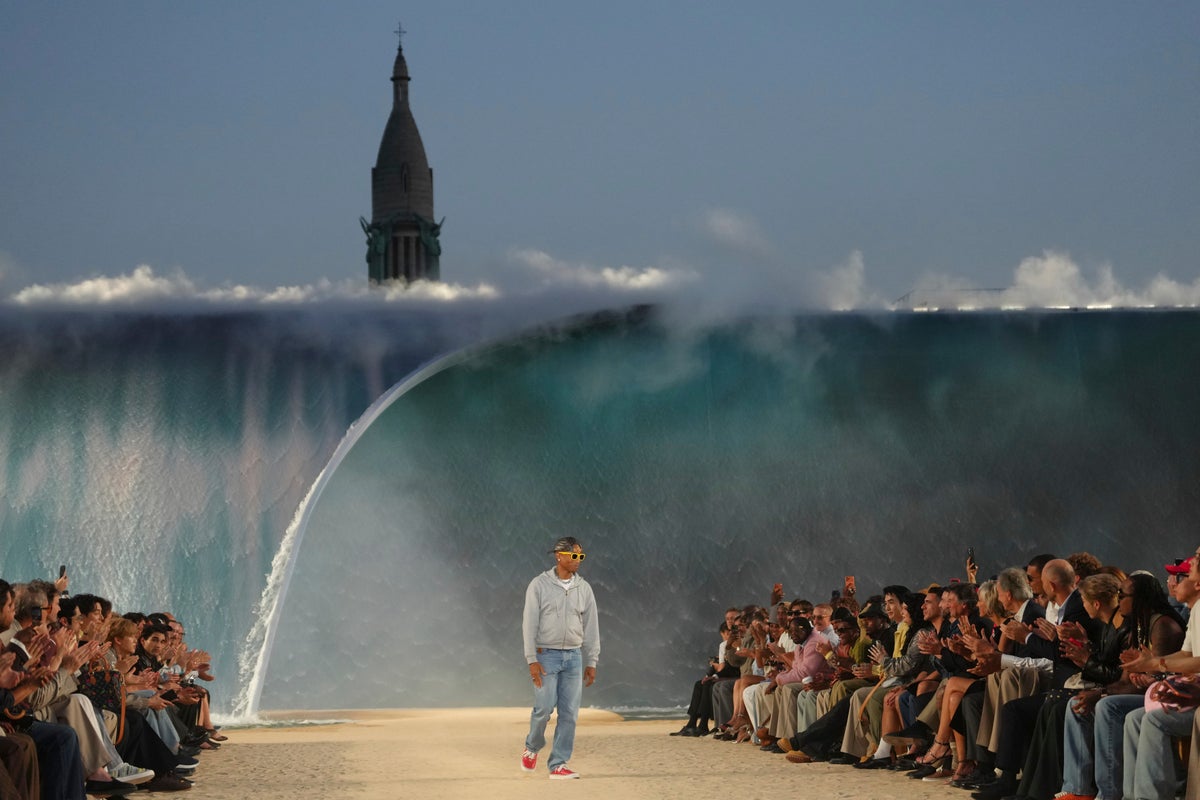
At Louis Vuitton, Pharrell Williams' models emerged from a giant artificial wave onto sand. Yet the wetsuits were neoprene, the coats cashmere and fur.
Issey Miyake’s IM Men offered one of the week’s clearer practical answers.
Its show, “In Praise of Bamboo Shadows,” handed out ice packs at the door, then sent out bamboo-thread fabrics woven with organic cotton, light nylon and shadowy prints.
The silhouettes moved away from the body, treating air as part of the design rather than something supplied only by the venue.
At Ami, Alexandre Mattiussi said the obvious from beside an industrial fan — “Paris is burning” — and dressed it like a Parisian living in it: loose shorts, washed trenches and “I Love Paris” T-shirts.
Rick Owens came closest to making heat the subject. He moved his Thursday show earlier because of the heat, then sent models through mist at the Palais de Tokyo in garments with fans whirring inside.
One prominent fashion critic called the show “a metaphor for climate catastrophe.”
A French fight over cooling
Pascal Morand, head of France’s Haute Couture and Fashion Federation, said organizers were following the French government’s heat-wave plan.
“We are conscious of the challenges and very attentive to preserving the Fashion Week experience in this context of structural change,” he told The Associated Press.
Fashion was not the only Paris institution straining. As the Louvre shortened its hours during the heat wave, the museum said its historic building “remains vulnerable and is not sufficiently adapted to climate change.”
That change feeds a French argument over air conditioning, still distrusted by many in much of Europe — dismissed as wasteful or unecological.
Fashion week became a glamorous version of the problem facing France itself: how to keep public life, work and spectacle running in heat the country was not built for, without turning every room into an air-conditioned box.
President Emmanuel Macron’s government has leaned, like much of France, toward shade, insulation and trees instead.
Europe is the fastest-warming continent, its cities built of stone and short on air conditioning.
“Paris Fashion Week is the canary in the mine,” Freeman said.
From sport to tourism to construction, industries built around fixed calendars and outdoor crowds are being forced to adapt to heat that comes earlier, lasts longer and climbs higher.
Paris Fashion Week — outdoor, fixed and watched by the world — became a visible test.
___
Colleen Barry in Milan contributed to this report.







