A great way to break away from the typical blues soloing sound of pentatonic scales is to incorporate dominant 7 arpeggios into your improvised lines. As the name implies, a dominant 7 arpeggio is sounded by playing the notes of a dominant 7 chord, such as G7, C7 or D7, individually and in succession.
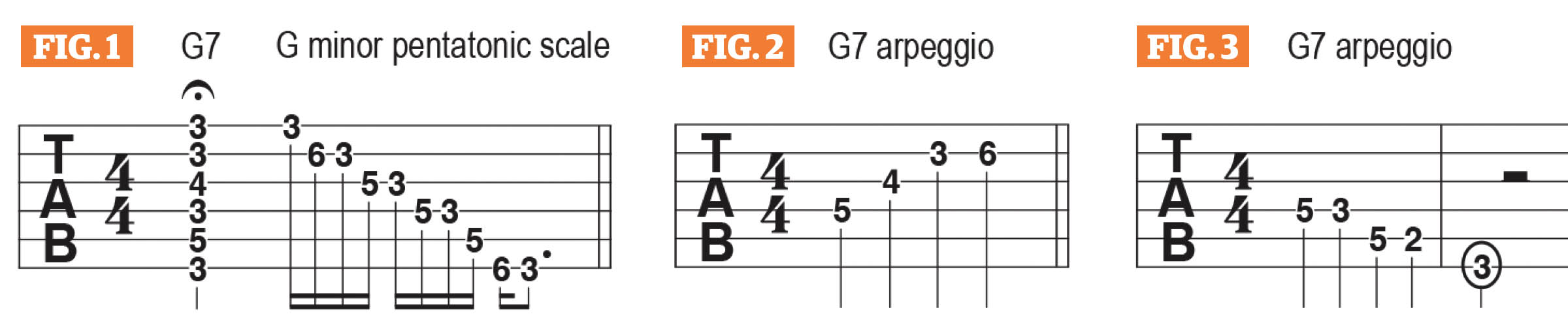
Let’s use the key of G as our point of reference: in Figure 1, a G7 chord is shown in 3rd position, followed by a G minor pentatonic scale (G, Bb, C, D, F) played in the same position.
What I often like to do, in order to create more interesting solo lines, is combine the notes of the minor pentatonic scale with those of a dominant 7 arpeggio, which, as you’ll notice, share three notes – the root, 5th and minor, of “flat” 7th.
Figure 2 illustrates a G7 arpeggio, built from the notes G, B, D and F. The first three notes give us a G major triad, and F is the minor, or “flatted,” 7th, which provides the dominant 7 sound. Figure 3 shows the same notes played in a descending manner on the lower strings.
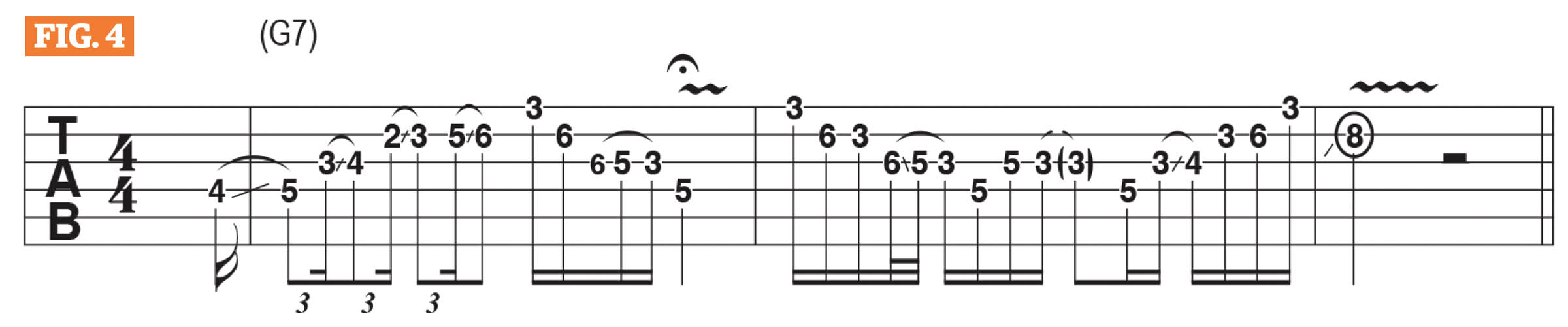
Articulation devices like finger slides and string bends offer great ways to incorporate the dominant 7 pitches into phrases.
For example, Figure 4 begins with a series of slides into the notes G, B, D and F, all from a half step below, after which I finish the phrase with more typical blues lines based on the G blues scale (G, Bb, C, Db, D, F).
A great way to practice improvising with dominant 7 arpeggios is to loop a rhythm part then solo over it. Figure 5 shows a simple shuffle-based rhythm part that sits on a G7 chord.
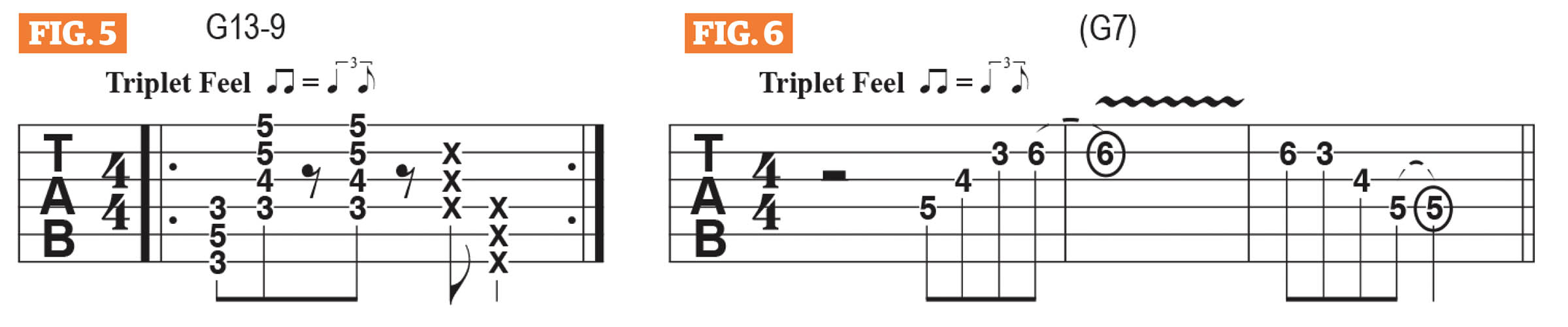
Figure 6 sounds the notes of a G7 arpeggio played over the loop, first ascending then descending.
To some people, this is more of a “jazzy” sound; the reason for this is, as is often the case in jazz, the chord tones are emphasized when playing arpeggios. The inclusion of B, the major 3rd, in addition to F, the minor, or “flatted,” 7th, builds a strong connection to the harmony of the G7 chord.
Figure 7 offers a longer example of how to combine phrases built from the G minor pentatonic and G blues scales with G7 arpeggio shapes. Bars 1 and 2 emphasize the G blues scale, followed in bars 3 and 4 with emphasis on the major 3rd, B, which brings in the dominant 7 arpeggio sound.
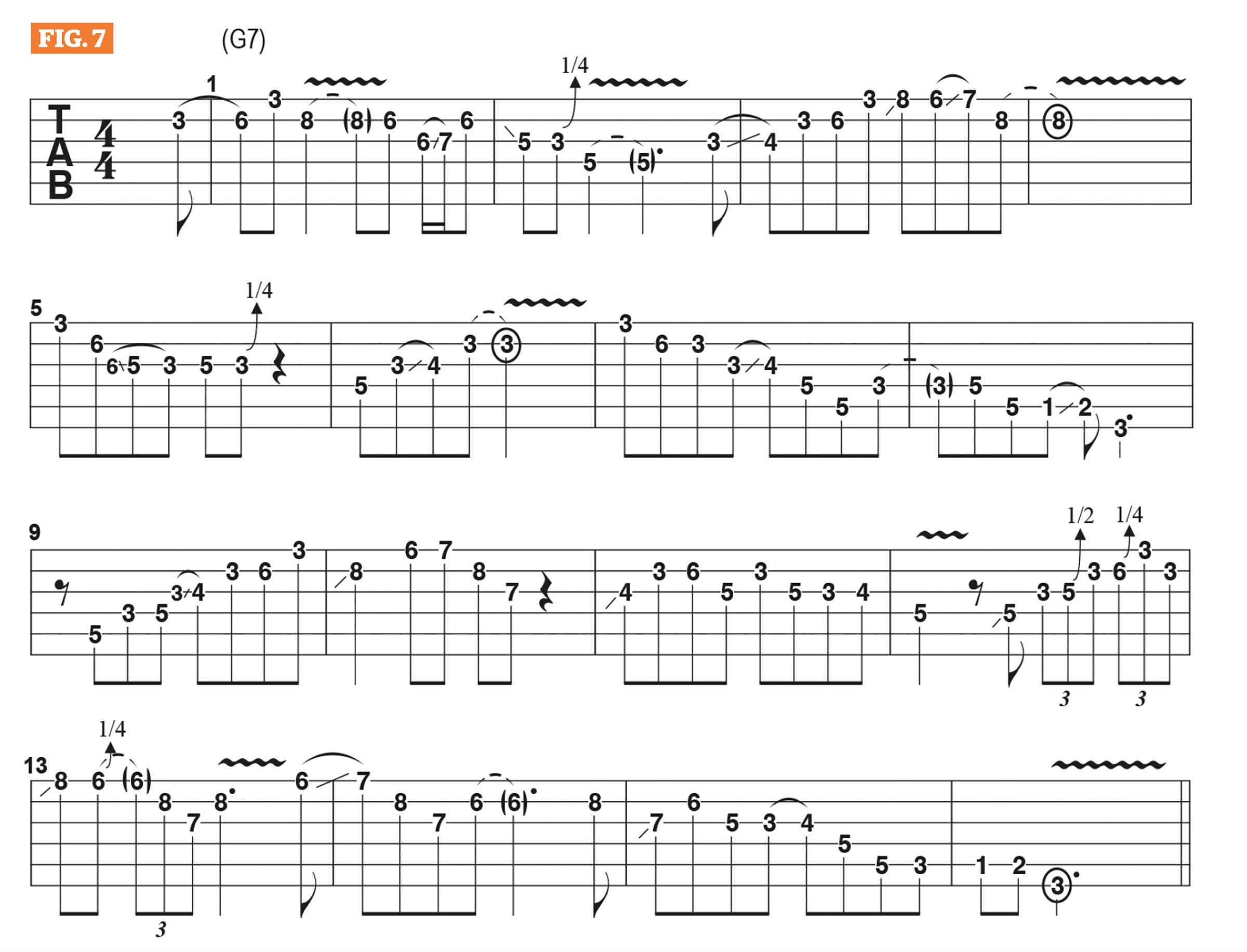
In bars 5-8, I move back and forth between straight G minor pentatonic and blues scale phrases and the inclusion of the major 3rd, B, in order to bring the arpeggio sound back to the forefront. Throughout the remainder of the example, I move freely between the two approaches, striving for musicality in the way the different elements work together.
As you work with this dualistic approach, think of it as an ongoing hand-off between scales and arpeggios. Use your ears to discern the differences in the musical effects created and to inform your note choices.
- This article first appeared in Guitar World . Subscribe and save .