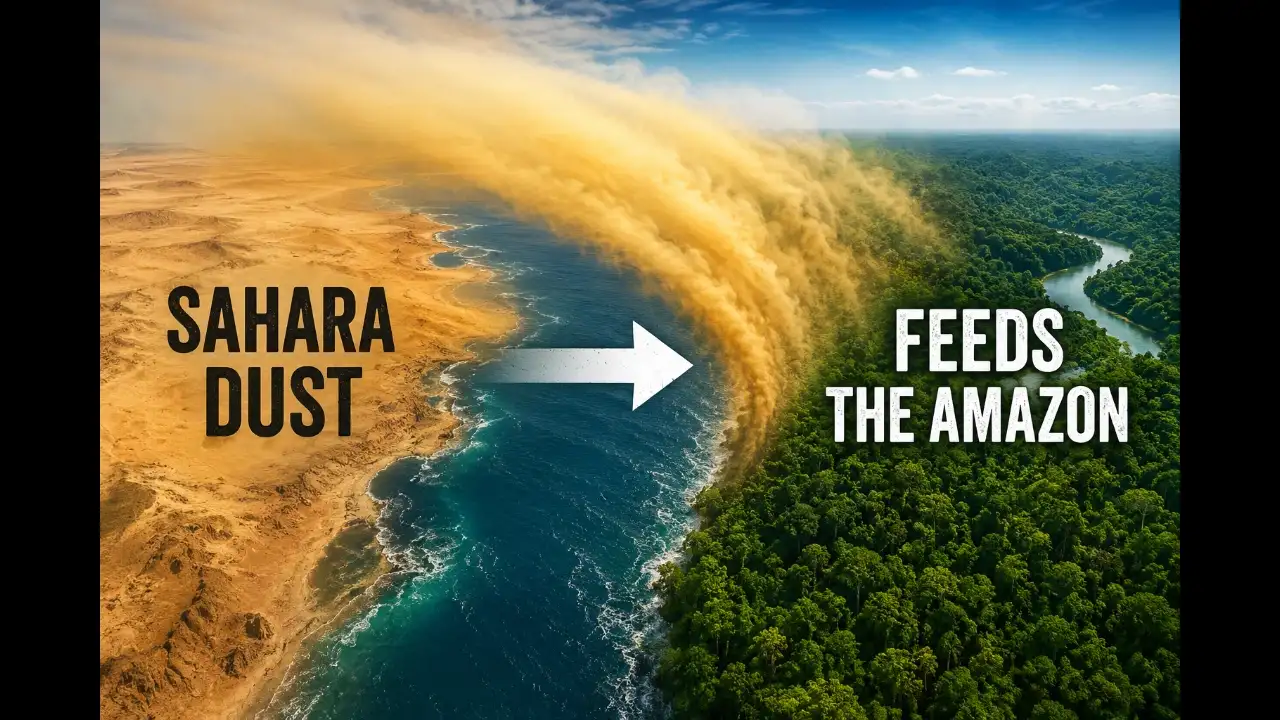
Every year, a vast cloud of dust rises from one of the driest places on Earth and begins a journey that seems almost impossible. It leaves the Bodélé Depression in northern Chad, crosses roughly 5,000 kilometres of Atlantic Ocean, and reaches South America. Much of that dust disappears into the Amazon Basin, where its minerals become part of the rainforest’s nutrient cycle.
A desert in Africa is, in a very real sense, helping feed a rainforest an ocean away. The scale is extraordinary. A 2015 study led by atmospheric scientist Hongbin Yu used seven years of observations from NASA’s CALIOP lidar aboard the CALIPSO satellite to estimate how much African dust enters the Amazon Basin. The study found an average deposition of about 28 million tonnes of dust each year, with a range of roughly 8 to 48 million tonnes. Within that material was an estimated 22,000 tonnes of phosphorus, a nutrient that is unusually important in the Amazon.