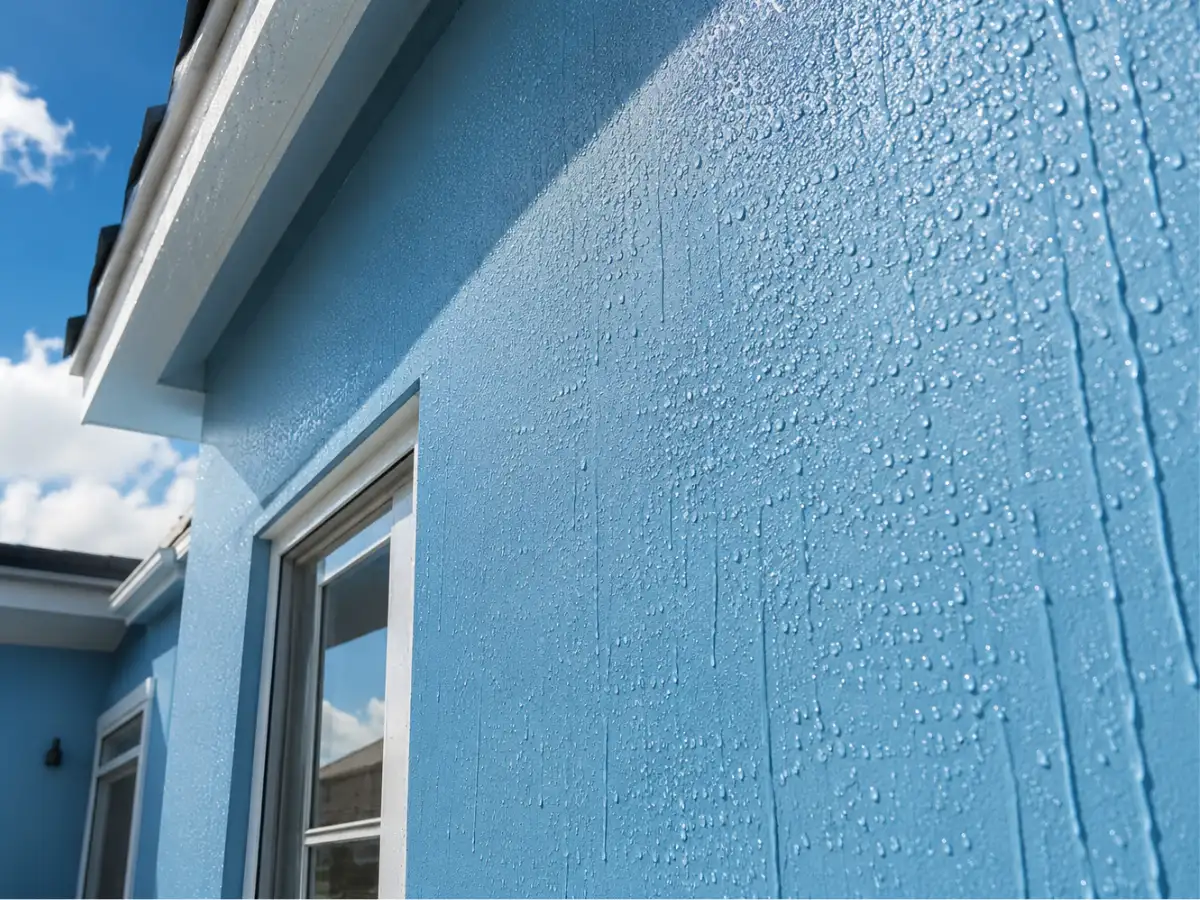
If you have ever touched a sun-baked wall and pulled your hand away, you know why this matters. A team at Singapore’s Nanyang Technological University (NTU) has created a paint that cools by absorbing and evaporating moisture. A model house painted with this new paint was more than 4.5°C cooler than the same house painted with conventional white paint, without consuming a single unit of electricity, according to the study titled ‘Passive cooling paint enabled by rational design of thermal-optical and mass transfer properties’ published in Science on June 5, 2025.
Why conventional cooling paints struggle

Most cooling paints perform one of two functions: they reflect sunlight like a mirror, or they radiate heat into the sky as infrared radiation, a process called radiative cooling. Both work best in dry weather. But Science News reports that in humid places, moisture in the air traps that escaping heat near the surface, so the wall is warm anyway, and that gap is what the NTU team set out to fill.
How does a paint actually sweat?
The human body stays cool when sweat evaporates from the skin, carrying heat away. The paint works on a similar principle. The scientists at NTU were inspired by this and used cement to develop their cooling paint. The paint, called CCP-30, contains a porous gel-based material made of calcium silicate hydrate, a cement-like compound. In this structure, water is trapped in small pores like a sponge, and as it evaporates, it carries heat away from the wall. The paint combines three cooling mechanisms. It reflects sunlight, emits heat as infrared radiation, and cools by evaporating water. As Associate Professor Hong Li, the lead material scientist in the development of the paint, puts it, passive cooling was the main inspiration because ordinary cooling paint cannot cool effectively once it is trapped by moisture.