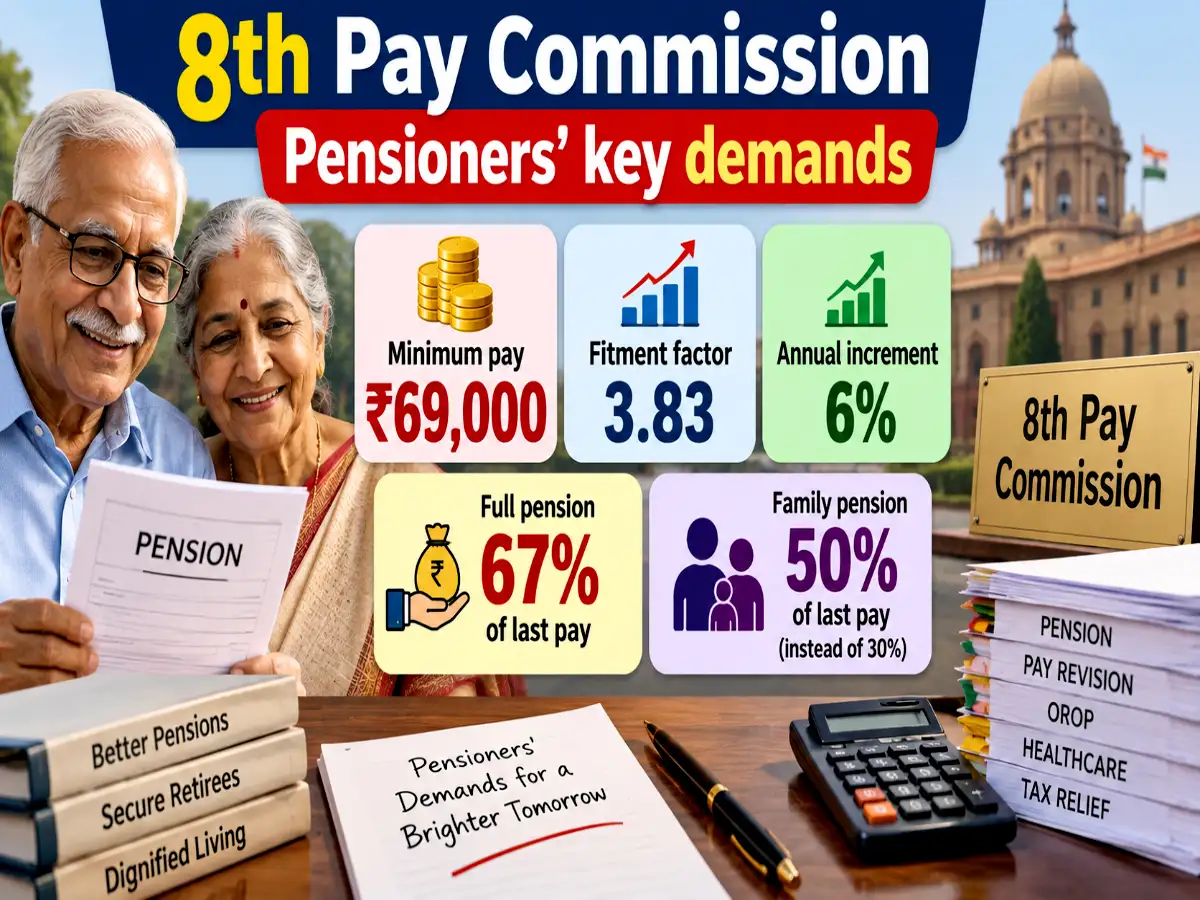
In its meeting with 8th Pay Commission officials in Chennai on Tuesday, the All India Federation of Pensioners’ Association (AIFPA) made several key recommendations, including a pension at 67% of last pay drawn, a minimum basic pay of Rs 69,000 at a 3.833 fitment factor for central government employees, One Rank One Pension (OROP) for all, and tax exemption on pension and family pension for all.
During the meeting, AIFPA also suggested reducing the pension commutation period from 15 years to 11, lowering qualifying service years required for defence pensioners to get their pensions, and revising the pension for Bharat Sanchar Nigam Limited (BSNL) employees were some of the other key demands. ET Wealth Online takes you through the 10 key demands raised by the All India Federation of Pensioners’ Association in its meeting with 8th CPC officials in Chennai.
1. Revision of full pension
The AIFPA has proposed that to support a decent and dignified retired life with a minimum of two-member family units, the full pension should be fixed at 67% of the last pay drawn. Accordingly, the family pension should be 50% of the last pay drawn instead of the existing 30%, the pensioner body recommended.
2. Additional pension
Under the existing system, the pension amount increases by 20% when a pensioner completes 80 years of age, and after that, it goes up by 10% every five years. By their 100th birthday, a pensioner gets a 100% pension increase.
In its recommendation to the 8th CPC, the AIFPA has referred to the report of the Parliamentary Standing Committee on Pensioners’ Grievances (110th report, December 2021), where it suggested an additional 5% pension increase upon reaching the age of 65 and thereafter, a 5% increase after every five years.
As per the pensioner body’s recommendations for the 8th Pay Commission, instead of 100 years of age, a pensioner will get a 100% rise in pension at their 90th birthday.
With the increase in additional pension for every 5 years, the AIFPA has proposed the following increased rates of pension.
| Age/Years | Proposed Pension / as a % of LPD |
| 60 | 67 |
| 65 | 70 |
| 70 | 75 |
| 75 | 80 |
| 80 | 85 |
| 85 | 90 |
| 90 | 100 |
In its recommendation for the minimum basic salary under the 8th Pay Commission, the pensioner body has highlighted increasing expenses of households, medical treatments, education, family functions, and recreational activities.
Also Read: 8th Pay Commission: How basic salary of Level 6 employees may double in 7 years after DA merger?
Based on these estimates, the AIFPA has recommended a minimum basic pay of Rs 69,000, a fitment factor of 3.83, five family units for pay calculation, and a 6% annual rate of increment.
4. Restoration of commutation of pension after 11 years
The AIFPA has recommended reducing the pension commutation period from 15 years to 11 years.
Central government pensioners get the option of a commuted pension, where they can take up to 40% of their basic pension as a lump sum amount at the time of retirement. The commuted portion is then deducted from their monthly pension and is restored only after 15 years.
The pensioner body, in its recommendation to the 8th CPC, says that with the commutation factor 8.194, the entire commuted the value of pension is recovered within 10 years.
5. On rank, one pension (OROP) for all
The AIFPA has recommended implementing the policy of One Rank One Pension (OROP) under the 8th Pay Commission.
The pensioner body says that ex-servicemen have been getting the OROP since 2017, and the Supreme Court has also allowed the OROP for judicial pensioners.
“The anomaly of junior pensioners getting more pension than seniors (of the same grade with the same service) shall be removed,” the AIFPA says in its presentation to the 8th CPC.
6. Reduction of qualifying service for Defence pensioners
The AIFPA says that while central government civil pensioners get pensions on the completion of 10 years of service, the criteria for defence pensioners is 15 years.
“The minimum qualifying service to draw a pension in defence service should be reduced on par with central civil pensioners,” the pension body suggests to the 8th CPC.
7. Exemption of pension and family pension from income tax and special exemption to d efence pensioners from income tax
In its presentation to the 8th Pay Commission, the AIFPA says pensions act as the primary source of survival for senior citizens who no longer have an active salary. With an increase in surviving age, medical care expenses, and requiring physical supportive care, senior citizens should not be taxed, says the pensioner body.
The AIFPA has also recommended that disability pension/compassionate allowance granted to ex-servicemen should also be exempted from income tax.
8. Enhancement of f ixed m edical a llowance (FMA)
The AIFPA says that a Parliamentary Panel in 2022 had recommended increasing the FMA to Rs 3,000 per month, which is yet to be implemented. The pensioner body has suggested that the 8th CPC increase the FMA to Rs 5,000.
The AIFPA also says that the FMA should be linked with the consumer price index, and whenever dearness relief (DR) increases, the FMA should automatically be increased.
Central government pensioners get DR as part of their payout for rising inflation.
9. Revision for BSNL pensioners
The AIFPA says that the pension of BSNL pensioners has not been revised since 2017.
“In spite of favourable recommendations from the courts of law, BSNL pensioners are eligible for government pensions under the CCS Pension Rules,” says the AIFPA.
The pensioner body has appealed to the 8th CPC that the pension of BSNL pensioners should be revised from 2017 based on the recommendations of the 7th Pay Commission (7th CPC).
10 . Implementation of arbitration award
The AIFPA says that the government delays the implementation of the ‘arbitration awards’, resulting in losses for the employees.
The pensioner body has suggested to the 8th CPC that it strengthen the system through suitable recommendations to maintain industrial peace.