
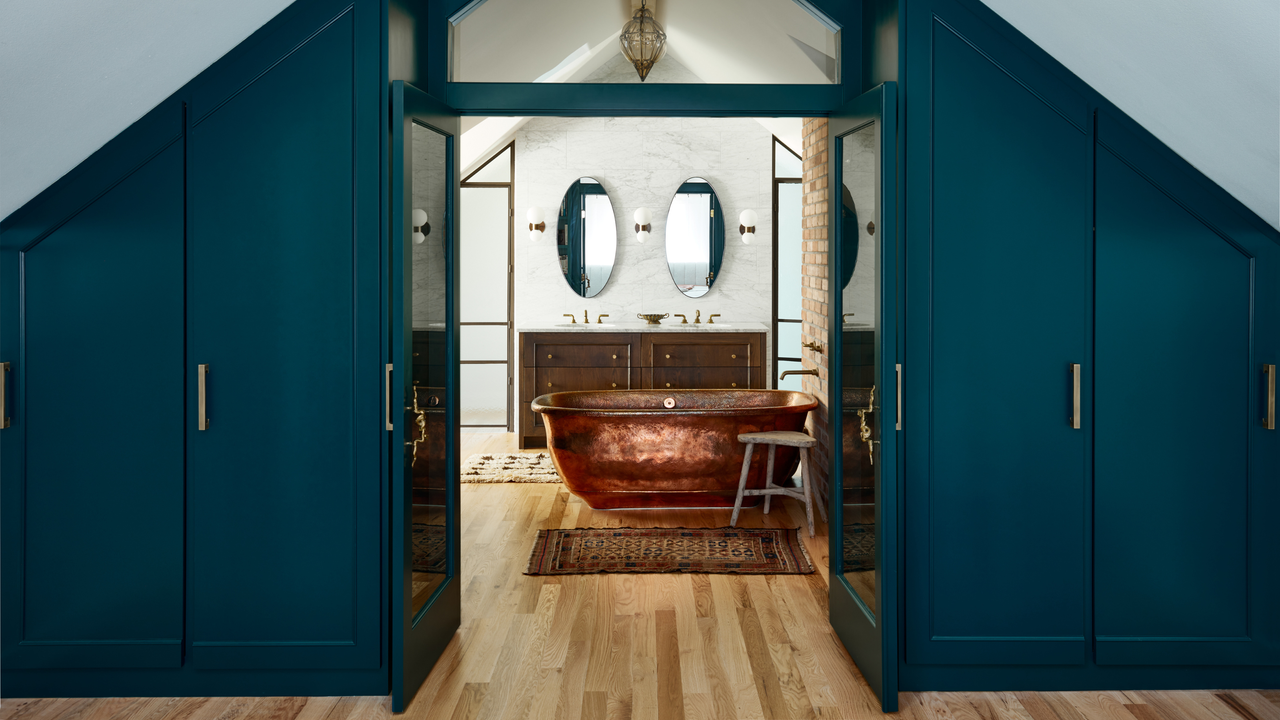
Minimalism isn’t just about what you add, but what you leave out. When the goal is a bathroom that feels utterly tranquil, spa-like, and intentionally uncluttered, every element must earn its place in the overall bathroom design.
Visual noise, bulky fixtures, and unnecessary accessories can quickly undermine that sense of quiet luxury, even in the most beautifully designed minimalist bathroom. This is exactly why minimalists take such a ruthless approach to bathroom design, from overcomplicated fittings to space-hogging features that disrupt the clean sightlines; certain choices simply do not align with the pared-back, serene aesthetic.

Instead, the focus should be on what really matters — prioritizing comfort, wellness, and escapism, and if anything in your bathroom doesn’t do that, it simply goes.
1. Hard Angles and Harsh Edges

Minimalist bathrooms place a strong emphasis on form purely because geometry has a direct impact on how a space can make you feel. Hard angles and sharp edges are naturally unforgiving in a minimalist interior design, and they can leave a cold, clinical ambiance, disrupting the sense of calm and flow.
“One detail we would typically avoid in a spa-like scheme is the use of harsh edges and strongly square lines on key elements such as baths and basins," Keeley Sutcliffe, Design Manager at BC Designs, echoes. "Sharp corners and rigid profiles introduce a sense of visual tension, which can register subconsciously as clutter, even when the room is otherwise pared back. Bathrooms that feel genuinely uncluttered tend to rely on forms that support visual continuity,” she refers to softer curves and gently rounded profiles. These both allow the eye to move more easily through the space, which helps the room feel cohesive rather than segmented. This is particularly relevant where the bath and basin act as the main visual anchors, as consistency in shape helps those elements sit more comfortably within the overall design.
“What is often overlooked is how repeated square lines can fragment a space without being immediately obvious,” Keeley continues, “Hard angles create subtle visual interruptions that work against a restorative atmosphere. Curved forms reduce this effect by softening transitions and supporting a more continuous reading of the room, which is why minimalists often favour them when the aim is a bathroom that feels calm.”
2. Feature Walls

Feature walls often work against a minimalist bathroom design because they introduce visual hierarchy and contrast, both of which disrupt the calm. According to Grazzie Wilson, Head of Creative at Ca’ Pietra, people often mistake minimalism as a ban on personality, when in actuality it is all about the way the eye moves through the space and how quickly it settles.
“The most common mistake we see when someone wants a ‘spa’ feel is reaching for a feature wall that relies on pattern to do the heavy lifting, because bold geometrics, high-contrast repeats, busy encaustic looks, or a mosaic with lots of color changes can make the wall feel like a graphic, and that breaks the room into ‘bits’ rather than letting it read as one calm envelope," Grazzie explains. "Bathrooms are typically smaller and more interrupted than other rooms, with mirrors, brassware, glazing, and towel rails already creating visual punctuation, so if the main surface is also shouting for attention, the result can feel restless even when everything is perfectly tidy.”
However, a minimalist bathroom still needs depth, so Grazzie advises that it gets there through material, scale, and restraint rather than a print effect. “If you want a wall to feel special without feeling fussy, start with a bathroom tile that has a natural variation or a softly worked surface, such as stone-effect porcelain, zellige-inspired ceramics, gentle ripples, plaster-like matt finishes, or a glaze that quietly catches light, then keep the layout simple so that texture becomes the interest.”
Large-format tiles are useful because they reduce the number of joints, which instantly makes a wall feel cleaner and therefore calmer, but Grazzie notes, “The key is keeping the palette tonal so the surface reads as one field rather than a patchwork,” this includes the ceiling too, “Similarly, if you prefer smaller formats, the spa-like route is usually a single tone laid with a minimal, consistent joint, rather than a mix of colours or a layout with lots of directional changes.”
Sit and enjoy your space while carrying out your daily routines.
3. Overly Decorative Shower Glass

Highly detailed, colored, or heavily framed shower glass can also introduce visual noise that disrupts the flow.
Louise Ashdown, Head of Design at West One Bathrooms, says, “Textured, tinted or digitally printed glass can quickly become a focal point when minimalism relies on quiet restraint.”
Instead, minimalists tend to favor clear or subtly frosted glass with discreet fixings for their shower room, allowing light to flow freely. The goal is a seamless and organic with the architecture of the space taking precedence.
4. Loud or Highly Saturated Color Palettes

Strong, energetic colors can bring vitality to a space, but they rarely promote stillness. “Minimalists tend to avoid highly saturated hues in favor of muted, calming tones,” explains Louise.
She suggests opting for soft grays, warm taupes, and gentle stone shades as bathroom color ideas, as these are restful palettes; easier to live with long term and allow materials and light to do the talking rather than color dominating the space.
Keep surfaces well maintained and pop this soap dish in your niche for natural material styling.
5. Uncoordinated Hardware and Finishes

Mixing multiple finishes, textures and hardware styles can make a bathroom feel busy, unresolved and sometimes quite jarring. In a minimalist bathroom design, the scheme should exude consistency, that will translate into always knowing where you’re at with the space and no nasty surprises.
Louise recommends selecting one or two complementary finishes and applying them throughout the space. Matching brassware, handles, and frames creates a seamless look that feels intentional and calm rather than fragmented.
6. Visible Clutter and Surface Storage

Let’s clear those surfaces, people. I know, I know, this can be difficult when you’re using products several times a day, but trust me — surfaces crowded with bottles, accessories, and other bathroom items totally undermine the sense of order that minimalism depends on.
“A spa-like bathroom keeps visual interruptions to a minimum through clever storage solutions like recessed niches, mirrored cabinets, and well-designed vanity units,” says Louise. Allow those essentials to disappear from view yet stay easily accessible. With everything still at hand, you’ll soon find yourself in a rhythm of getting things in and out just as easily as before.
7. Technology Added for Novelty

Let’s talk tech. If you’re someone who loves gadgets and wants to include smart features, bear in mind that they can complicate a space.
Louise suggests where to apply this. “Minimalists prioritise technology that genuinely streamlines daily routines, such as touchless flush plates, demisting mirrors or discreet lighting controls.” When tech is chosen thoughtfully, it enhances comfort and hygiene in the bathroom and eases even more clutter.
Blend accessories into your chosen neutral palette.
8. Statement lighting that overwhelms the space

Large decorative lights or overly dramatic fittings can dominate a bathroom, and as a place to unwind, we dont need any overstated show of any products. “Minimalist lighting is layered but discreet, combining clean task lighting with soft ambient sources,” explains Louise. She suggests integrated LEDs, backlit mirrors and subtle low-level lighting support daily routines as well as maintaining a spa-like mood.
Creating a minimalist, spa-like bathroom is less about following strict rules and more about making intentional choices. By removing features that introduce visual noise, harsh contrasts, or unnecessary complication, you allow the space to simply breathe, and in turn, make the bathroom look expensive.
When every element is considered for how it looks, feels, and functions, the bathroom becomes so much more than just a practical place. This is when it starts to feel truly restorative, a place to slow down and reset – a moment of escapism.